

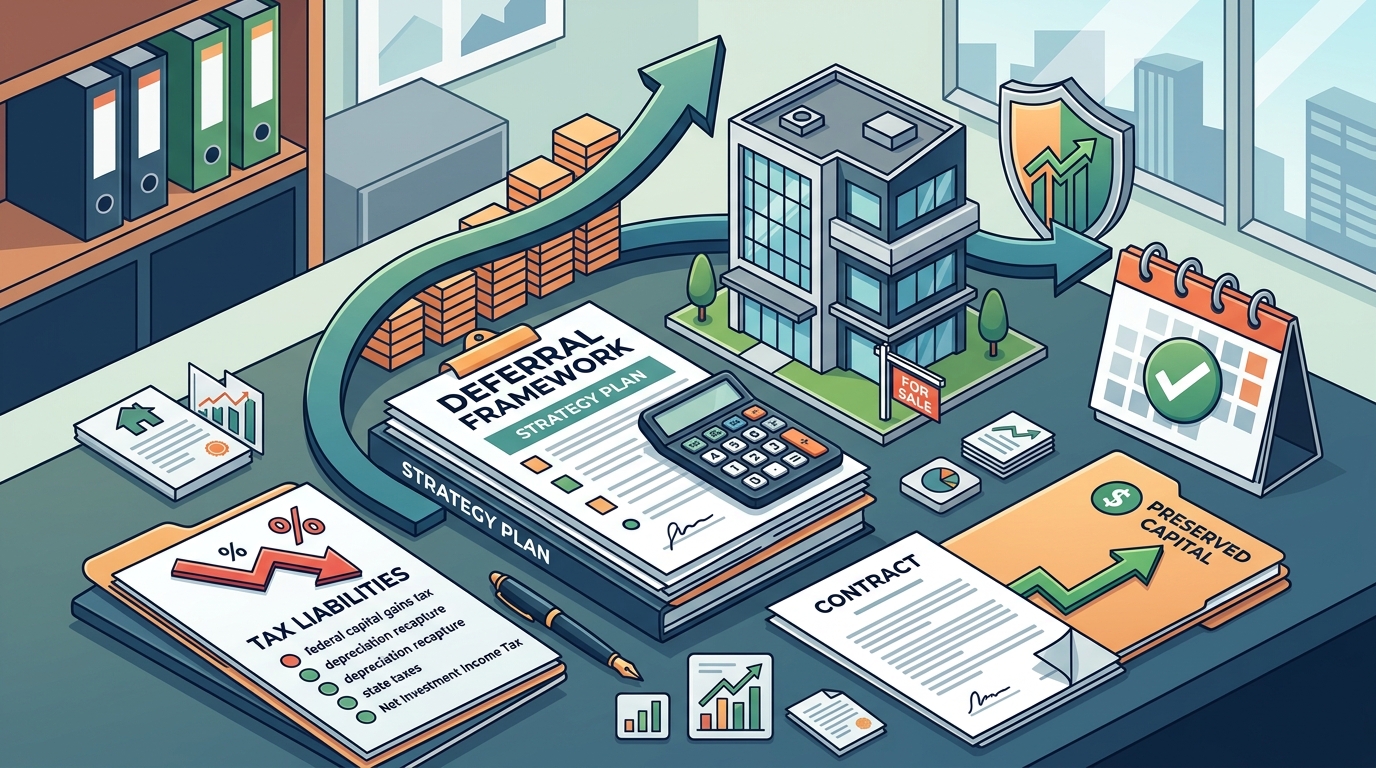
If you own investment real estate and are thinking about selling, there is a good chance you are also thinking about the tax bill that comes with it. Between federal capital gains tax, depreciation recapture, state taxes, and the Net Investment Income Tax, you could lose 25–40 percent of your profit to taxes. The good news: yes, you can start the process of deferring those capital gains taxes today—and in many cases, the earlier you start, the better your outcome.
The primary tool for deferring capital gains on real estate is the 1031 exchange, named after Section 1031 of the Internal Revenue Code. This article walks you through exactly how the process works, what you need to do before listing your property, and the critical deadlines that determine whether your deferral succeeds or fails.
What Is a 1031 Exchange and Why Does It Matter?
A 1031 exchange allows you to sell one investment or business property and reinvest the proceeds into another qualifying “like-kind” property while deferring the capital gains tax that would otherwise be due at sale. The concept is straightforward: instead of paying tax on the gain, you roll it forward into the replacement property through your adjusted tax basis.
As of 2026, the core rules of Section 1031 remain fully intact for real property. The 2017 Tax Cuts and Jobs Act eliminated 1031 exchanges for personal property such as equipment, vehicles, and artwork, but preserved them for real estate. Recent federal legislation, including the One Big Beautiful Bill Act (OBBBA), did not limit or repeal 1031 exchanges for real estate investors.
To put the savings in perspective, on a property with $250,000 in gains, a typical investor would owe roughly $90,000 in combined federal capital gains tax, NIIT, depreciation recapture, and state taxes. A properly structured 1031 exchange defers all of it, letting you reinvest 100 percent of your equity.
Can You Actually Start Today? Yes—Here Is How
A successful 1031 exchange is usually decided long before the sale closes. Once the property transfers, the clock starts running and there is very little flexibility left. That means the best time to begin preparing is right now—even if your property is not yet listed.
Step 1: Confirm Your Property Qualifies
Section 1031 applies only to real property held for investment or business use. Your primary residence and vacation homes that are not rented out do not qualify. The term “like-kind” is broader than most people expect: any real property held for investment or business use can be exchanged for any other real property held for investment or business use. You can exchange an apartment building for an office building, vacant land for a warehouse, or a single-family rental for a commercial property.
Step 2: Engage a Qualified Intermediary Before You List
A Qualified Intermediary (QI) is not optional—it is legally required for a valid 1031 exchange. The QI holds the sale proceeds, prepares exchange documents, and ensures funds never touch your hands. This is critical: if you receive or control the sale proceeds at any point, even briefly, the exchange is disqualified.
Your QI must be set up before the sale closes. Once closing occurs, it is too late to add these protections. The Federation of Exchange Accommodators (FEA) maintains a directory of accredited QI companies, and major title companies also offer QI services. Always verify that the QI carries adequate errors-and-omissions (E&O) insurance and holds your funds in a federally insured account.
Step 3: Align Your Advisory Team
A successful exchange requires coordination among your tax advisor, real estate agent, title company, and QI. Getting these professionals involved early prevents structural problems—such as mismatched ownership entities or partnership complications—from derailing your exchange later.
Step 4: Begin Scouting Replacement Properties
You do not need a replacement property under contract before you sell, but you should understand what inventory realistically exists. Waiting until after the sale closes to begin this analysis often creates pressure that leads to poor acquisition decisions. The 45-day identification window is short, and the market does not pause for your timeline.
The Critical 1031 Exchange Timeline
Once your relinquished property closes, three strict deadlines govern your exchange:
| Milestone | Deadline | What Happens |
|---|---|---|
| Day 0 — Sale Closes | Closing date | Exchange clock starts; proceeds go directly to QI |
| Day 1–45 — Identification Period | 45 calendar days | You must identify potential replacement properties in writing to your QI |
| Day 46–180 — Exchange Period | 180 calendar days total | You must close on your replacement property |
Both the 45-day and 180-day deadlines run concurrently from the sale date. There are no extensions—not for weekends, holidays, or market slowdowns. The only exception the IRS generally recognizes is for presidentially declared disasters.
If your exchange period crosses into the next calendar year, you must file for an extension on your tax return to preserve the full 180-day window.
Identification Rules
When identifying replacement properties, most investors use one of three IRS-approved methods:
- Three-Property Rule: Identify up to three properties of any value.
- 200% Rule: Identify more than three properties, as long as their total value does not exceed 200 percent of the relinquished property’s value.
- 95% Rule: Identify any number of properties, but you must acquire at least 95 percent of their total value.
The identification must be in writing, signed by you, and delivered to your QI or another permissible party before midnight on the 45th day. A legal description, street address, or distinguishable name satisfies the description requirement.
Common Mistakes That Kill an Exchange
The IRS is strict about 1031 compliance. Here are the errors that most frequently disqualify exchanges:
- Touching the proceeds. Even briefly holding sale funds in your personal account disqualifies the exchange under constructive receipt rules.
- Missing the 45-day identification deadline. If you miss it, the funds return to you and the exchange is invalid.
- Failing to set up a QI before closing. Without the QI in place at closing, there is no valid exchange structure.
- Buying down in value. If the replacement property is worth less than the relinquished property, the difference (called “boot”) is taxable.
- Entity mismatch. The taxpayer who sells must be the same taxpayer who buys. Partnership exits or LLC restructurings need to happen before the exchange begins.
When a 1031 Exchange May Not Be Right for You
A 1031 exchange is not always the optimal strategy. Consider paying the tax instead if:
- Your gain is minimal or you have capital losses that can offset it—the complexity and cost of an exchange may not be worthwhile.
- You need liquidity. A 1031 exchange locks all proceeds into another property. If you need cash for non-real-estate purposes, the exchange does not serve you.
- You want to exit real estate entirely. The deferral just delays the inevitable tax bill.
However, for investors who plan to hold property long-term, the step-up in basis at death means all deferred gains can be permanently eliminated for your heirs. This makes chaining 1031 exchanges one of the most powerful estate-planning strategies available to real estate investors.
Types of 1031 Exchanges You Should Know
Not every exchange follows the same pattern. Depending on your situation, one of these structures may fit better:
- Delayed (Deferred) Exchange: The most common type. You sell first, then buy within 180 days.
- Simultaneous Exchange: Both properties close on the same day. Simple but logistically difficult.
- Reverse Exchange: You buy the replacement property before selling the relinquished property, using an exchange accommodation titleholder.
- Improvement (Build-to-Suit) Exchange: You use deferred tax dollars to make improvements on the replacement property. All construction must be completed within 180 days.
IRS Reporting: Form 8824
After completing a 1031 exchange, you must file IRS Form 8824 with your tax return. This form documents how the exchange was structured and how gain was deferred. The reporting year is based on when the relinquished property was sold, not when the replacement property was acquired. Even if the exchange produced no taxable income, the form is still required. Inconsistent reporting between Form 8824 and your closing documents is one of the common triggers for IRS follow-up.
Key Takeaways
- You can begin the 1031 exchange process today—even before your property is listed—by engaging a Qualified Intermediary and assembling your advisory team.
- Section 1031 remains fully available for real estate investors in 2026; no recent legislation has limited or repealed it.
- You have 45 days to identify replacement properties and 180 days total to close after selling your relinquished property.
- The QI must be in place before closing. Once proceeds hit your account, the exchange fails.
- Replacement property must be equal or greater in value to defer 100 percent of gains.
- Chaining 1031 exchanges with a step-up in basis at death can permanently eliminate deferred capital gains for your heirs.
Frequently Asked Questions
Can I use a 1031 exchange on my primary residence?
No. Section 1031 only applies to property held for investment or business use. Your primary residence does not qualify. If you have lived in the home for at least two of the past five years, you may be eligible for the Section 121 exclusion, which shelters up to $250,000 in gains for single filers or $500,000 for married couples filing jointly.
How many times can I do a 1031 exchange?
There is no limit on how frequently you can perform 1031 exchanges. Many investors chain exchanges throughout their lifetime, deferring gains indefinitely. However, the IRS may scrutinize rapid sales of replacement properties, so it is advisable to hold each property for a meaningful investment period.
What happens to my deferred capital gains when I die?
Your heirs receive a step-up in basis to the property’s fair market value at the date of your death. This effectively wipes out all previously deferred gains, meaning your heirs inherit the property without owing the deferred tax.
Are there any extensions to the 45-day or 180-day deadlines?
Generally, no. The IRS does not grant extensions for weekends, holidays, or market conditions. The only recognized exception is for presidentially declared disasters, which may postpone deadlines for affected taxpayers.
Do I need to use all the sale proceeds to defer 100% of taxes?
Yes. To achieve full tax deferral, you must reinvest all proceeds from the sale into replacement property of equal or greater value. Any leftover cash or debt reduction is treated as taxable “boot.”
Has recent legislation changed 1031 exchange rules?
No. As of 2026, the One Big Beautiful Bill Act (OBBBA) did not directly impact 1031 exchanges. They remain fully intact, and the tax treatment is the same as it has been since the Tax Cuts and Jobs Act of 2017.