

When you sell an investment property through a 1031 exchange, your entire net equity passes through the hands of a third party before it reaches your replacement property. That third party—the qualified intermediary—is the single most important safeguard standing between your capital and a catastrophic tax bill or outright loss. This guide breaks down every layer of protection a QI provides so you can make a confident, informed decision.
What Exactly Is a Qualified Intermediary?
A qualified intermediary (QI)—sometimes called an accommodator or exchange facilitator—is an independent entity that facilitates a 1031 tax-deferred exchange. Its role is defined under Treasury Regulation §1.1031(k)-1(g)(4). In practical terms, the QI holds sale proceeds from your relinquished property and deploys those funds to purchase your replacement property on your behalf.
The IRS requires this third-party buffer because the exchanger is prohibited from having actual or constructive receipt of the funds during the exchange period. If you personally receive or control the proceeds—even briefly—your exchange is disqualified and you owe capital gains taxes immediately.
The Five Layers of Capital Protection a QI Provides
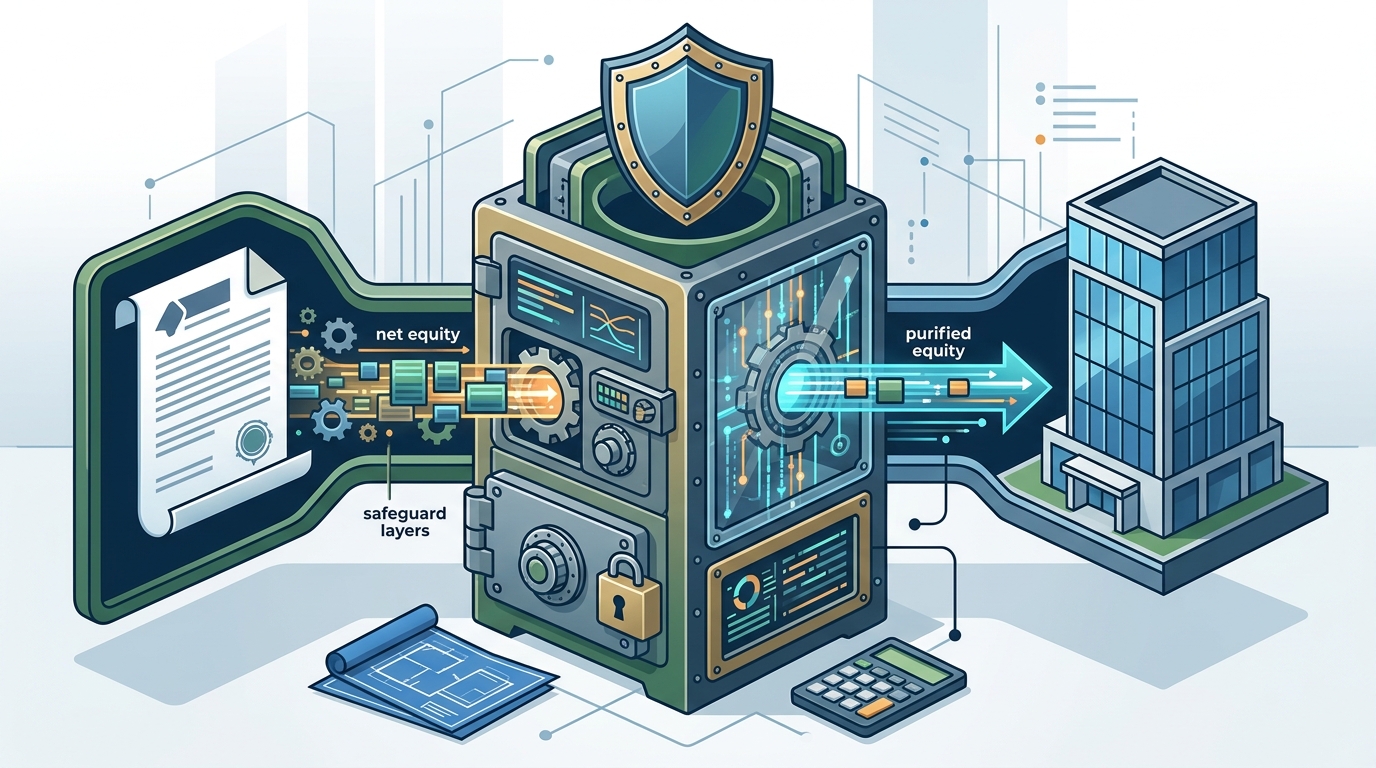
Understanding how a qualified intermediary protects your money requires looking at multiple overlapping safeguards. Here are the five most critical layers.
Layer 1: Preventing Constructive Receipt
The foundational protection a QI offers is structural. Under Treasury Regulation §1.1031(k)-1(g)(4), the QI must limit your ability to access or control the exchange funds. Many QIs implement a dual-signoff requirement: both the investor and the QI must authorize any transfer of funds. Because the investor cannot move the money without the QI's signature, constructive receipt is avoided and the tax-deferred status of the exchange is preserved.
Layer 2: Segregated Escrow Accounts
A reputable QI holds your exchange funds in a segregated account at a highly rated bank—separate from the QI's own operating funds and from every other client's money. This distinction matters enormously if the QI encounters financial difficulties. When funds are segregated, they are designated for the benefit of the individual exchanger and are far more likely to be returned in a bankruptcy scenario rather than going to other creditors.
By contrast, if a QI commingles funds—which some less scrupulous firms do—your capital could be tied up in prolonged bankruptcy proceedings or even lost entirely to other lien holders. Always confirm in writing that your QI uses individually segregated, FDIC-insured accounts labeled with your taxpayer identification number.
Layer 3: Fidelity Bonds and Performance Guarantees
A fidelity bond protects the investor in the unlikely event of a company failure or criminal act by the QI. The bond exists to satisfy the financial obligations of the company so your deposit is returned. Industry best practice calls for a fidelity bond of at least one million dollars. Top-tier intermediaries carry significantly more—some hold bonds exceeding $100 million alongside separate performance guarantees.
Some states have codified these requirements into law. For example, Washington state law (RCW 19.310.040) requires an exchange facilitator to either maintain a fidelity bond of not less than one million dollars or hold all client funds in a qualified escrow account or qualified trust requiring the client's consent for withdrawals.
Layer 4: Errors and Omissions (E&O) Insurance
Even experienced professionals make mistakes. Errors and omissions insurance functions like malpractice coverage: it protects both the investor and the QI from losses resulting from actual or perceived errors during the exchange period. Depending on the policy details, E&O insurance may cover judgments, settlements, and legal costs. A QI without E&O coverage leaves you personally exposed if an administrative error delays your closing or causes your exchange to fail.
Layer 5: Cybersecurity and Wire Fraud Prevention
Modern 1031 exchanges face digital threats that didn't exist a decade ago. Wire fraud, phishing schemes, and business email compromise attacks specifically target real estate transactions where large sums change hands quickly. The best QIs employ institutional-grade security protocols—encrypted banking portals, multi-factor authentication on wire instructions, and callback verification procedures—to protect your funds from cyber threats.
How a QI Protects Your Tax-Deferred Status
Capital protection isn't limited to keeping funds safe in a bank. A qualified intermediary also protects the tax-deferred status of your exchange—which is, effectively, protecting the 20-40% of your equity that would otherwise go to federal and state taxes.
Deadline Management
The IRS enforces two non-negotiable deadlines: a 45-day identification period to formally designate replacement properties, and a 180-day period to close on the acquisition. Missing either deadline results in full capital gains tax liability. An experienced QI tracks these deadlines proactively and ensures all necessary documents are executed on time.
Document Preparation and Compliance
The QI prepares the Exchange Agreement, Assignment of Contract, Notice of Assignment, and other required paperwork. These documents demonstrate that the exchange has been properly structured under Section 1031 and will withstand IRS scrutiny during an audit. A single documentation error can disqualify an entire transaction, triggering immediate tax consequences that can reach tens of thousands of dollars or more.
Coordination with Closing Agents
Your QI interfaces with title companies, escrow officers, closing attorneys, and real estate professionals to ensure closing statements properly reflect the 1031 exchange. This coordination prevents the kinds of administrative misalignments that can inadvertently create taxable boot or disqualify the transaction entirely.
Real-World Risks of Choosing the Wrong QI
Because the qualified intermediary industry is largely unregulated at the federal level, not all providers offer the same level of protection. History includes numerous cases where investors lost exchange funds due to unscrupulous or poorly managed QIs. Here are the most common risk scenarios:
- Commingled accounts: Your funds are pooled with other clients' money or the QI's operating capital. In a bankruptcy, your capital may be claimed by the QI's creditors.
- No fidelity bond or insurance: If the QI fails or an employee commits fraud, there is no financial backstop to recover your funds.
- Referral fee conflicts: Some QIs pay referral fees or revenue-sharing kickbacks to brokers who recommend them, creating conflicts of interest that may even disqualify the exchange under IRS rules.
- Lax compliance standards: A QI willing to bend the rules might seem convenient, but any non-compliance discovered in an audit exposes you to full tax liability plus potential fraud allegations.
A Practical Due Diligence Checklist
Before entrusting your exchange proceeds to any qualified intermediary, work through this checklist:
- Verify segregated accounts: Get written confirmation that your funds will be held in a separately identified, FDIC-insured account under your TIN.
- Review bonding and insurance: Request proof of fidelity bond coverage (minimum $1 million) and an active E&O policy with no gaps.
- Assess financial backing: Determine whether the QI has a financially strong parent company or sufficient capitalization to weather disruptions.
- Check credentials: Look for Certified Exchange Specialist (CES) designations, FEA membership, and legal or accounting professionals on staff.
- Ask about cybersecurity protocols: Confirm multi-factor authentication, encrypted portals, and callback verification for wire transfers.
- Request references: Speak with past clients and review independent testimonials. A reputable firm will welcome this.
- Understand the fee structure: Most QIs charge between $500 and $2,500 per transaction. Be cautious of prices that seem unusually low—they may signal corners being cut on security.
- Confirm dual-signature controls: No single individual—neither you nor any QI employee—should be able to unilaterally move exchange funds.
Why This Matters for Your Long-Term Wealth Strategy
A 1031 exchange isn't just a one-time tax maneuver. It is a compounding wealth strategy. Every dollar you keep working in real estate—rather than paying to the IRS—generates returns year after year. In high-tax states like California, where the combined capital gains and depreciation recapture rate can reach 40% of the sales price, the stakes are enormous.
By deferring taxes through successive exchanges over a lifetime, investors can ultimately pass properties to heirs who receive a stepped-up cost basis, effectively eliminating the accumulated deferred gains. The qualified intermediary is the professional who makes each link in that chain possible—and secure.
Key Takeaways
- A qualified intermediary prevents constructive receipt by holding and controlling exchange funds so your 1031 exchange remains tax-deferred.
- Segregated, FDIC-insured accounts labeled with your TIN protect your capital from QI bankruptcy or creditor claims.
- Fidelity bonds and E&O insurance provide financial backstops against fraud, negligence, and company failure.
- The QI industry is largely unregulated—thorough due diligence is your responsibility as the investor.
- Dual-signature controls, cybersecurity protocols, and transparent communication are non-negotiable safeguards.
- Typical QI fees range from $500 to $2,500 per exchange—a fraction of the capital at risk.
Frequently Asked Questions
What is a qualified intermediary in a 1031 exchange?
A qualified intermediary is an independent third-party entity that holds the proceeds from the sale of your relinquished property and uses those funds to acquire your replacement property. The QI ensures compliance with IRS Section 1031 rules so that your capital gains taxes are properly deferred.
Why can't I hold the exchange funds myself?
The IRS prohibits the exchanger from having actual or constructive receipt of the sale proceeds during the exchange period. If you receive or control the funds, even momentarily, the exchange is disqualified and capital gains taxes become immediately due.
How does a segregated account protect my money?
A segregated account keeps your exchange funds completely separate from the QI's operating funds and other clients' money. If the QI faces financial difficulty or declares bankruptcy, your segregated funds are designated for your benefit and are far more likely to be returned to you rather than distributed to other creditors.
What insurance should a qualified intermediary carry?
At minimum, look for a fidelity bond of at least one million dollars and an active errors and omissions (E&O) insurance policy. The fidelity bond protects against criminal acts by QI employees, while E&O insurance covers losses from professional mistakes or negligence during the exchange.
How much does a qualified intermediary cost?
Most QIs charge between $500 and $2,500 per standard delayed exchange. More complex transactions—such as reverse exchanges, improvement exchanges, or multi-property portfolios—will typically incur higher fees.
Are qualified intermediaries regulated?
QIs are largely unregulated at the federal level and by most state governments, although a handful of states like Washington have enacted specific requirements. Because of this regulatory gap, the burden of vetting your QI's financial security, insurance, and compliance standards falls squarely on you as the investor.
Who cannot serve as my qualified intermediary?
The IRS disqualifies anyone who has acted as your employee, attorney, accountant, investment banker, broker, or real estate agent within the two years preceding the exchange—unless their services were specifically related to prior 1031 exchanges. Family members and entities you control are also prohibited.
What happens if my qualified intermediary goes bankrupt?
If your funds are in a properly segregated account, they are held for your benefit and should be returned rather than absorbed into the QI's bankruptcy estate. If funds were commingled, recovery becomes far more uncertain and may require lengthy legal proceedings.
Ready to ensure your 1031 exchange capital is fully protected? Contact 1031 Granite to discuss your exchange with a team that puts fund security first.