

Every 1031 exchange must be reported to the IRS on Form 8824, regardless of whether any gain is recognized. Filing this form correctly requires organized documentation that covers property descriptions, transaction dates, financial figures, and intermediary details. Mistakes or missing records can trigger IRS inquiries, delay your tax return, or even jeopardize your tax deferral. This guide walks you through every document you need to gather, how the form is structured, and how to avoid the most common filing errors that trip up real estate investors.
What Is IRS Form 8824?
IRS Form 8824 is the primary document used for reporting like-kind exchanges to the Internal Revenue Service. Titled "Like-Kind Exchanges," it captures the details of your 1031 exchange so the IRS can verify that the transaction meets all requirements for capital gains tax deferral.
According to the IRS, Parts I, II, and III of the form are used to report each exchange of business or investment property for property of a like kind. The form captures property descriptions, identification and transfer dates, financial calculations, and any boot received in the exchange.
When Must You File Form 8824?
Form 8824 must be filed with your federal tax return for the tax year in which the exchange occurred. The exchange is reported for the year the relinquished property closes, even if the replacement property is acquired the following calendar year. If the 180-day period extends past your filing deadline, you may need to file an extension.
For related-party exchanges, you must also file Form 8824 for the two years following the exchange year. This ongoing requirement lets the IRS monitor whether the related party disposes of the property in a way that triggers deferred gain recognition.
Complete Documentation Checklist
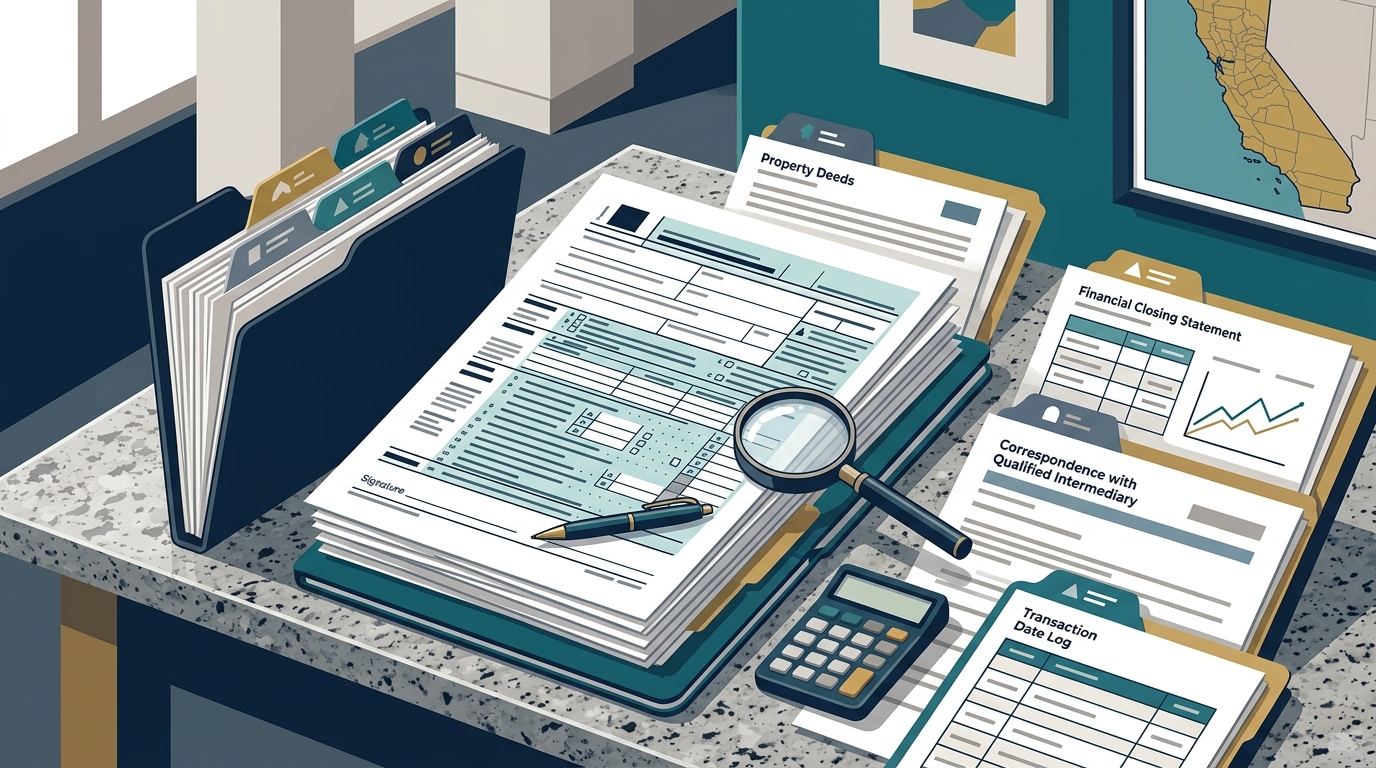
Gathering the right paperwork before tax time prevents delays and errors. Below is a comprehensive list of every document you or your CPA will need.
| Document | Purpose on Form 8824 | Where to Find It |
|---|---|---|
| Closing/settlement statement (relinquished property) | Adjusted basis, sale price, liabilities relieved (Lines 15-18) | Title or escrow company |
| Closing/settlement statement (replacement property) | Purchase price, liabilities assumed (Lines 15-18) | Title or escrow company |
| Written 45-day identification notice | Date of identification (Line 5) | Your Qualified Intermediary |
| Exchange agreement | QI legal name and EIN | Your QI |
| QI closing statement / exchange summary | Exchange expenses, net proceeds, boot calculation | Your QI |
| Depreciation schedule (relinquished property) | Adjusted basis calculation (Line 18) | Prior tax returns or CPA |
| Form 1099-S | IRS cross-references reported sale price | Title company or closing agent |
| Deed or transfer documents | Property descriptions (Lines 1-2) | County recorder or escrow |
| Loan payoff and new mortgage documents | Liabilities relieved and assumed (Line 15) | Lender |
Your Qualified Intermediary plays a central role in assembling these records. At Granite Exchange Services, we prepare a detailed exchange summary and closing documents that align directly with Form 8824 line items, making tax-time preparation straightforward for you and your CPA.
Understanding the Form's Structure
Part I: Information on the Like-Kind Exchange
Lines 1 and 2 require descriptions of the relinquished and replacement properties. Use specific street addresses and property types rather than vague labels. Lines 3 through 6 capture key dates: the date the relinquished property was transferred, the date the replacement property was received, and the 45-day identification date.
Part II: Related-Party Exchange Information
If the exchange involved a related party (directly or through an intermediary), Part II must be completed. A related party is a family member, controlled entity, or any person described under IRC Section 267(b) or 707(b)(1). The IRS uses this section to ensure neither party uses the exchange to shift gains improperly.
Part III: Realized Gain, Recognized Gain, and Basis
This is the calculation section. Lines 12 through 25 capture fair market values, adjusted basis, boot received, realized gain, recognized gain, and the basis of the replacement property. For multi-asset exchanges, the IRS requires a separate attached statement instead of completing lines 12 through 18.
Common Mistakes to Avoid
Even experienced investors stumble on Form 8824. Here are the errors that most frequently trigger IRS scrutiny:
- Not filing when gain is zero. The form is required for every 1031 exchange, even those with no recognized gain. Failure to file can trigger inquiries years later.
- Vague property descriptions. Use complete street addresses and legal descriptions on Lines 1 and 2. Generic descriptions like "rental property in Texas" invite questions.
- Incorrect boot reporting. Under-reporting cash boot or mortgage boot on Line 15 is a red flag. The IRS cross-references your 1099-S and settlement statements.
- Wrong QI information. Confirm your QI's exact legal entity name and EIN from the exchange agreement before filing.
- Missing the 45-day or 180-day deadline disclosure. If a deadline was missed, the exchange failed. Do not file Form 8824 as if it succeeded. Work with your CPA to report the transaction as a taxable sale.
Understanding the 45-day and 180-day deadlines is essential to accurate reporting. If your exchange crossed calendar years, your CPA may need to file an extension to finalize the form after the replacement property closes.
Related-Party Exchange Documentation
Exchanges with related parties carry additional reporting obligations. Under IRC Section 1031(f), if either party disposes of the exchanged property within two years, the deferred gain may become taxable. You must file Form 8824 for the exchange year plus the following two tax years, reporting whether a disposition occurred.
Exceptions to this two-year rule include dispositions after the death of either party, involuntary conversions where the threat occurred after the exchange, and transactions where neither party had tax avoidance as a principal purpose. Keep written records that document the business rationale for related-party transactions.
Key Takeaways
- Form 8824 is required for every 1031 exchange, even when no gain is recognized.
- File the form with your federal tax return for the year the relinquished property was transferred.
- Gather settlement statements, the 45-day identification notice, depreciation schedules, and your QI's exchange summary before meeting with your CPA.
- Use specific street addresses and legal descriptions on Lines 1 and 2, not generic labels.
- Related-party exchanges require filing Form 8824 for two additional years after the exchange.
- Your Qualified Intermediary's exchange summary is the single most useful document for completing the form accurately.
- Errors in boot calculation or missing filings are the top triggers for IRS scrutiny of 1031 exchanges.
Frequently Asked Questions
Do I need to file Form 8824 if my exchange had zero taxable gain?
Yes. The IRS requires Form 8824 for every completed 1031 exchange regardless of whether gain is recognized. The form documents the exchange itself, not just the tax owed.
What happens if I forget to file Form 8824?
Failing to file can lead to IRS inquiries and may jeopardize your tax deferral. If you missed a prior year, work with your CPA to file an amended return as soon as possible.
Can my Qualified Intermediary fill out Form 8824 for me?
A QI provides the exchange documentation and summary needed to complete the form, but the form itself is part of your tax return. Your CPA or tax preparer files it. At Granite Exchange Services, we provide a detailed summary aligned to each line of the form.
What property description should I use on Lines 1 and 2?
Enter the full street address and property type (e.g., "4-unit residential rental, 123 Main St, Sacramento, CA 95814"). For properties without a standard address, provide a short legal description.
How do I report boot on Form 8824?
Boot is any non-like-kind property received in the exchange, typically cash or net debt relief. It is reported on Line 15 and directly affects recognized gain on Line 20. Learn more about how boot works in a 1031 exchange.
Do I need to attach additional documents to Form 8824?
For standard single-property exchanges, no attachments are typically required. However, multi-asset exchanges require a separate statement showing how you calculated realized and recognized gain instead of completing Lines 12 through 18.
What if my exchange spans two tax years?
Report the exchange on the return for the year the relinquished property was transferred. If the replacement property closes in the following year, you may need to file a tax extension so the form reflects the completed transaction.
Where can I find the official Form 8824 and instructions?
The form and instructions are available on the IRS website for Form 8824. Always use the version corresponding to your tax year.
Get Your Exchange Documents in Order
Proper documentation is the foundation of a successful 1031 exchange and a clean Form 8824 filing. Granite Exchange Services has guided over 20,000 exchanges since 2000, and every client receives a comprehensive exchange summary built for seamless tax reporting. Contact our CES-certified team at 800-899-6959 to start your exchange with confidence.