

Selling a rental property can trigger a significant tax bill. Between federal capital gains rates of 15-20%, the 3.8% net investment income tax, depreciation recapture at 25%, and state income taxes, you could owe well over 30% of your profit. A 1031 exchange is a legal strategy under IRC Section 1031 that lets you defer all of those taxes by reinvesting sale proceeds into another like-kind investment property. This guide walks you through every step of completing a 1031 exchange for a rental property, from engaging a Qualified Intermediary to closing on your replacement property.
What Is a 1031 Exchange?
A 1031 exchange is a tax-deferral strategy authorized by Section 1031 of the Internal Revenue Code that allows real estate investors to swap one investment property for another without immediately paying capital gains taxes. The provision has been part of the tax code since 1921. After the Tax Cuts and Jobs Act of 2017, only real property qualifies for like-kind exchange treatment; personal property exchanges were eliminated.
A Qualified Intermediary (QI) is a neutral third party that holds the sale proceeds and facilitates the exchange so the investor never takes constructive receipt of the funds. Without a QI in place before closing, the IRS treats the transaction as a taxable sale rather than an exchange.
Does Your Rental Property Qualify?
To qualify for a 1031 exchange, both the property you sell (the relinquished property) and the property you buy (the replacement property) must be held for investment or business use. Rental properties held for income production are one of the clearest qualifying categories.
What Does Not Qualify
Properties held primarily for resale, such as fix-and-flip projects, do not qualify. Neither do primary residences, personal-use vacation homes, or property located outside the United States if you are exchanging into domestic real estate. The IRS looks at your intent: the property must be held for productive use in a trade or business or for investment.
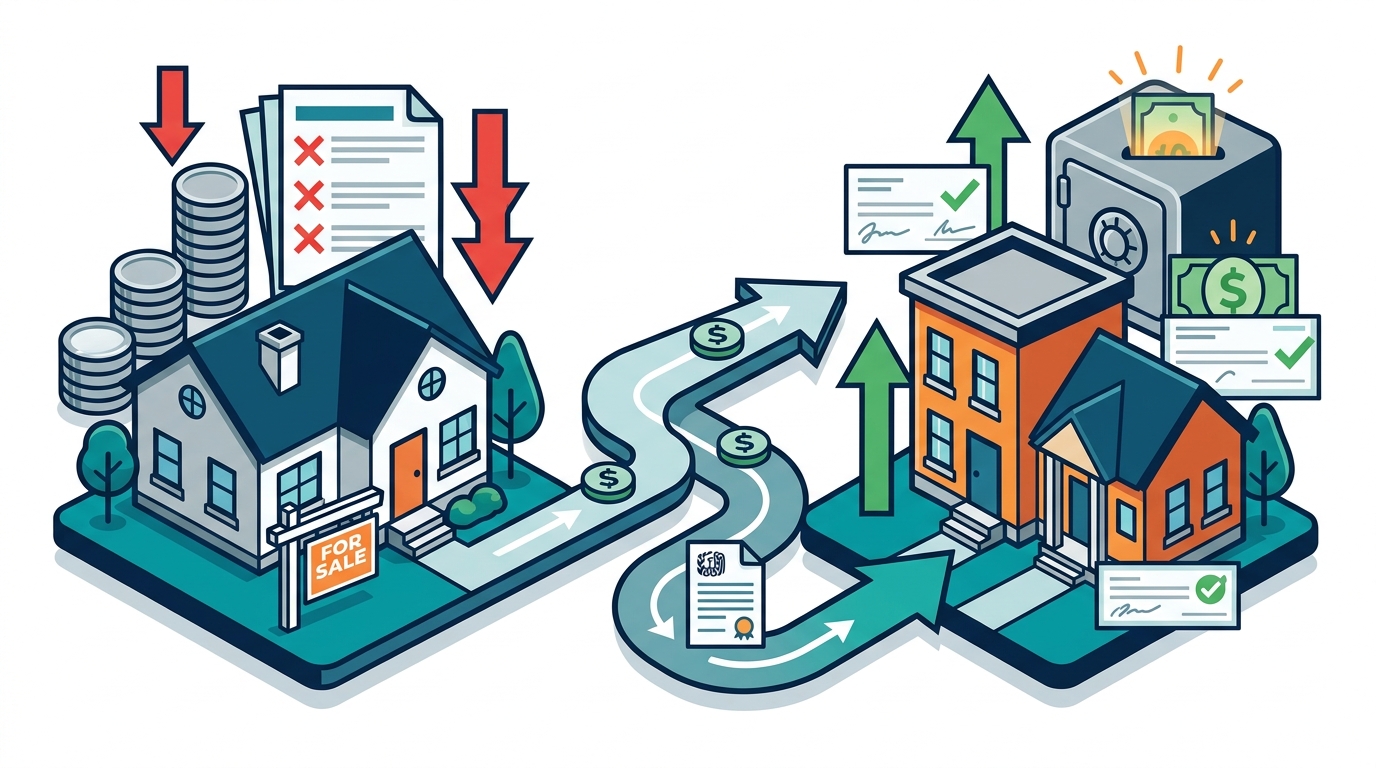
Vacation Rentals: The Gray Area
If you rent a vacation property part-time, the IRS provides a safe harbor under Revenue Procedure 2008-16. The property must be rented at fair market rates for at least 14 days per year, and personal use must be limited to 14 days or 10% of rental days, whichever is greater, for at least two years before and after the exchange.
Step-by-Step Process for a Rental Property 1031 Exchange
1. Engage a Qualified Intermediary Before You Sell
Before your relinquished property closes, you must have exchange documents executed with a QI. Granite Exchange Services has facilitated over 20,000 exchanges since 2000 and provides each client a dedicated CES-certified counselor with direct phone and email access. The QI prepares exchange agreements, coordinates with your escrow and title companies, and holds funds in individually segregated, FDIC-insured accounts.
2. Close on the Sale of Your Rental Property
At closing, the sale proceeds transfer directly to your QI. You never take possession of the funds. If you receive the proceeds, even briefly, the IRS will disqualify the exchange and the gain becomes fully taxable.
3. Identify Replacement Property Within 45 Days
Starting from the day your relinquished property closes, you have exactly 45 calendar days to formally identify potential replacement properties in writing. You can use one of three IRS identification rules (detailed below). Submit your identification list to your QI, who will ensure it meets the written identification requirements.
4. Close on Replacement Property Within 180 Days
You must acquire the replacement property within 180 calendar days of the sale of your relinquished property, or by the due date (with extensions) of your tax return for the year the exchange began, whichever comes first. Your QI wires the exchange funds directly to the closing agent.
5. File IRS Form 8824
Report the completed exchange on IRS Form 8824 with your federal income tax return for the year in which the exchange occurred. Your QI typically provides an exchange summary with the dates and figures you need for accurate Form 8824 reporting.
Critical Deadlines: The 45-Day and 180-Day Rules
The IRS enforces two non-negotiable deadlines. Missing either one disqualifies the entire exchange and triggers immediate capital gains tax liability. These deadlines cannot be extended except in narrow federally declared disaster situations.
| Deadline | Days After Sale | Requirement | Consequence of Missing |
|---|---|---|---|
| Identification Period | 45 calendar days | Submit written list of potential replacement properties to QI | Exchange fails; gain is fully taxable |
| Exchange Period | 180 calendar days | Close on at least one identified replacement property | Exchange fails; unused funds returned and taxed |
Use the 1031 exchange timeline calculator on Granite Exchange Services to pinpoint your exact deadlines based on your sale closing date.
Property Identification Strategies
The IRS allows three methods for identifying replacement properties during the 45-day window:
| Rule | Properties Allowed | Value Limitation |
|---|---|---|
| Three-Property Rule | Up to 3 | No limit on value |
| 200% Rule | Unlimited | Total FMV cannot exceed 200% of relinquished property value |
| 95% Rule | Unlimited | Must acquire 95% or more of total value identified |
Most rental property investors use the Three-Property Rule because of its simplicity. If you sold a rental home for $400,000, you could identify any three potential replacement properties regardless of their individual values.
Understanding Boot and Full Tax Deferral
Boot is any non-like-kind value received in the exchange, typically cash left over or a reduction in mortgage debt. Boot is taxable in the year it is received. To defer 100% of your capital gains, you must reinvest all net sale proceeds and acquire replacement property of equal or greater value with equal or greater debt.
For example, if you sell a rental duplex for $500,000 with a $200,000 mortgage, your replacement property must be worth at least $500,000 and carry at least $200,000 in debt (or you must add cash to make up the difference). The team at Granite Exchange Services helps structure each transaction to minimize or eliminate boot.
Key Takeaways
- A 1031 exchange lets rental property owners defer federal capital gains, depreciation recapture, state income tax, and the 3.8% NIIT by reinvesting into like-kind real property.
- You must engage a Qualified Intermediary before the sale closes. The QI holds funds, prepares documents, and ensures IRS compliance.
- The 45-day identification and 180-day closing deadlines are strict, with almost no exceptions.
- Both properties must be held for investment or business use. Personal residences and fix-and-flip inventory do not qualify.
- Reinvest all proceeds and match or exceed your debt to avoid taxable boot.
- Report every completed exchange on IRS Form 8824 with your tax return for that year.
- An independent QI like Granite Exchange Services provides dedicated, personal service without the conflicts of interest that come with title-company or lender-owned intermediaries.
Frequently Asked Questions
Can I do a 1031 exchange on a single-family rental property?
Yes. Any real property held for investment qualifies, including single-family rentals, duplexes, and small multifamily buildings. The like-kind definition is broad: you could exchange a rental house for a commercial building, vacant land, or even a DST interest.
How long do I need to hold my rental before exchanging?
There is no statutory minimum holding period. However, most tax advisors recommend holding the property for at least one to two years to clearly demonstrate investment intent and satisfy IRS scrutiny.
Can I exchange into a property in a different state?
Yes. IRC Section 1031 is federal law, so you can exchange a rental property in California for one in Texas, Florida, or any other state. The deferral applies regardless of where the replacement property is located.
What happens if I miss the 45-day deadline?
The exchange fails entirely. Your QI returns the sale proceeds to you, and the full capital gain becomes taxable in the year the sale occurred. There are no extensions except in very limited federally declared disaster scenarios.
Do I need to use a Qualified Intermediary?
Yes. The IRS requires that a neutral third party hold the funds. You cannot use your attorney, real estate agent, or anyone who has served as your agent within the prior two years. An independent QI like Granite Exchange Services ensures your exchange meets every IRS requirement.
What is a reverse 1031 exchange?
A reverse exchange is a structure where you acquire the replacement property before selling your relinquished property. It is governed by Rev. Proc. 2000-37 and involves an Exchange Accommodation Titleholder (EAT) that temporarily holds title. Learn about all exchange types to find the right structure for your situation.
Is a 1031 exchange still available in 2025 and beyond?
Yes. On July 4, 2025, the "One Big Beautiful Bill" was signed into law, and Section 1031 survived with no new caps, phase-outs, or restrictions. All exchange types remain fully qualifying.
How much does a 1031 exchange cost?
QI fees vary but typically range from $750 to $1,500 for a standard delayed exchange. Reverse and improvement exchanges cost more due to their added complexity. The tax savings almost always far exceed the cost of the exchange.
Start Your 1031 Exchange Today
If you are planning to sell a rental property, the time to engage a Qualified Intermediary is before you list it, not after closing. Granite Exchange Services has guided investors through over 20,000 exchanges across all 50 states since 2000, with CES-certified counselors, FDIC-insured segregated accounts, and the personal attention of an independent, relationship-driven firm. Call 800-899-6959 or contact Granite Exchange Services to start your exchange.