

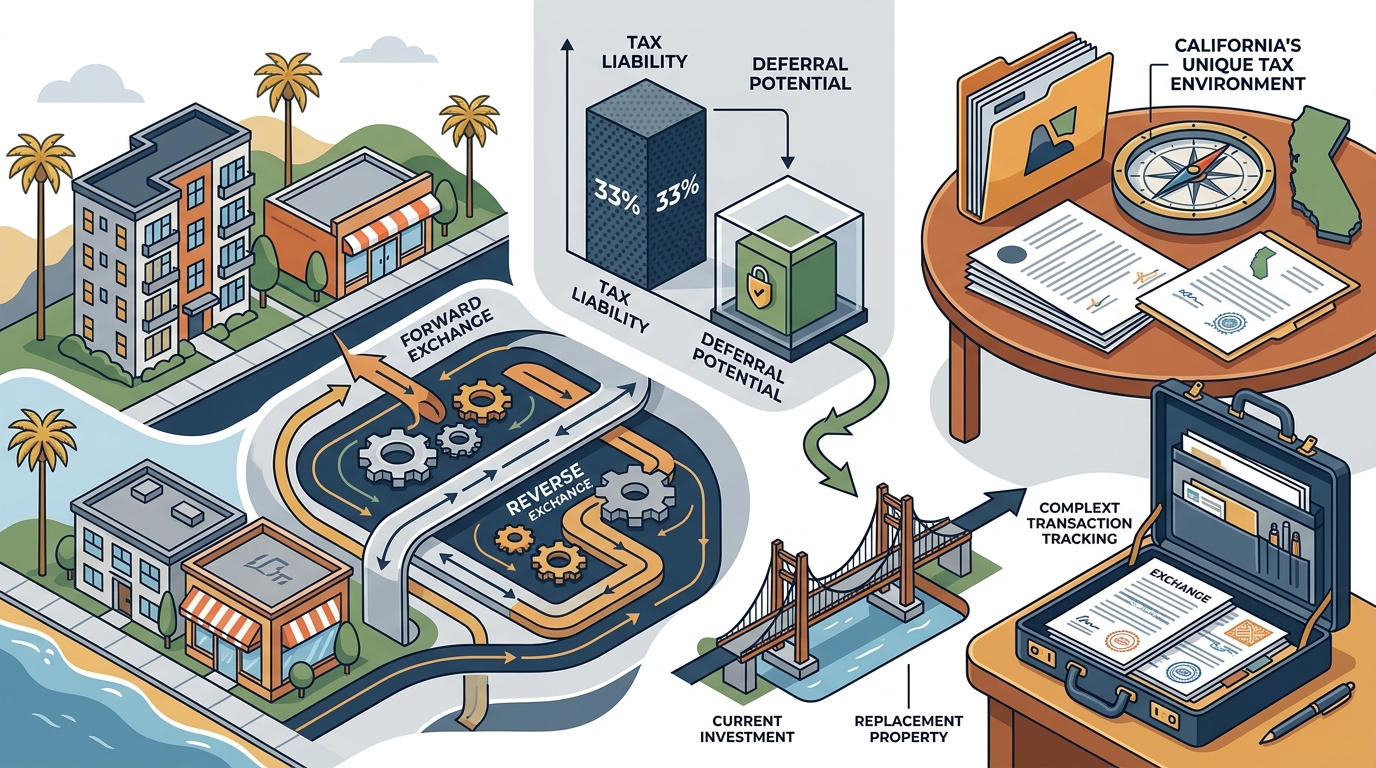
California investors face some of the highest capital gains tax rates in the nation. The state taxes all investment gains as ordinary income at rates up to 13.3%, and when you add federal long-term rates of 15-20% plus the 3.8% net investment income tax, a single property sale can trigger a combined tax burden exceeding 33% of the gain. A properly executed 1031 like-kind exchange defers all of it. But success depends heavily on choosing the right Qualified Intermediary. This guide walks you through the criteria that matter most and explains why independent, service-driven firms consistently outperform corporate competitors.
What Is a Qualified Intermediary?
A Qualified Intermediary (QI) is a neutral third party that facilitates a 1031 exchange by holding sale proceeds, preparing exchange documents, and coordinating the acquisition of replacement property. The IRS requires that the exchanger never take direct possession of funds during the transaction. Without a QI, the sale is treated as a taxable event rather than a tax-deferred exchange.
The QI's role goes beyond paperwork. A skilled intermediary guides you through identification deadlines, coordinates with escrow and title companies, and ensures full IRS compliance from the opening sale through final closing.
Why California Investors Need a 1031 Exchange Specialist
California does not offer a preferential rate for long-term capital gains. The Franchise Tax Board (FTB) taxes all capital gains as ordinary income at marginal rates reaching 13.3%. For a high-earning investor selling a $2 million rental property with an $800,000 gain, the California tax alone could exceed $106,000.
California also enforces its unique clawback provision. If you exchange a California property for one in another state, you must file Form FTB 3840 annually until the replacement property is sold in a taxable transaction. A QI experienced in California exchanges helps you navigate these state-specific requirements so nothing falls through the cracks.
7 Criteria for Choosing the Best 1031 Exchange Company
| Criterion | What to Look For | Why It Matters |
|---|---|---|
| Experience | 20+ years, thousands of completed exchanges | Proven ability across every market cycle |
| CES® Certification | Counselors holding the Certified Exchange Specialist designation from the Federation of Exchange Accommodators | Highest professional credential in the industry |
| Fund Security | Segregated, FDIC-insured accounts; no commingling | Protects your proceeds from risk |
| Independence | Not owned by a title, escrow, or lender company | Eliminates conflicts of interest |
| Personal Service | Dedicated counselor, direct phone and email access | Avoids call-center delays during tight deadlines |
| Exchange Breadth | Handles forward, reverse, improvement, and DST exchanges | One QI for any deal structure |
| California Expertise | Understands FTB clawback, Form 3840, and state withholding | Prevents costly state-level compliance mistakes |
Independent vs. Corporate Qualified Intermediaries
Large national QIs like Asset Preservation (API) and IPX 1031 are backed by parent companies and financial conglomerates. They bring brand recognition and scale, but that size often means you interact with a call center rather than a dedicated counselor who knows your deal.
An independent QI is a firm whose sole business is facilitating 1031 exchanges. Independence means there are no cross-selling incentives tied to a parent title or lending company. Granite Exchange Services exemplifies this model. Founded in 2000, it has processed over 20,000 exchanges totaling more than $1 billion in secured funds, all while operating as a relationship-driven, independent accommodator.
What Independence Means for You
When your QI is not beholden to a corporate parent, their loyalty is entirely to you. You get one dedicated CES® certified counselor with direct phone and email access. No queues, no handoffs, no runarounds. During a 45-day identification window, that kind of responsiveness can be the difference between a successful exchange and a missed deadline.
Exchange Types Your QI Should Handle
Not every deal fits the standard delayed exchange. Your QI should be equipped to structure any of the following:
- Delayed (Forward) Exchange — the most common structure. Sell first, then identify and acquire replacement property within IRS deadlines. Learn about all exchange types.
- Reverse Exchange — acquire replacement property before selling your current asset, structured under Rev. Proc. 2000-37 safe harbor.
- Improvement (Build-to-Suit) Exchange — use exchange proceeds to construct or substantially improve replacement property within the 180-day window.
- DST Exchange — invest in a Delaware Statutory Trust for passive, fractional ownership in institutional-grade real estate. DST interests qualify as like-kind property under Rev. Rul. 2004-86.
Critical Deadlines That Make or Break Your Exchange
A 1031 exchange is governed by two non-negotiable IRS deadlines. The 45-day identification period requires you to designate potential replacement properties in writing within 45 calendar days of selling your relinquished property. The 180-day exchange period is the maximum time allowed to close on the replacement property. Both periods run concurrently, not consecutively.
The Tax-Return Trap
If your tax return is due before the 180th day, your exchange deadline becomes the earlier of the two dates unless you file an extension. This issue most commonly affects investors who sell property late in the tax year. Use the 1031 exchange calculator to map your specific deadlines.
California's Clawback Rule
When you exchange a California property for one in another state, California tracks the deferred gain through annual FTB 3840 filings. If you later sell the replacement property without completing another exchange, California taxes the original deferred gain. An experienced California QI builds this requirement into your closing checklist automatically.
Key Takeaways
- California's capital gains tax rate of up to 13.3% makes 1031 exchanges especially valuable for state investors.
- A Qualified Intermediary is a neutral third party required by the IRS to hold exchange funds and ensure compliance.
- Independence matters: a QI not owned by a title, escrow, or lender company eliminates conflicts of interest.
- The 45-day identification and 180-day exchange deadlines are absolute and run concurrently.
- California's clawback provision tracks deferred gains on out-of-state replacement properties via Form FTB 3840.
- CES® certification from the Federation of Exchange Accommodators is the highest credential in the 1031 industry.
- Granite Exchange Services has completed over 20,000 exchanges since 2000, with FDIC-insured segregated accounts and dedicated counselors.
Frequently Asked Questions
What is a 1031 exchange?
A 1031 exchange is a tax-deferral strategy authorized by IRC Section 1031 that allows real estate investors to sell an investment property and reinvest the proceeds into a like-kind replacement property while deferring capital gains taxes.
How much does a 1031 exchange cost in California?
Administrative fees charged by qualified intermediaries in California typically range from $750 to $1,200 for a standard delayed exchange. Complex structures like reverse or improvement exchanges cost more due to additional coordination.
Can I exchange California property for property in another state?
Yes. IRC Section 1031 permits exchanges of real property anywhere in the United States. However, California requires annual filing of Form FTB 3840 to track deferred gains when the replacement property is out of state.
What happens if I miss the 45-day deadline?
If you fail to identify replacement properties within 45 calendar days, the exchange is disqualified. The sale proceeds become fully taxable in the year of the sale, and the tax deferral benefit is lost entirely.
Why should I choose an independent QI over a large corporate firm?
An independent Qualified Intermediary focuses solely on 1031 exchanges with no cross-selling incentives from a parent company. You receive dedicated, personal service instead of being routed through a call center, which is critical when deadlines are tight.
Does California conform to federal 1031 exchange rules?
Yes, California recognizes Section 1031 and allows tax deferral on both state and federal capital gains for qualifying like-kind exchanges. However, the state adds its own requirements, including withholding rules and the clawback provision for out-of-state replacements.
Is Section 1031 still available after the latest tax legislation?
Yes. Despite proposals that threatened to cap or eliminate 1031 exchanges, the provision emerged fully intact in the most recent federal tax legislation with no new cap, phase-out, or dollar threshold on exchange amounts.
How are exchange funds protected?
Reputable QIs hold client funds in individually segregated, FDIC-insured bank accounts. Funds should never be commingled with operating funds or other client accounts and must be available for same-day wiring at closing.
Start Your California 1031 Exchange Today
Whether you are a commercial investor, a landlord with a single rental property, or part of an investment group, the right Qualified Intermediary makes all the difference. Contact Granite Exchange Services at 800-899-6959 to speak directly with a CES® certified exchange counselor. No call centers. No runarounds. Just expert guidance from a team that has handled over 20,000 exchanges since 2000.