

Companies That Handle Reverse 1031 Exchanges
A reverse 1031 exchange lets you buy replacement property before selling the property you already own. It is one of the most complex exchange structures available under IRS Revenue Procedure 2000-37, and not every Qualified Intermediary is equipped to handle it. If you are a commercial investor, a landlord with a few rentals, or part of an investment group, knowing which companies can guide a reverse exchange from start to finish is critical to keeping your tax deferral intact. Below, we break down the types of firms that facilitate reverse exchanges and what to look for before you sign an agreement.
What Is a Reverse 1031 Exchange?
A reverse 1031 exchange is a transaction in which the investor acquires replacement property before selling the relinquished property. Unlike a standard delayed (forward) exchange, where you sell first and buy second, a reverse exchange flips the order so you can lock in a deal on a new property without waiting for your current asset to close.
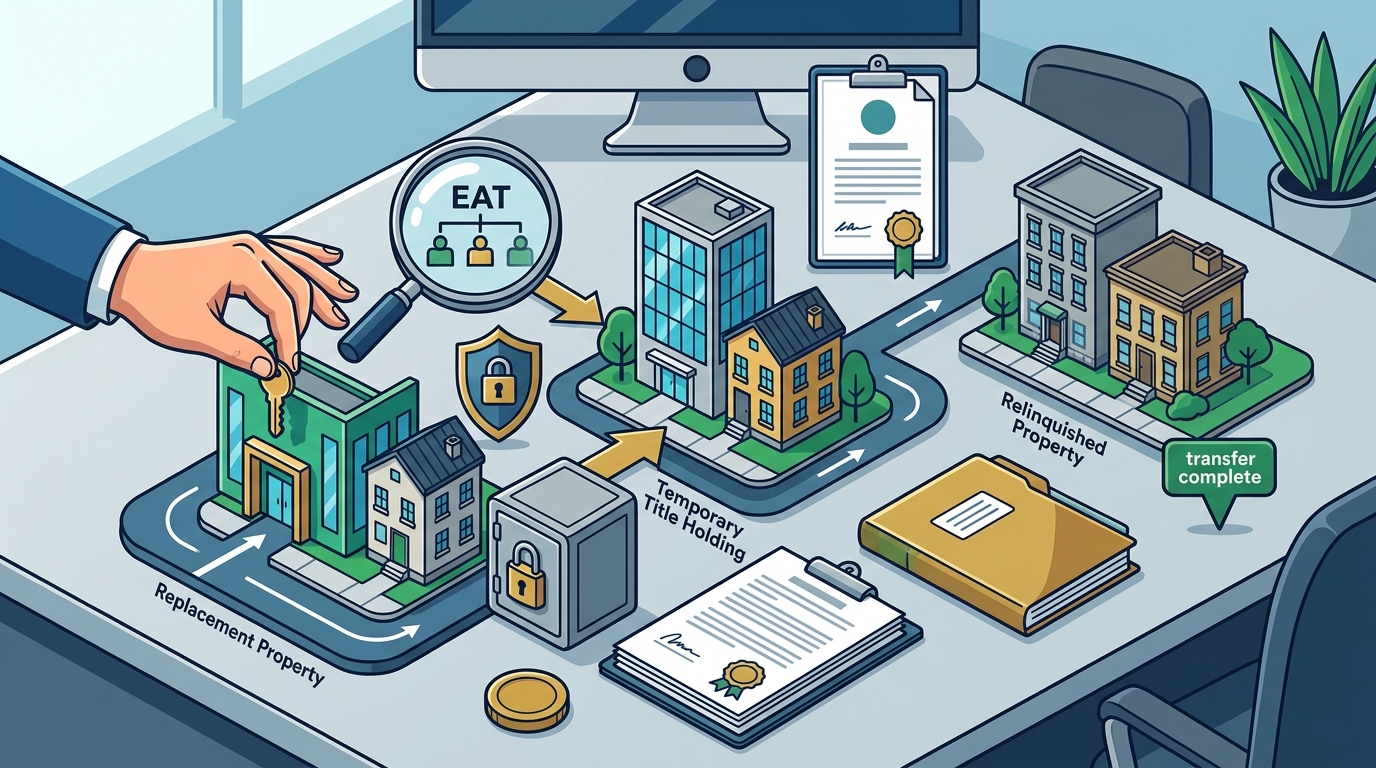
The IRS formalized this structure through Revenue Procedure 2000-37, which created the safe harbor framework that governs how reverse exchanges must be structured. The procedure requires an Exchange Accommodation Titleholder (EAT) to hold legal title to the parked property for a maximum of 180 days while the investor completes the sale of the relinquished property.
How the EAT Structure Works
An Exchange Accommodation Titleholder (EAT) is a third-party entity that temporarily takes title to either the replacement or relinquished property during a reverse exchange. The EAT and the investor enter into a Qualified Exchange Accommodation Arrangement (QEAA), which is a written agreement confirming that the EAT holds the property solely to facilitate a Section 1031 exchange.
Critical Deadlines
The same 45-day identification and 180-day exchange period rules apply to reverse exchanges. Once the EAT acquires the replacement property, the investor has 45 days to formally identify the relinquished property and 180 days to sell it and complete the exchange. A QEAA must be signed within five business days of the EAT taking title.
Financing Considerations
Many lenders are unfamiliar with reverse exchanges. The EAT, as the titleholder, may need to be the borrower on any acquisition loan. Involving your lender early is essential. Experienced QI firms coordinate this process so financing does not derail the timeline.
Types of Companies That Handle Reverse Exchanges
Not every QI offers reverse exchange services. Here are the main categories of providers:
1. Independent Qualified Intermediaries
An independent QI is a company whose sole business is facilitating 1031 exchanges and that is not owned by a title, escrow, or lending company. Granite Exchange Services is an example of an independent, CES-certified QI that has facilitated over 20,000 exchanges since 2000, including complex reverse and construction structures. Independent QIs typically offer dedicated counselors and direct access rather than routing clients through call centers.
2. Title-Company-Affiliated QIs
Some of the largest QI operations are subsidiaries of title insurance conglomerates. These firms have deep financial backing and national office networks. However, because they are owned by a parent company, their independence as a neutral third party can be a consideration for investors who prefer a QI with no corporate affiliations.
3. Regional and Niche Firms
Smaller regional firms and law-firm-affiliated accommodators also handle reverse exchanges, though capacity and experience levels vary. Always verify that any regional provider has specific reverse exchange experience and appropriate bonding.
Key Criteria for Choosing a Reverse Exchange QI
Selecting the right company is more important in a reverse exchange than in a standard forward exchange. Here is what to evaluate:
- CES Certification: The Certified Exchange Specialist designation is awarded by the Federation of Exchange Accommodators (FEA) and represents the highest professional credential in the 1031 exchange industry.
- EAT Capability: Confirm the company can serve as the Exchange Accommodation Titleholder or has a dedicated EAT entity.
- Segregated Accounts: Your exchange funds should be held in individually segregated, FDIC-insured accounts, never commingled with the QI's operating funds.
- Direct Access: Complex reverse exchanges require responsive communication. Look for a firm that assigns a dedicated exchange counselor rather than cycling you through a support queue.
- Independence: A QI that is not owned by a title or escrow company functions as a truly neutral accommodator with loyalty solely to the client.
Cost Comparison: Reverse vs. Delayed Exchanges
| Factor | Delayed (Forward) Exchange | Reverse Exchange |
|---|---|---|
| Typical QI Fee Range | $500 - $2,500 | $3,000 - $7,500+ |
| EAT Entity Required | No | Yes |
| Governing IRS Authority | Treas. Reg. §1.1031(k)-1 | Rev. Proc. 2000-37 |
| Maximum Timeline | 180 days from sale | 180 days from EAT acquisition |
| Complexity Level | Moderate | High |
| Lender Coordination | Standard | Extensive (EAT may be borrower) |
Reverse exchanges cost more because the QI takes on additional risk and responsibility, including holding legal title, managing tax reporting attributes, and coordinating lender requirements. The higher fee reflects the complexity, not a markup on a simple service.
Why an Independent QI Matters for Reverse Exchanges
In a reverse exchange, the QI or its affiliated EAT entity literally takes title to your property. That makes neutrality essential. An independent QI has no parent company that might steer you toward affiliated title, escrow, or lending products. The loyalty runs entirely to you as the client.
Granite Exchange Services was founded in 2000 with exactly this philosophy. As an independent, relationship-driven firm, it provides one dedicated CES-certified counselor per engagement, individually segregated FDIC-insured accounts, and transparent flat-fee pricing with no hidden charges. Whether you are exchanging a single rental property or coordinating a multi-asset portfolio for a hedge fund, the team handles your reverse exchange from opening through final closing.
Key Takeaways
- A reverse 1031 exchange allows you to buy replacement property before selling your existing investment property.
- The transaction must comply with the safe harbor rules of IRS Revenue Procedure 2000-37, which requires an Exchange Accommodation Titleholder (EAT).
- Independent QIs, title-affiliated QIs, and regional firms all offer reverse exchange services, but experience and independence levels vary widely.
- Reverse exchange QI fees typically range from $3,000 to $7,500 or more, reflecting the added complexity and risk.
- A QEAA must be executed within five business days of the EAT taking title to the parked property.
- Choosing an independent, CES-certified QI with segregated accounts and a dedicated counselor reduces risk on your most complex transactions.
- Granite Exchange Services has completed over 20,000 exchanges since 2000 and serves investors in all 50 states.
Frequently Asked Questions
What is a reverse 1031 exchange?
A reverse 1031 exchange is a tax-deferred transaction in which the investor acquires the replacement property before selling the relinquished property. It is structured under IRS Revenue Procedure 2000-37 using an Exchange Accommodation Titleholder.
Do all Qualified Intermediaries handle reverse exchanges?
No. Reverse exchanges require the QI or an affiliated entity to act as the EAT and take legal title to property. Many smaller QIs only handle standard delayed exchanges. Always confirm reverse exchange capability before engaging a provider.
How much does a reverse 1031 exchange cost?
QI fees for reverse exchanges generally range from $3,000 to $7,500 or more, depending on transaction complexity, the number of properties involved, and the amount of capital at stake. This is significantly higher than the $500 to $2,500 typical for a delayed exchange.
What is an Exchange Accommodation Titleholder (EAT)?
An EAT is a third-party entity that holds legal title to property during a reverse exchange under a Qualified Exchange Accommodation Arrangement (QEAA). The IRS treats the EAT as the beneficial owner of the parked property for federal tax purposes.
How long can the EAT hold the property?
Under the Rev. Proc. 2000-37 safe harbor, the EAT can hold the parked property for a maximum of 180 days. The investor must identify the relinquished property within 45 days of the EAT acquiring title and complete the entire exchange within the 180-day window.
Can I do a reverse exchange in any state?
Yes. Section 1031 is a federal tax code provision, so reverse exchanges work in all 50 states. State-level income tax treatment varies, so consult your tax advisor for state-specific implications. Granite Exchange Services handles exchanges nationwide.
Why should I choose an independent QI for a reverse exchange?
An independent QI is not owned by a title, escrow, or lending company, which means its only obligation is to you. In a reverse exchange where the QI's EAT entity takes legal title to your property, that neutrality is especially important.
What happens if I cannot sell my relinquished property within 180 days?
If the relinquished property does not sell within the 180-day safe harbor window, the QEAA terminates. The investor may take title to the replacement property outright, but the transaction will likely not qualify for tax-deferred treatment under the safe harbor. Non-safe-harbor structures may exist but carry higher audit risk.
Start Your Reverse Exchange Today
Reverse exchanges demand precision, experience, and a QI you can trust with legal title to your property. Granite Exchange Services has guided investors through over 20,000 exchanges since 2000, with CES-certified counselors, segregated FDIC-insured accounts, and the personal service that complex transactions require. Call 800-899-6959 or contact Granite Exchange Services to discuss your reverse exchange.