

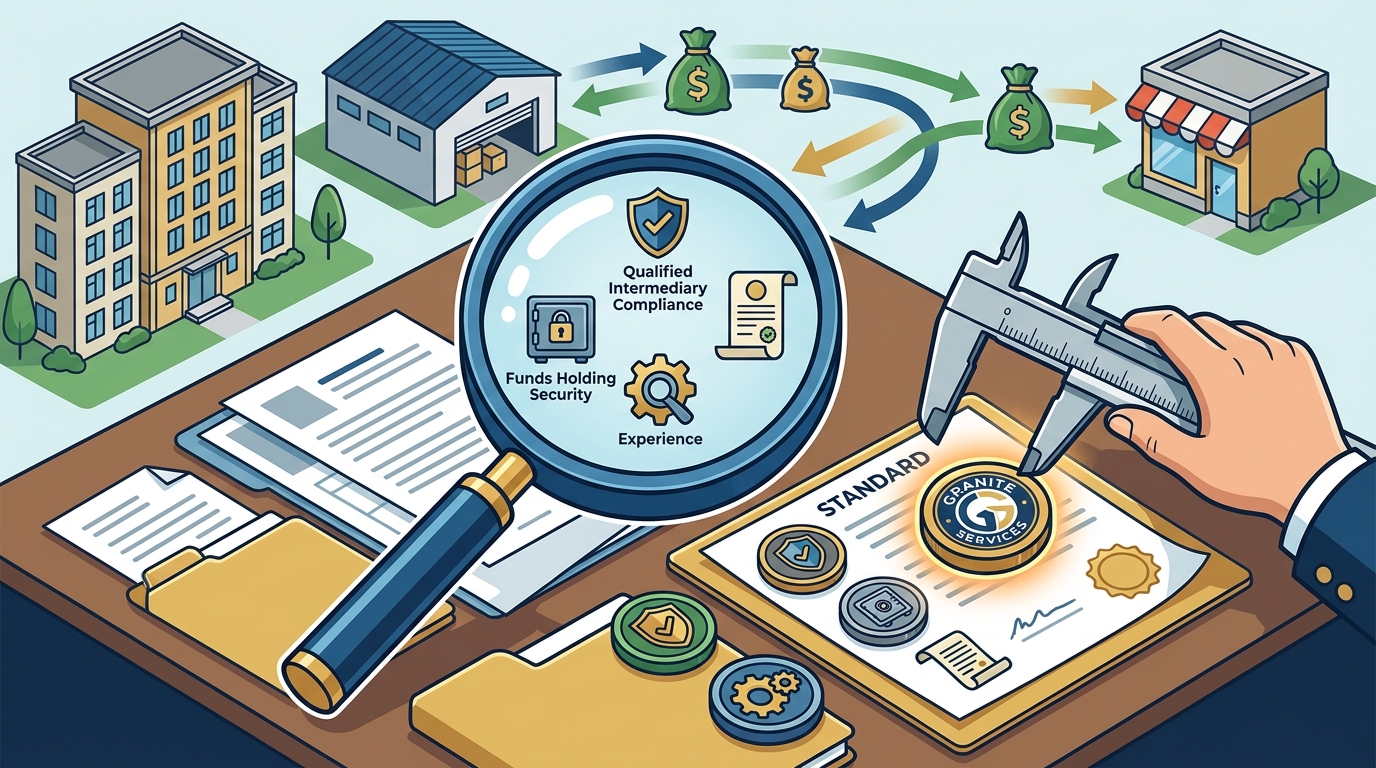
Choosing the right 1031 exchange accommodator is one of the most consequential decisions a real estate investor can make. A qualified intermediary (QI) is a third-party facilitator required by the IRS to hold your sale proceeds, prepare exchange documents, and ensure your transaction complies with IRC Section 1031. Because the QI industry is largely unregulated at the federal level, the burden of due diligence falls squarely on you. This guide breaks down the seven essential qualities every investor should evaluate before entrusting hundreds of thousands of dollars, or more, to an accommodator.
Why Your Choice of QI Matters
A qualified intermediary is the person or company that holds your exchange proceeds between the sale of your relinquished property and the purchase of your replacement property. The IRS mandates a QI for deferred exchanges; without one, your capital gains taxes become immediately due. There are no second chances if the exchange is disqualified.
The IRS itself has warned investors to be careful in their selection of a qualified intermediary because some have declared bankruptcy or failed to meet contractual obligations. The wrong choice can cost you the entire tax deferral.
Credentials and Certifications to Verify
The CES Designation
The Certified Exchange Specialist (CES) designation is a voluntary professional credential awarded by the Federation of Exchange Accommodators (FEA). Candidates must complete at least three years of full-time exchange facilitation experience and pass a comprehensive exam covering IRC Section 1031 rules. CES holders are bound by a code of ethics and must complete 20 hours of continuing education every two years.
When evaluating an accommodator, ask whether their counselors hold the CES designation. Granite Exchange Services employs CES-certified counselors on every engagement, ensuring you work with professionals who have demonstrated advanced knowledge of exchange law.
FEA Membership
FEA membership requires adherence to professional standards of ethics and competency. Membership alone does not guarantee quality, but it signals a commitment to industry best practices.
Bonding and Licensing
While no federal license is required to operate as a QI, some states impose bonding or registration requirements. Confirm that your accommodator is licensed and bonded in accordance with applicable state law.
Fund Security and Segregated Accounts
Fund security is the single most important safety consideration. Your QI will hold potentially millions of dollars on your behalf. Insist on individually segregated, FDIC-insured accounts where your funds are never commingled with other clients' money or the QI's operating funds.
Granite Exchange Services holds all client exchange funds in individually segregated, FDIC-insured bank accounts with same-day wiring available at closing. This is the gold standard for fund protection.
Ask your prospective QI these direct questions:
- Are my funds held in a segregated account or a commingled/pooled account?
- Is the account FDIC-insured?
- Does the QI carry fidelity bond or errors-and-omissions insurance?
- Can I receive same-day wiring when I close on my replacement property?
Independence and Neutrality
Independence is the quality of operating without ownership ties to any title company, escrow firm, lender, or brokerage. An independent accommodator has no conflicting financial incentives; their only loyalty is to you and IRS compliance.
Some of the largest QI firms in the country are subsidiaries of Fortune 500 financial conglomerates. That corporate structure can introduce conflicts of interest and bureaucratic layers. An independent QI like Granite Exchange Services functions as a neutral, third-party accommodator whose recommendations are driven solely by the investor's best interest.
Experience and Track Record
Exchange facilitation requires deep procedural knowledge accumulated over years and market cycles. Look for a QI that has operated through multiple economic environments, including downturns, when exchange structures become more complex and timelines more critical.
Key questions to ask include:
- How many years has the firm been in continuous operation?
- How many exchanges has the firm completed?
- What is the total dollar volume of funds the firm has safeguarded?
Granite Exchange Services has been guiding investors since 2000, processing over 20,000 exchanges and safeguarding more than $1 billion in client funds. That 25-year track record spans the dot-com collapse, the 2008 financial crisis, the COVID-19 pandemic, and the current market.
Service Model: Personal Access vs. Call Centers
A service model is the way a company structures client communication and support. In the QI industry, service models range from dedicated personal counselors to high-volume call centers.
When you are under a strict 45-day identification deadline or 180-day closing deadline, being routed through a queue or handed off between departments can be costly. You want direct phone and email access to a knowledgeable counselor who knows your file.
Granite Exchange Services assigns one dedicated counselor per exchange. No call centers, no queues, no runarounds. Clients get direct access to the team handling their transaction from opening sale through final closing.
Range of Exchange Structures Supported
Not all exchanges are simple delayed transactions. Depending on your investment strategy, you may need a reverse exchange, a construction (build-to-suit) exchange, a DST exchange, or a blended multi-property exchange. Your QI should be experienced in all of them.
Granite Exchange Services handles every exchange structure under IRC Section 1031, including:
- Delayed (forward) exchanges — the most common structure
- Reverse exchanges — acquire replacement property before selling
- Construction/improvement exchanges — build or renovate replacement property
- DST exchanges — passive fractional ownership in institutional-grade real estate
- Complex and multi-asset exchanges — multiple properties across states
Quick Comparison: QI Evaluation Checklist
| Evaluation Criteria | What to Look For | Red Flag |
|---|---|---|
| CES Certification | CES-designated counselors on staff | No professional credentials |
| Fund Security | Segregated, FDIC-insured accounts | Commingled or pooled accounts |
| Independence | No parent company ties to title, escrow, or lender | Owned by a financial conglomerate |
| Experience | 10+ years, thousands of completed exchanges | New entrant with limited track record |
| Service Model | Dedicated counselor with direct access | Call center or ticket-based support |
| Exchange Structures | Handles delayed, reverse, construction, DST | Only offers basic delayed exchanges |
| Bonding/Insurance | Licensed, bonded, with E&O coverage | No insurance or bonding disclosures |
Key Takeaways
- The IRS requires a qualified intermediary for all deferred 1031 exchanges; choosing the wrong one can disqualify your entire tax deferral.
- QIs are largely unregulated at the federal level, so verifying credentials like the CES designation is essential.
- Fund security is non-negotiable: demand individually segregated, FDIC-insured accounts.
- An independent QI with no ties to title, escrow, or lending companies provides neutral, conflict-free guidance.
- Years of continuous operation through multiple market cycles indicate reliability and deep procedural knowledge.
- Direct access to a dedicated counselor, rather than a call center, ensures timely support during time-sensitive deadlines.
- Your QI should handle every exchange structure, including reverse, construction, DST, and multi-asset exchanges.
Frequently Asked Questions
What is a qualified intermediary in a 1031 exchange?
A qualified intermediary is a third-party facilitator required by the IRS to hold the proceeds from your relinquished property sale and use those funds to acquire your replacement property, ensuring compliance with IRC Section 1031.
Is a qualified intermediary required by law?
Yes. For deferred exchanges, the IRS mandates the use of a QI. Without one, you take constructive receipt of the funds and capital gains taxes become immediately due.
Are 1031 exchange accommodators regulated?
There is no federal licensing or regulatory body governing QIs. Some states have enacted bonding or registration requirements, but investors must perform their own due diligence.
What is the CES designation?
The Certified Exchange Specialist (CES) designation is awarded by the Federation of Exchange Accommodators to professionals who complete at least three years of full-time exchange facilitation experience, pass a comprehensive exam, and maintain ongoing continuing education.
How should my exchange funds be held?
Your funds should be held in individually segregated, FDIC-insured bank accounts. They should never be commingled with the QI's operating funds or other clients' funds.
Can my attorney or CPA act as my qualified intermediary?
No. Under Treasury Regulation Section 1.1031(k)-1(g)(4), anyone who has served as your agent, including your attorney, CPA, real estate broker, or employee, within the two years preceding the exchange is disqualified from acting as your QI.
What deadlines does a QI help me meet?
A QI helps you comply with the 45-day identification period and 180-day exchange period mandated by the IRS. Missing either deadline disqualifies the exchange.
Does Granite Exchange Services handle exchanges nationwide?
Yes. Based in Granite Bay, California, Granite Exchange Services handles 1031 exchanges in all 50 states with particular expertise in California's complex real estate market.
Ready to Choose the Right Accommodator?
Your exchange is too important to leave to chance. Granite Exchange Services offers CES-certified counselors, FDIC-insured segregated accounts, and a 25-year track record of guiding investors through every type of 1031 exchange. Contact Granite Exchange Services or call 800-899-6959 to speak directly with a dedicated exchange counselor today.