

Selling a rental property can trigger a massive tax bill. Federal capital gains rates of 15% to 20%, the 3.8% net investment income tax, depreciation recapture at 25%, and state taxes can combine to consume more than a quarter of your profit. A 1031 exchange is a provision under Internal Revenue Code Section 1031 that lets you defer all of those taxes by reinvesting the proceeds into another like-kind investment property. Below, we walk through every step rental property owners need to follow, from engaging a Qualified Intermediary to closing on replacement property within the IRS deadlines.
What Is a 1031 Exchange?
A 1031 exchange is a tax-deferred transaction that allows a real estate investor to sell an investment property and reinvest the proceeds into a like-kind replacement property without paying immediate capital gains taxes. The provision has been part of the U.S. tax code since 1921, and after the Tax Cuts and Jobs Act of 2017, it applies exclusively to real property held for investment or business use.
A Qualified Intermediary (QI) is a neutral third party that holds the exchange proceeds and facilitates the transaction so the investor never takes constructive receipt of the funds. Without a QI in place before closing, the IRS treats the sale as a taxable event.
Does Your Rental Property Qualify?
To qualify, both the property you sell (the relinquished property) and the property you buy (the replacement property) must be held for investment or productive use in a trade or business. Rental homes, apartment buildings, commercial offices, vacant land, and even Delaware Statutory Trust (DST) interests all qualify as like-kind real property.
Properties That Do Not Qualify
Primary residences, fix-and-flip inventory, and property held primarily for resale are excluded. Vacation homes fall into a gray area: IRS Revenue Procedure 2008-16 provides a safe harbor requiring the property to be rented at least 14 days per year at fair market rates, with personal use limited to 14 days or 10% of rental days, whichever is greater, for two years before and after the exchange.
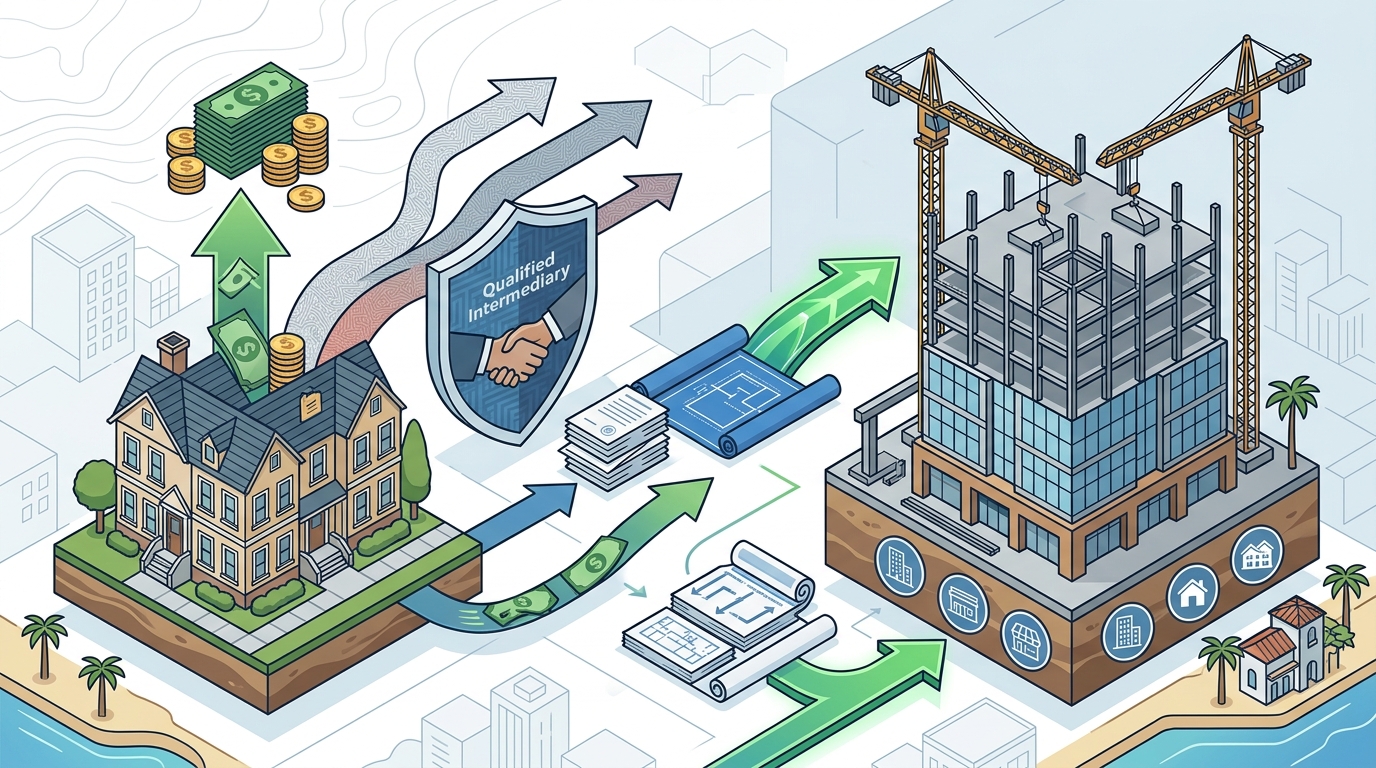
Step-by-Step Process for a Rental Property 1031 Exchange
1. Engage a Qualified Intermediary Before Closing
Your exchange documents must be executed before the sale closes. Granite Exchange Services prepares all exchange agreements, holds funds in individually segregated FDIC-insured accounts, and coordinates with your escrow and title companies from day one.
2. Sell the Relinquished Property
At closing, the sale proceeds are wired directly to your QI. You cannot touch or control the funds at any point. If you receive even a dollar, the IRS may invalidate the entire exchange.
3. Identify Replacement Property Within 45 Days
The 45-day identification period begins the day your relinquished property transfers. You must formally designate potential replacement properties in writing to your QI before midnight on day 45. This deadline is strict and, except in limited federally declared disaster situations, cannot be extended.
4. Close on Replacement Property Within 180 Days
You have a total of 180 calendar days from the sale of your relinquished property to close on at least one identified replacement property. The 45-day and 180-day windows run concurrently, not sequentially.
5. Report the Exchange on Form 8824
File IRS Form 8824 with your federal tax return for the year the exchange occurred. Your QI will help you complete this form accurately.
Critical IRS Deadlines
| Deadline | Duration | Starts When | What Happens If Missed |
|---|---|---|---|
| Identification Period | 45 calendar days | Day relinquished property transfers | Exchange fails; gain is fully taxable |
| Exchange Period | 180 calendar days | Day relinquished property transfers | Exchange fails; gain is fully taxable |
| Tax Return Filing | Due date (with extensions) | End of tax year of exchange | Penalties and interest may apply |
Both periods run concurrently. If you close your sale on January 15, day 45 falls on March 1 and day 180 falls on July 14. Use the 1031 exchange deadline calculator on our site to instantly compute your dates.
Replacement Property Identification Rules
The IRS provides three methods to identify replacement properties:
- Three-Property Rule: Identify up to three properties of any value.
- 200% Rule: Identify any number of properties as long as their combined fair market value does not exceed 200% of the relinquished property's value.
- 95% Rule: Identify any number of properties if you ultimately acquire at least 95% of the aggregate value identified.
Most rental property investors use the three-property rule for simplicity. Your identification must be in writing, signed, and delivered to your QI before the 45-day deadline.
Understanding Boot and How to Avoid It
Boot is any non-like-kind value received in an exchange, most commonly cash proceeds you keep or a reduction in mortgage debt. Boot is taxable in the year it is received. To defer 100% of your capital gain, you must reinvest all net sale proceeds and acquire replacement property of equal or greater value with equal or greater debt.
At Granite Exchange Services, our CES-certified counselors help structure your exchange to minimize or eliminate boot before closing.
Types of 1031 Exchanges for Rental Owners
| Exchange Type | Best For | Key Feature |
|---|---|---|
| Delayed (Forward) Exchange | Most rental investors | Sell first, then buy within 180 days |
| Reverse Exchange | Competitive markets | Buy replacement before selling |
| Improvement (Construction) Exchange | Value-add investors | Use proceeds to build or renovate |
| DST Exchange | Passive-income seekers | Fractional ownership, no management |
A delayed exchange is the most common structure. Reverse exchanges let you lock in a replacement property in a hot market before your rental sells. Improvement exchanges allow you to use exchange funds for construction on the replacement property, provided improvements are completed within the 180-day window.
Key Takeaways
- A 1031 exchange lets rental property owners defer federal and state capital gains taxes by reinvesting in like-kind real estate.
- You must engage a Qualified Intermediary before the sale closes or the transaction is disqualified.
- The 45-day identification and 180-day closing deadlines are absolute and run concurrently.
- Like-kind is broadly defined: you can exchange a single-family rental for an apartment complex, commercial building, land, or DST interest.
- Boot (cash or debt relief not reinvested) is taxable. Structure your exchange to reinvest all proceeds into equal or greater value property.
- Section 1031 survived the 2025 "One Big Beautiful Bill" fully intact with no new caps or restrictions.
- Working with an independent, CES-certified QI like Granite Exchange Services ensures your exchange stays compliant from start to finish.
Frequently Asked Questions
Can I do a 1031 exchange on a single rental property?
Yes. There is no minimum property count or dollar amount. A single rental home qualifies as long as it was held for investment and you follow all IRS rules.
What is a Qualified Intermediary?
A Qualified Intermediary is a neutral third party that holds your exchange funds, prepares the exchange documents, and ensures you never take constructive receipt of the proceeds. The QI must be engaged before your relinquished property closes.
Can I exchange a rental property for a different type of real estate?
Yes. The like-kind definition for real property is broad. You can exchange a rental house for commercial property, vacant land, an apartment building, or a DST interest.
What happens if I miss the 45-day identification deadline?
Your exchange fails. The sale proceeds become fully taxable as a capital gain in the year of the sale, and there are no extensions except in limited federally declared disaster situations.
Do I have to buy a property of equal or greater value?
To defer 100% of the gain, yes. If you purchase a less expensive replacement property, the difference (boot) is taxable. Your QI can help you structure the exchange to avoid boot.
Is a 1031 exchange available in all 50 states?
Yes. Section 1031 is a federal tax provision. Granite Exchange Services has completed over 20,000 exchanges across every U.S. state since 2000.
How are exchange funds protected?
Granite Exchange Services holds all client funds in individually segregated, FDIC-insured bank accounts. Funds are never commingled with operating capital or other client accounts and are available for same-day wiring at closing.
Did the 2025 tax bill change 1031 exchange rules?
No. The "One Big Beautiful Bill" signed on July 4, 2025, left Section 1031 fully intact with no new caps, phase-outs, or restrictions.
Start Your Rental Property 1031 Exchange Today
Whether you own a single rental home or manage a multi-property portfolio, Granite Exchange Services provides hands-on guidance from your first phone call through final closing. As an independent, CES-certified Qualified Intermediary with 25 years of experience, we deliver the personal service that large corporate intermediaries simply cannot match. Call 800-899-6959 or contact us online to speak directly with an exchange counselor and get your exchange started.