

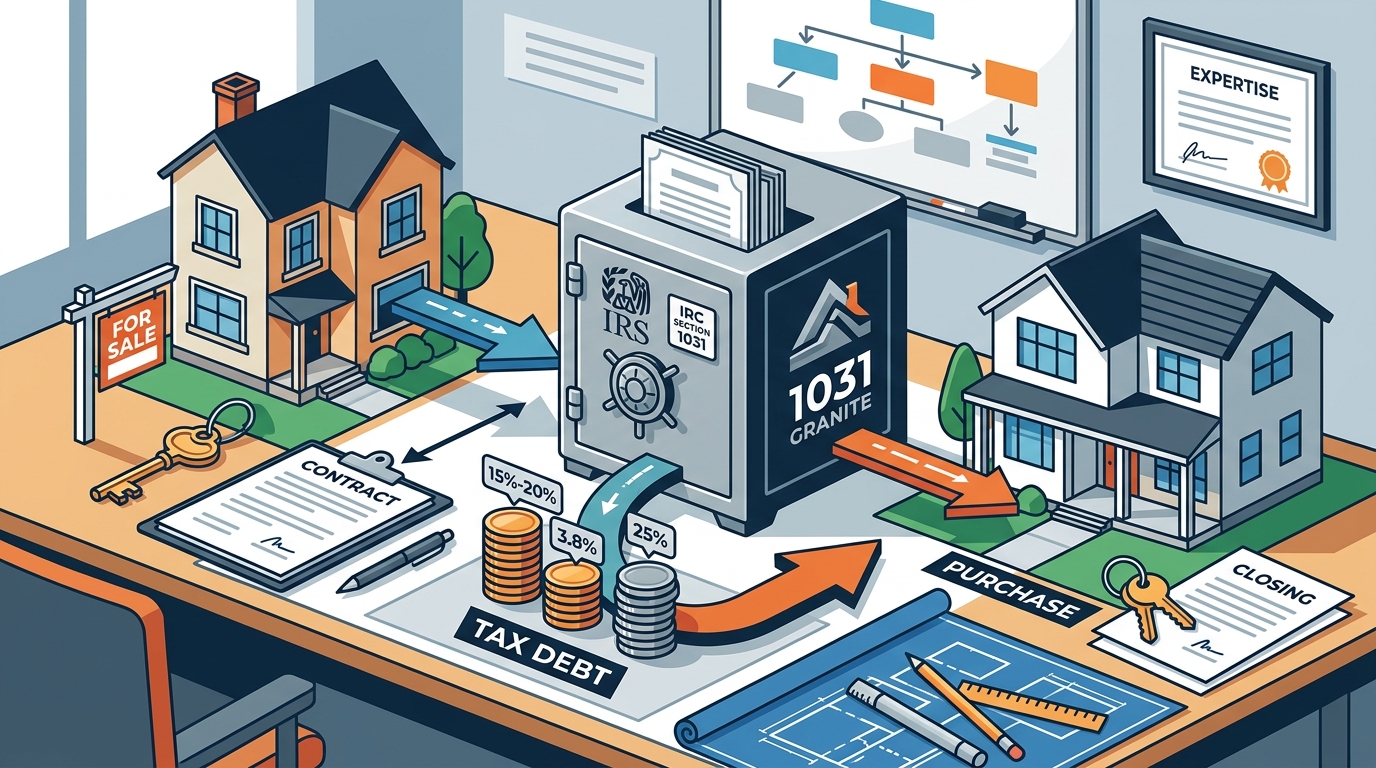
Selling a rental property can trigger a steep tax bill. Federal capital gains rates of 15% to 20%, plus the 3.8% net investment income tax and up to 25% depreciation recapture, can consume a significant portion of your profit. A 1031 exchange is a tax-deferral strategy authorized by IRC Section 1031 that lets you reinvest your sale proceeds into another like-kind property and defer those taxes indefinitely. Below, we walk through every step rental property owners need to follow, from hiring a Qualified Intermediary to closing on replacement property.
What Is a 1031 Exchange?
A 1031 exchange is a transaction that allows a real estate investor to sell an investment property and purchase a replacement property of equal or greater value while deferring capital gains taxes. The provision has been part of the U.S. tax code since 1921 and remains one of the most powerful wealth-building tools available to property owners.
After the Tax Cuts and Jobs Act of 2017, Section 1031 applies only to exchanges of real property, not personal or intangible property. Both the property you sell (the relinquished property) and the property you buy (the replacement property) must be held for investment or productive business use.
Does Your Rental Property Qualify?
Rental properties are among the most common assets exchanged under Section 1031. To qualify, your property must be held for investment or use in a trade or business. Properties held primarily for resale, such as fix-and-flip projects, do not qualify. Personal residences are also excluded.
Vacation Rentals and Mixed-Use Properties
If your rental doubles as a vacation home, stricter rules apply. Under the IRS safe harbor in Revenue Procedure 2008-16, the property must be rented at fair market rates for at least 14 days per year and your personal use must be limited to 14 days or 10% of rental days, whichever is greater, for the two years before and after the exchange.
Like-Kind Is Broadly Defined
Like-kind property is any real property of the same nature or character, regardless of grade or quality. You can exchange a single-family rental for an apartment complex, vacant land, a commercial building, or even a Delaware Statutory Trust (DST) interest. The flexibility makes a 1031 exchange an excellent portfolio-diversification tool.
Step-by-Step Process for a Rental Property 1031 Exchange
1. Engage a Qualified Intermediary Before Closing
A Qualified Intermediary (QI) is a neutral third party that holds your sale proceeds and facilitates the exchange. The exchange documents must be executed before you close on the sale of the relinquished property. If these documents are not in place beforehand, the IRS treats the transaction as a taxable sale, not an exchange. Choosing an independent QI, one not owned by a title, escrow, or lender company, helps ensure impartial guidance throughout the process.
2. Sell Your Rental Property
Close on the sale as you normally would. Your QI receives the net proceeds directly from the closing agent. You never take constructive or actual receipt of the funds. Direct access to the funds by the investor disqualifies the exchange.
3. Identify Replacement Property Within 45 Days
Starting from the day you close the sale, you have exactly 45 calendar days to formally identify potential replacement properties in writing to your QI. The IRS offers three identification methods (detailed below).
4. Close on Replacement Property Within 180 Days
You must acquire at least one identified replacement property within 180 calendar days of selling the relinquished property. Your QI wires the held funds to the closing agent to complete the purchase.
5. File IRS Form 8824
You must report the exchange on Form 8824 and file it with your federal tax return for the year the exchange occurred.
Critical IRS Deadlines You Cannot Miss
Two non-negotiable deadlines govern every 1031 exchange, and they run concurrently. Missing either one disqualifies the entire exchange and triggers immediate capital gains tax liability.
| Deadline | Duration | Starts | What Happens |
|---|---|---|---|
| Identification Period | 45 calendar days | Day of sale closing | You must identify replacement properties in writing |
| Exchange Period | 180 calendar days | Day of sale closing | You must close on at least one identified property |
These deadlines cannot be extended except in IRS-declared disaster situations. Even if you are mid-negotiation on day 179, you must close by day 180.
Property Identification Rules
The IRS allows three methods for identifying replacement properties during the 45-day window:
- Three-Property Rule: Identify up to three properties of any value.
- 200% Rule: Identify any number of properties as long as their total fair market value does not exceed 200% of the relinquished property's value.
- 95% Rule: Identify unlimited properties, but you must acquire at least 95% of the total value identified.
Most rental property investors use the Three-Property Rule because it is simple and provides enough flexibility without the risk of the 95% threshold.
Understanding Boot and Full Deferral
Boot is any non-like-kind value received in an exchange, typically cash or a reduction in mortgage debt. Boot is taxable in the year it is received. To achieve full tax deferral, you must reinvest all net sale proceeds and acquire replacement property of equal or greater value and equal or greater debt.
For example, if you sell a rental property for $500,000 with $200,000 of remaining mortgage debt, your replacement property should cost at least $500,000 and carry at least $200,000 in debt. Any shortfall creates taxable boot.
Exchange Structures Compared
Not every 1031 exchange follows the same playbook. The right structure depends on your timeline and goals.
| Exchange Type | How It Works | Best For |
|---|---|---|
| Delayed (Forward) | Sell first, then buy replacement within 180 days | Most rental property owners |
| Reverse | Buy replacement first, then sell relinquished property | Competitive markets where you need to lock in a deal |
| Improvement (Build-to-Suit) | Use proceeds to build or improve replacement property | Investors customizing or developing property |
| DST Exchange | Exchange into a Delaware Statutory Trust for passive income | Investors wanting to exit active management |
Key Takeaways
- A 1031 exchange lets you defer capital gains, depreciation recapture, and net investment income tax when you sell a rental property.
- Your rental must be held for investment or business use, not personal use, to qualify.
- You must engage an independent Qualified Intermediary before your sale closes.
- The 45-day identification and 180-day exchange deadlines are strict and run concurrently.
- Reinvest all proceeds and match or exceed your relinquished property's value and debt to avoid taxable boot.
- Exchange structures range from simple delayed exchanges to reverse, improvement, and DST exchanges.
- File Form 8824 with your tax return in the year the exchange occurs.
Frequently Asked Questions
Can I exchange a single rental property into multiple replacement properties?
Yes. You can exchange one relinquished property into up to three replacement properties under the Three-Property Rule, or more under the 200% or 95% rules, as long as you close within the 180-day exchange period.
Do both properties need to be in the same state?
No. IRC Section 1031 permits exchanges of real property located anywhere within the United States. You can sell a rental in California and purchase replacement property in Texas or Florida.
What happens if I miss the 45-day identification deadline?
Your exchange fails and the full capital gain from the sale becomes taxable in the year of the sale. There are no extensions except in federally declared disaster areas.
Can I use a 1031 exchange to buy a property I will eventually live in?
You cannot immediately convert replacement property to a personal residence. The IRS requires that the replacement property be held for investment. After holding it for a reasonable period, typically at least one to two years, you may convert it to personal use, though additional rules under Section 121 may apply.
How much does a Qualified Intermediary cost?
QI fees vary, but a standard delayed exchange typically costs between $750 and $1,500. Reverse and improvement exchanges are more complex and cost more. The fee is modest compared to the taxes deferred, which often reach tens of thousands of dollars.
Is a 1031 exchange the same as a tax-free exchange?
No. A 1031 exchange is a tax-deferred exchange, not tax-free. The capital gains tax is postponed until you eventually sell the replacement property in a taxable transaction. Many investors use successive exchanges to defer taxes indefinitely, and upon death, heirs may receive a stepped-up basis that eliminates the deferred gain entirely.
What forms do I file for a 1031 exchange?
You must file IRS Form 8824 with your federal tax return for the year in which the exchange occurred. Your QI and tax advisor can help you complete it accurately.
Start Your Rental Property 1031 Exchange Today
Granite Exchange Services has guided investors through over 20,000 exchanges since 2000. As an independent, CES-certified Qualified Intermediary, we provide direct access to a dedicated exchange counselor, not a call center. We hold your funds in individually segregated, FDIC-insured accounts and manage every detail from document preparation through final closing. Contact us at 800-899-6959 or request a free consultation to get started.