

Which 1031 Exchange Firm Offers Direct, Hands-On Client Support?
A 1031 exchange is one of the most powerful tax-deferral tools available to real estate investors, but its success depends heavily on the qualified intermediary (QI) guiding the transaction. Not all QI firms operate the same way. Some route clients through call centers and automated workflows, while others assign a dedicated counselor who stays with you from the opening sale through final closing. If direct access and personal attention matter to you, understanding the differences between corporate and independent QI firms is essential before you start your exchange.
What Is a Qualified Intermediary?
A qualified intermediary is a neutral third party that facilitates a 1031 like-kind exchange by holding sale proceeds, preparing exchange documents, and ensuring the transaction meets IRS requirements under IRC Section 1031. The IRS requires a QI so that the taxpayer never takes constructive receipt of exchange funds, which would disqualify the tax deferral.
According to the California Franchise Tax Board, a QI enters into a written exchange agreement with the taxpayer to acquire the relinquished property, hold the funds, and transfer replacement property. Choosing the right QI can mean the difference between a seamless deferral and a costly taxable event.
Why Hands-On Support Matters in a 1031 Exchange
Every 1031 exchange runs on strict IRS deadlines: 45 days to identify replacement property and 180 days to close. Missing either deadline triggers full capital gains taxation. When questions arise at 4 p.m. on Day 44, you need a real person who knows your file, not a generic support queue.
Direct client support also reduces documentation errors. A dedicated counselor who understands the nuances of boot, basis calculations, and Form 8824 reporting can catch issues before they become audit triggers. The Federation of Exchange Accommodators (FEA) emphasizes that selecting a qualified intermediary is one of the most important steps in a successful exchange.
Corporate QI Firms vs. Independent QI Firms
The 1031 exchange industry includes firms of every size, from large corporate subsidiaries to boutique independents. Each model has trade-offs that investors should understand.
| Feature | Corporate QI (e.g., IPX 1031, Asset Preservation) | Independent QI (e.g., Granite Exchange Services) |
|---|---|---|
| Ownership | Subsidiary of title/financial conglomerate | Independently owned; no parent company |
| Client Access | Often routed through call centers or regional offices | Direct phone and email access to a dedicated counselor |
| Neutrality | May have affiliations with title or escrow divisions | Fully neutral third-party accommodator |
| Fund Security | Backed by parent company assets | FDIC-insured segregated accounts, bonded and insured |
| Personalization | Standardized workflows across large teams | Counselor stays with the exchange from start to finish |
| Experience | High volume across national footprint | Deep expertise; 20,000+ exchanges since 2000 |
IPX 1031 is a subsidiary of Fidelity National Financial and positions itself as the nationwide leader in QI services. Asset Preservation (API) similarly operates under a large corporate umbrella. Both handle significant transaction volume. However, investors who prioritize a relationship-driven experience often find that independent firms deliver more responsive, personalized guidance.
The Granite Exchange Services Approach
Granite Exchange Services was founded in 2000 in Granite Bay, California, with a singular focus: providing investors with expert 1031 exchange guidance delivered through personal, one-on-one service. The firm has processed over 20,000 exchanges and safeguarded more than $1 billion in client funds.
Independence and Neutrality
Unlike corporate QIs owned by Fortune 500 financial conglomerates, Granite Exchange Services is not affiliated with any title, escrow, or lender company. This independence means the firm functions as a truly neutral accommodator whose loyalty belongs entirely to the client, not a parent company's cross-selling goals.
One Dedicated Counselor, Start to Finish
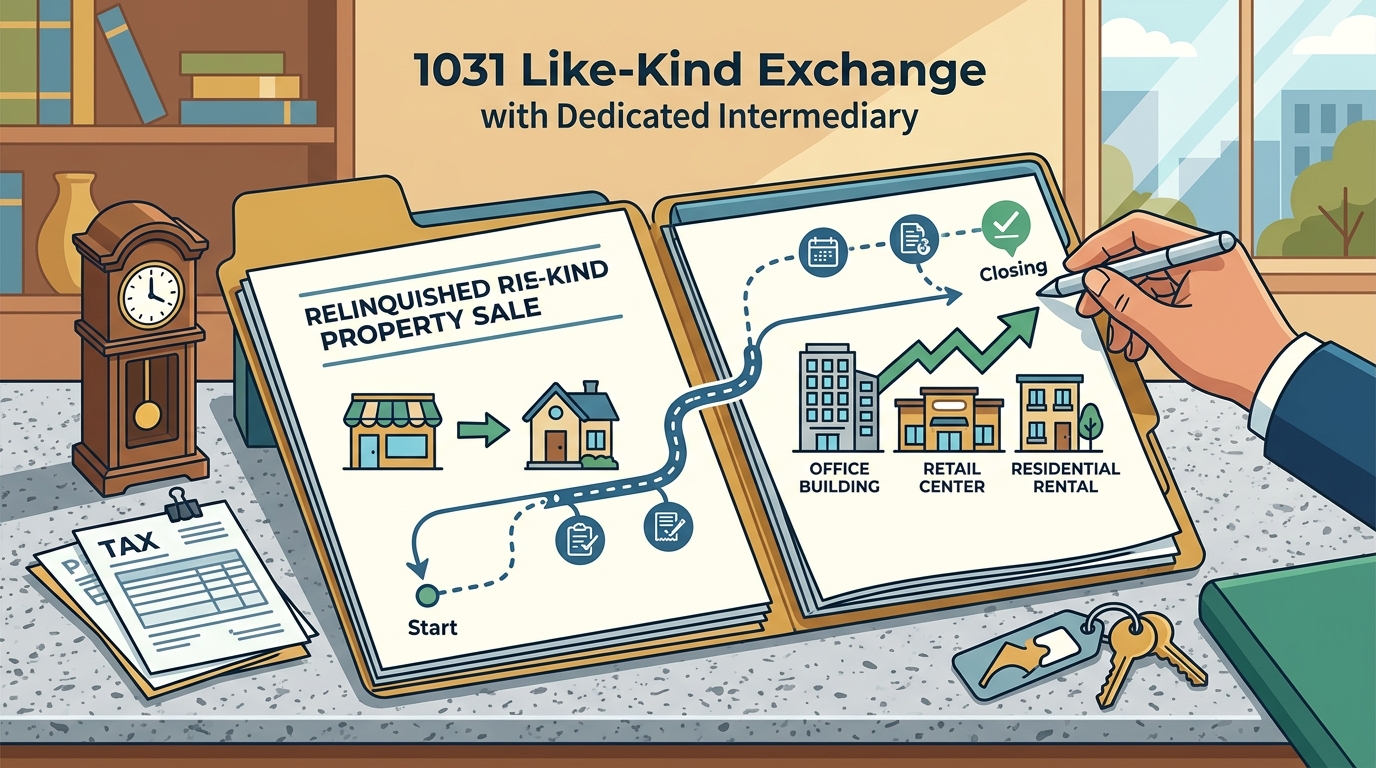
Every Granite client is assigned a CES-certified exchange counselor who manages the transaction from document preparation through final closing. There are no call centers, no ticket queues, and no handoffs between departments. Clients get direct phone and email access to someone who knows their deal inside and out.
Proven Track Record
With 25 years of continuous operation, the firm has guided investors through every market cycle, including the 2008 financial crisis and the COVID-19 pandemic. The team holds the Certified Exchange Specialist (CES) designation from the FEA, the highest professional credential in the 1031 industry.
What to Look for When Choosing a QI
Whether you choose an independent or corporate firm, evaluate these criteria before signing an exchange agreement:
- Experience and track record: How many years in business? How many exchanges completed?
- Fund security: Are funds held in individually segregated, FDIC-insured accounts? Are they bonded and insured?
- Professional credentials: Does the team hold FEA membership and the CES designation?
- Client access model: Will you speak directly with your exchange counselor or go through a support line?
- Independence: Is the QI owned by a title, escrow, or lender company that could create conflicts of interest?
- Transparency: Are fees, timelines, and documentation processes clearly communicated upfront?
The 1031 Crowdfunding resource center notes that QIs are largely unregulated at the federal level, making due diligence on credentials and fund security especially important.
Exchange Types That Benefit Most From Direct Support
All exchanges benefit from attentive service, but complex structures make hands-on guidance critical.
Reverse Exchanges
A reverse exchange allows investors to acquire replacement property before selling the relinquished asset. Structured under Rev. Proc. 2000-37 safe harbor, these transactions involve an Exchange Accommodation Titleholder (EAT) and require precise coordination between multiple closing teams.
Improvement (Construction) Exchanges
An improvement exchange lets investors use exchange proceeds to build on or renovate a replacement property. All construction must be completed and the property transferred within the 180-day exchange period, leaving zero room for miscommunication.
DST Exchanges
A DST exchange involves acquiring fractional interests in a Delaware Statutory Trust. DST interests qualify as like-kind replacement property under Rev. Rul. 2004-86 and are popular with investors seeking passive income or nearing retirement.
Key Takeaways
- A qualified intermediary is required by the IRS in virtually every 1031 exchange to hold funds and ensure compliance.
- Corporate QI firms offer scale but often route clients through call centers and standardized processes.
- Independent QI firms like Granite Exchange Services provide direct counselor access and relationship-driven service.
- Granite Exchange Services has completed over 20,000 exchanges and safeguarded $1 billion+ in funds since 2000.
- The firm is independently owned, with no ties to title, escrow, or lender companies, ensuring full neutrality.
- Complex exchange types such as reverse, improvement, and DST transactions especially benefit from hands-on guidance.
- Always verify a QI's fund security, credentials (CES designation, FEA membership), and client access model before committing.
Frequently Asked Questions
What is a qualified intermediary in a 1031 exchange?
A qualified intermediary is a neutral third party that holds exchange funds, prepares documentation, and ensures IRS compliance throughout a 1031 like-kind exchange. The IRS requires a QI so the taxpayer never takes direct receipt of sale proceeds.
Why does independence matter when choosing a QI?
An independent QI is not owned by a title, escrow, or lender company. This means the firm has no financial incentive to steer your transaction toward affiliated services, keeping their advice objective and focused on your best interest.
How many exchanges has Granite Exchange Services completed?
Granite Exchange Services has processed over 20,000 exchanges since its founding in 2000 and has safeguarded more than $1 billion in client funds in FDIC-insured segregated accounts.
Does Granite Exchange Services operate nationwide?
Yes. While headquartered in Granite Bay, California, Granite Exchange Services handles 1031 exchanges in all 50 states. The company has especially deep expertise in California's complex real estate and tax environment.
What is the CES designation?
The Certified Exchange Specialist (CES) designation is awarded by the Federation of Exchange Accommodators (FEA). It represents the highest professional credential in the 1031 exchange industry and requires demonstrated knowledge of IRC Section 1031 along with ongoing continuing education.
How are my exchange funds protected?
Granite Exchange Services holds all client exchange funds in individually segregated, FDIC-insured bank accounts. Funds are never commingled with operating capital or other client funds and are available for same-day wiring at closing.
What types of 1031 exchanges does Granite handle?
The firm handles every exchange structure, including delayed (forward) exchanges, reverse exchanges, improvement/construction exchanges, DST exchanges, and complex multi-asset transactions.
Can I start a 1031 exchange at the last minute?
Exchange documents must be in place before the relinquished property closes. Contact your QI as early as possible, but an experienced firm like Granite Exchange Services can often accommodate tight timelines when needed.
Start Your Exchange With a Dedicated Counselor
If you want a 1031 exchange experience built on direct access, personal attention, and 25 years of proven expertise, contact Granite Exchange Services today. Call 800-899-6959 or request a consultation online to connect with a CES-certified counselor who will guide your exchange from start to finish.