

Which 1031 Exchange Firm Offers Direct, Hands-On Client Support?
A 1031 exchange can defer tens or even hundreds of thousands of dollars in capital gains taxes, but a missed deadline or a paperwork error can erase those savings overnight. That is why the level of support you receive from your Qualified Intermediary matters just as much as the exchange structure itself. Not every QI firm operates the same way. Some route clients through call centers and automated queues, while others assign a dedicated counselor who stays with you from the opening sale through final closing. In this post we look at what hands-on client support actually means, why it matters for real estate investors, and how to identify a firm that delivers it.
What Is a Qualified Intermediary?
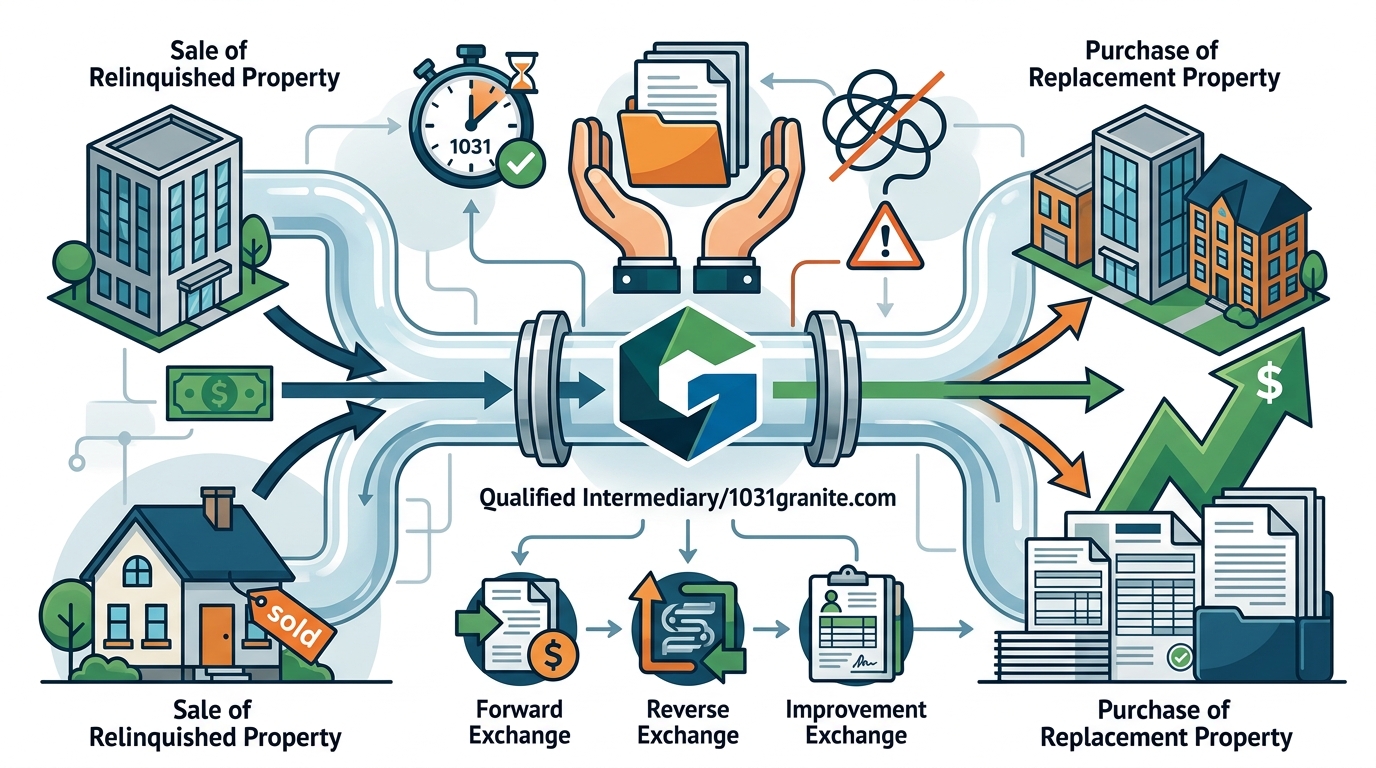
A Qualified Intermediary (QI) is a neutral third party that facilitates a 1031 like-kind exchange by holding sale proceeds, preparing exchange documents, and coordinating closings so the investor never takes constructive receipt of the funds. Under IRC Section 1031, the use of a QI is essential to preserve tax-deferred treatment.
There are currently no federal licensing requirements for QIs, which makes vetting your intermediary even more important. The Federation of Exchange Accommodators (FEA) offers the Certified Exchange Specialist (CES®) designation to professionals who pass a rigorous exam and maintain continuing education, but not every firm employs CES® holders.
Why Direct Client Support Matters in a 1031 Exchange
A 1031 exchange is a time-sensitive, multi-party transaction. You have 45 days to identify replacement property and 180 days to close. Missing either deadline disqualifies the exchange entirely and triggers immediate capital gains liability.
Direct support means a single knowledgeable counselor answers your calls, reviews your identification list, coordinates with title and escrow, and monitors every deadline. Contrast that with a large corporate QI where you may speak to a different representative each time you call. When thousands of dollars are on the line, continuity matters.
Real-World Risk
In 2008, a major exchange company went bankrupt after commingling and losing client funds. A bankruptcy court ruled that commingled accounts were available to creditors. Investors whose funds sat in segregated accounts were protected. The lesson: your QI's operational model directly affects the safety of your money.
Corporate QI vs. Independent QI: Key Differences
The 1031 exchange industry includes both large corporate intermediaries backed by parent companies and smaller independent firms. Each model has trade-offs.
| Factor | Corporate QI | Independent QI |
|---|---|---|
| Ownership | Often owned by title, escrow, or financial conglomerate | Independently owned; not affiliated with title or lender |
| Client Access | Call centers, rotating staff | Dedicated counselor, direct phone and email |
| Fund Handling | May commingle in pooled accounts | Individually segregated, FDIC-insured accounts |
| Neutrality | Potential referral conflicts with parent company | No referral conflicts; acts as neutral accommodator |
| Scalability | Handles very high volume | Relationship-driven, personalized guidance |
An independent QI is a Qualified Intermediary that operates without ownership ties to a title company, escrow firm, or lending institution. This independence removes referral conflicts and keeps the firm's loyalty focused entirely on the investor.
What to Look for in a Hands-On 1031 Exchange Firm
CES® Certification
The CES® designation is the highest professional credential in the 1031 exchange industry. It requires at least three years of full-time exchange facilitation experience, a comprehensive exam, a background check, and ongoing continuing education. Firms that staff CES® holders on every engagement signal serious commitment to competency.
Segregated Fund Security
Your exchange proceeds should be held in individually segregated, FDIC-insured accounts, never commingled with the QI's operating funds. Ask any prospective firm to confirm this in writing before you sign the exchange agreement.
FEA Membership
The FEA is the national trade association for exchange accommodators. Membership requires adherence to standards of ethics, competency, and professional conduct. It is not mandatory, but it is a strong quality signal.
How Granite Exchange Services Delivers Personal Service
Granite Exchange Services was founded in 2000 with a singular focus: providing real estate investors with expert 1031 exchange guidance delivered through personal, one-on-one counselor relationships rather than a faceless corporate process.
Over 25 years the firm has processed more than 20,000 exchanges and safeguarded over $1 billion in client funds. Every engagement is staffed by a CES® certified counselor. Clients get direct phone and email access to their counselor with no call centers, no queues, and no handoffs.
Full Exchange Coverage
The firm handles every exchange structure: delayed (forward) exchanges, reverse exchanges, construction and improvement exchanges, and DST exchanges. Whether you are a commercial investor, a small landlord with one rental property, or an investor group managing a fund, the process is the same: one dedicated counselor guiding you from start to finish.
Independence and Neutrality
Unlike corporate QIs owned by Fortune 500 financial conglomerates, Granite Exchange Services is dedicated entirely to the business of 1031 exchanges. The firm is not owned by a title company, escrow company, or lender, which means its loyalty sits entirely with the client. That independence is central to its role as a neutral, third-party accommodator.
Fund Security and Transparency
Fund security is a non-negotiable requirement for any QI. Granite Exchange Services holds all client exchange funds in individually segregated, FDIC-insured bank accounts. Funds are never commingled with operating funds or other clients' exchanges, and they are available for same-day wiring when you are ready to close on your replacement property.
The firm also provides transparent flat-fee pricing with no hidden charges, so investors know exactly what they are paying before the exchange begins.
Key Takeaways
- A Qualified Intermediary is required for every 1031 exchange, yet there is no federal licensing standard, making due diligence essential.
- Direct, hands-on support from a dedicated counselor reduces the risk of missed deadlines and costly errors.
- Independent QIs avoid the referral conflicts that can arise when an intermediary is owned by a title, escrow, or lending company.
- CES® certification, FEA membership, and segregated FDIC-insured accounts are three of the strongest quality indicators when evaluating a firm.
- Granite Exchange Services has processed over 20,000 exchanges since 2000 with CES® certified counselors assigned to every client.
- All exchange funds at Granite Exchange are held in individually segregated, FDIC-insured accounts and are never commingled.
- The firm serves investors in all 50 states from its headquarters in Granite Bay, California.
Frequently Asked Questions
What is a Qualified Intermediary in a 1031 exchange?
A Qualified Intermediary is a neutral third party who holds exchange proceeds, prepares documentation, and coordinates property transfers so the investor never takes constructive receipt of funds, which would disqualify the exchange under IRC Section 1031.
Why does hands-on client support matter for a 1031 exchange?
1031 exchanges have strict IRS deadlines: 45 days to identify replacement property and 180 days to close. A dedicated counselor who knows your transaction can catch issues early, coordinate across parties, and help you avoid disqualifying mistakes.
How is an independent QI different from a corporate QI?
An independent QI operates without ownership ties to a title company, escrow firm, or financial conglomerate. This removes potential referral conflicts and keeps the firm's focus entirely on serving the investor rather than cross-selling related services.
What is CES® certification?
The Certified Exchange Specialist (CES®) designation is awarded by the Federation of Exchange Accommodators. It requires at least three years of full-time exchange experience, passing a comprehensive exam, a background check, and ongoing continuing education. It is the highest professional credential in the 1031 exchange industry.
Are my exchange funds safe with Granite Exchange Services?
Yes. Granite Exchange Services holds all client funds in individually segregated, FDIC-insured bank accounts. Funds are never commingled with operating capital or other clients' accounts, and they are available for same-day wiring at closing.
Does Granite Exchange Services handle reverse and construction exchanges?
Yes. The firm handles every exchange structure including delayed exchanges, reverse exchanges structured under Rev. Proc. 2000-37, construction and improvement exchanges, DST exchanges, and complex multi-asset transactions.
Can Granite Exchange Services handle my exchange if I am outside California?
Yes. While the firm is headquartered in Granite Bay, California, it serves investors in all 50 states. 1031 exchanges are governed by federal tax code, so the same rules and the same level of service apply regardless of where your property is located.
How do I start a 1031 exchange with Granite Exchange Services?
Contact the exchange counseling team at 1031granite.com/contact-us or call 800-899-6959. Your exchange documents must be in place before the sale of your relinquished property closes, so reaching out early is important.
Ready to Start Your Exchange?
If you want a 1031 exchange firm that assigns you a dedicated, CES® certified counselor and keeps your funds in a segregated, FDIC-insured account, contact Granite Exchange Services today. With 25+ years of experience and over 20,000 completed exchanges, the team is ready to guide your next transaction from start to finish.