

Selling a rental property can trigger a combined federal and state tax bill exceeding 30% of your gain. A 1031 exchange is a provision under IRC Section 1031 that lets real estate investors defer capital gains taxes by reinvesting sale proceeds into another like-kind property. Whether you own a single-family rental or a small apartment building, completing a 1031 exchange keeps your full equity working instead of handing a chunk to the IRS. Below is a step-by-step walkthrough of how the process works, what qualifies, and how to avoid the most common mistakes.
What Is a 1031 Exchange?
A 1031 exchange is a tax-deferred transaction authorized by Section 1031 of the Internal Revenue Code that allows an investor to sell one investment property and acquire another of like kind without recognizing capital gains at the time of sale. The gain is deferred, not eliminated, and carries forward into the replacement property's cost basis.
Federal long-term capital gains rates of 15 to 20%, the 3.8% Net Investment Income Tax, and 25% depreciation recapture can combine to create a tax burden that exceeds 28% of the gain. A properly structured exchange defers all of it, keeping your capital compounding in real estate.
Does Your Rental Property Qualify?
Both the property you sell (relinquished property) and the property you buy (replacement property) must be held for investment or productive use in a trade or business. Rental properties, including single-family rentals, duplexes, apartment buildings, and commercial rentals, are the most common assets exchanged under Section 1031.
What Does Not Qualify
A primary residence, a vacation home used exclusively for personal purposes, fix-and-flip inventory held primarily for resale, and partnership interests are all excluded. As Granite Exchange Services explains, property held for resale immediately after acquisition or completion of improvements does not qualify.
Vacation Rentals: A Special Case
If you rent a vacation property at fair market value for at least 14 days per year and limit personal use to no more than 14 days or 10% of rental days, the property may qualify under the IRS safe harbor established in Revenue Procedure 2008-16. You must meet these thresholds for at least two 12-month qualifying periods before the exchange.
Step-by-Step Process for a Rental Property Exchange
Step 1: Engage a Qualified Intermediary Before Closing
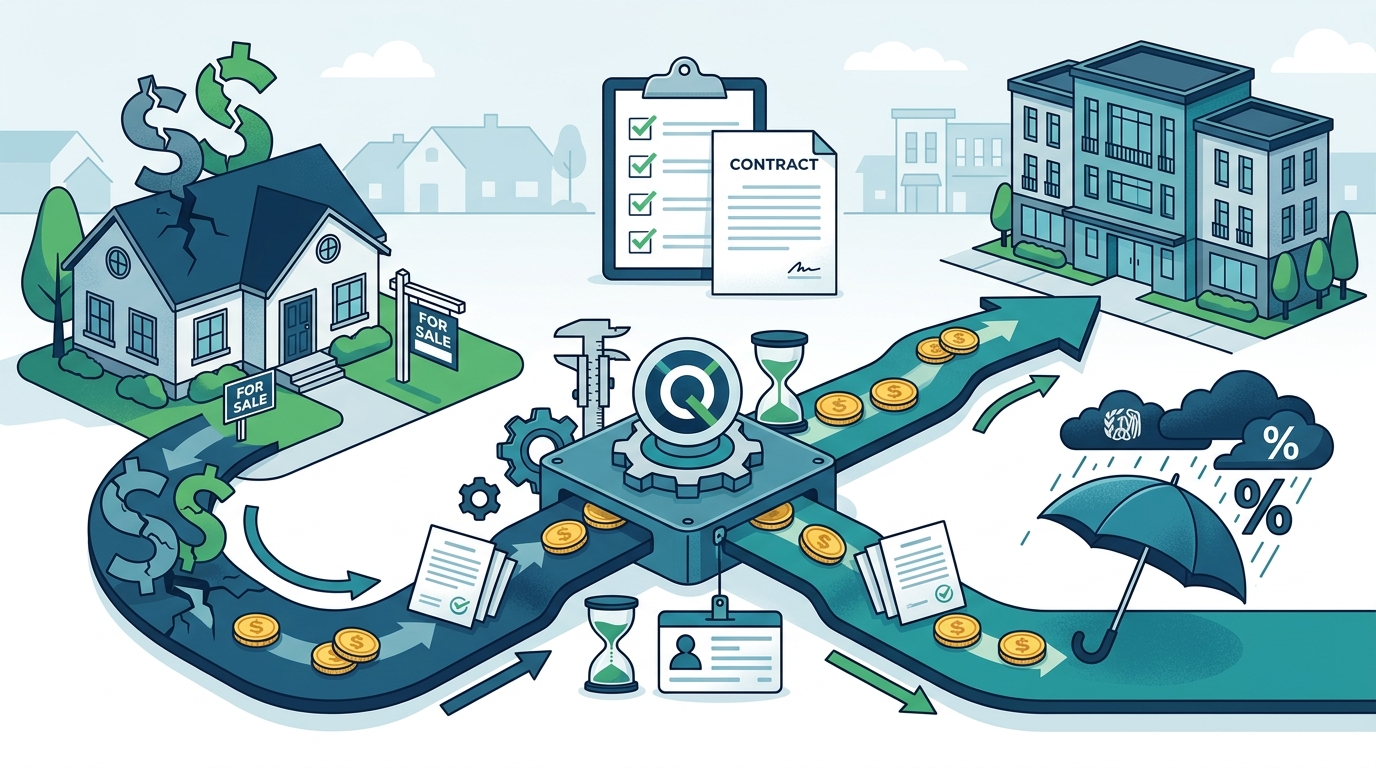
A Qualified Intermediary (QI) is a neutral third party who holds sale proceeds and facilitates the exchange documentation. Your QI must be in place before you close the sale of your rental property. If the funds touch your hands or bank account at any point, the exchange fails. Granite Exchange Services has completed over 20,000 exchanges since 2000 and holds all funds in individually segregated, FDIC-insured accounts.
Step 2: Close on Your Relinquished Property
At closing, the net sale proceeds are wired directly to your QI, not to you. The QI holds the funds in a segregated exchange trust account. This is the moment the 45-day and 180-day clocks begin.
Step 3: Identify Replacement Property Within 45 Days
Within 45 calendar days of closing, you must provide your QI with a written identification of potential replacement properties. The IRS allows three identification rules: the 3-property rule (identify up to three properties of any value), the 200% rule (unlimited properties totaling no more than 200% of the relinquished property's value), or the 95% rule (identify any number but acquire 95% of total value identified). Most rental investors use the 3-property rule.
Step 4: Close on Replacement Property Within 180 Days
You must complete the purchase of at least one identified replacement property within 180 calendar days of the relinquished property closing, or by your federal tax return due date (including extensions), whichever comes first. Your QI wires the exchange funds directly to escrow for the replacement closing.
Step 5: Report on Form 8824
Every completed exchange must be reported to the IRS on Form 8824, filed with your tax return for the year the exchange occurred. Include depreciation schedules if the relinquished property was depreciated.
Critical Deadlines You Cannot Miss
The two IRS deadlines run concurrently and are measured in calendar days, not business days. Missing either deadline disqualifies the entire exchange and triggers immediate capital gains tax liability.
| Deadline | Days After Closing | What Must Happen |
|---|---|---|
| Identification Period | 45 calendar days | Written identification of replacement property received by your QI |
| Exchange Period | 180 calendar days (or tax return due date, whichever is earlier) | Replacement property acquisition must close |
If your relinquished property closes late in the calendar year, you may need to file a tax return extension to preserve the full 180-day window. Deadlines falling on weekends or federal holidays advance to the next business day under IRC Section 7503.
Exchange Structures Compared
Not every rental property sale fits the standard forward exchange. Here are the structures Granite Exchange Services handles for rental investors nationwide.
| Exchange Type | How It Works | Best For |
|---|---|---|
| Delayed (Forward) Exchange | Sell first, then buy replacement within 45/180-day windows | Most rental property sales |
| Reverse Exchange | Acquire replacement before selling relinquished property | Competitive markets where ideal properties move fast |
| Construction (Improvement) Exchange | Use exchange proceeds for construction or improvement on replacement | Investors building or renovating rental property |
| DST Exchange | Exchange into passive fractional ownership in institutional real estate | Investors seeking passive income without landlord duties |
Common Mistakes That Kill an Exchange
Touching the funds. If sale proceeds are deposited into your personal account, even briefly, the IRS treats the transaction as a taxable sale. The QI must receive and hold all proceeds.
Missing the 45-day identification deadline. This is the most frequently blown deadline. Start researching replacement properties before you even list the relinquished property.
Receiving boot. Boot is any non-like-kind value received in the exchange, typically cash taken out or a reduction in mortgage debt. Boot is taxable in the year received. To defer 100% of the gain, reinvest all net proceeds and acquire property of equal or greater value and equal or greater debt.
Choosing a non-independent QI. A QI owned by the title company, escrow company, or lender handling your transaction may create conflicts of interest. An independent QI like Granite Exchange Services exists solely to serve the investor.
Key Takeaways
- A 1031 exchange allows rental property investors to defer federal and state capital gains taxes by reinvesting in like-kind real estate.
- Your Qualified Intermediary must be engaged before the relinquished property closes; retroactive exchanges are not permitted.
- You have 45 calendar days to identify replacement property and 180 calendar days to close the acquisition.
- Rental properties, apartment buildings, commercial real estate, vacant land, and DST interests all qualify as like-kind to each other.
- Section 1031 was preserved fully intact under the 2025 tax law signed July 4, 2025, with no new caps or restrictions.
- Boot (cash or debt reduction) is taxable; reinvest all proceeds and match or exceed the relinquished property's value and debt to defer 100%.
- An independent, dedicated QI protects your interests better than one affiliated with a title or escrow company.
Frequently Asked Questions
Can I do a 1031 exchange on a single-family rental property?
Yes. Any real property held for investment or business use qualifies under IRC Section 1031. A single-family rental home is one of the most commonly exchanged property types.
Do I have to buy the same type of property?
No. "Like-kind" refers to the nature of the property (real estate held for investment), not the property type. You can exchange a rental house for a commercial warehouse, vacant land, an apartment complex, or a DST interest.
What happens if I miss the 45-day identification deadline?
The exchange fails entirely. The QI returns your funds, and the full capital gain becomes taxable in the year of sale. There are no extensions except in limited federally declared disaster situations.
Can I live in the replacement property after the exchange?
Not immediately. The replacement property must be held for investment or business use. Converting it to a personal residence too quickly may cause the IRS to challenge the exchange. Most tax advisors recommend holding the property as a rental for at least one to two years before any conversion.
Was the 1031 exchange eliminated in 2025?
No. The "One Big Beautiful Bill" signed on July 4, 2025 left Section 1031 fully intact. Despite congressional proposals to cap exchanges at $500,000, like-kind exchange rules were preserved without restriction.
How much does a Qualified Intermediary cost?
QI fees vary but typically range from $750 to $1,500 for a standard delayed exchange. Reverse and construction exchanges involve more complexity and higher fees. Contact Granite Exchange Services for a quote specific to your transaction.
Do I need to use a QI in the same state as my property?
No. Because 1031 exchanges are governed by federal tax code, your QI can be located anywhere in the United States. Granite Exchange Services is headquartered in Granite Bay, California and serves investors in all 50 states.
What is boot in a 1031 exchange?
Boot is any non-like-kind property or cash received during the exchange. Common examples include cash pulled out of the transaction and net debt reduction when the replacement property has a smaller mortgage. Boot is taxable in the year it is received.
Start Your Exchange Today
Your Qualified Intermediary must be in place before closing. If you are planning to sell a rental property, call Granite Exchange Services at 800-899-6959 or submit an inquiry online to speak directly with a CES-certified exchange specialist. No call centers, no runarounds. Just 25 years of hands-on expertise guiding your exchange from first call to final closing.