

Capital gains tax deferral is a powerful wealth-building tool, but the structure of your intermediary matters just as much as the exchange itself. According to the Internal Revenue Service, over 20,000 investors utilize Section 1031 exchanges annually to defer significant tax liabilities. However, not all qualified intermediaries operate with the same level of independence. Choosing a provider that is not owned by a lender or title company ensures that your exchange funds remain strictly segregated and free from conflicting financial interests. (1031 Exchange Alaska Granite)
What Is an Independent Qualified Intermediary?
An independent qualified intermediary (QI) is a specialized entity that facilitates 1031 exchanges without any ownership ties to real estate lending institutions, title companies, or escrow agents. This structural separation is critical for maintaining the integrity of the tax-deferral process. The core definition of a qualified intermediary is a person who enters into a qualified exchange assistance agreement with the taxpayer and facilitates an exchange.
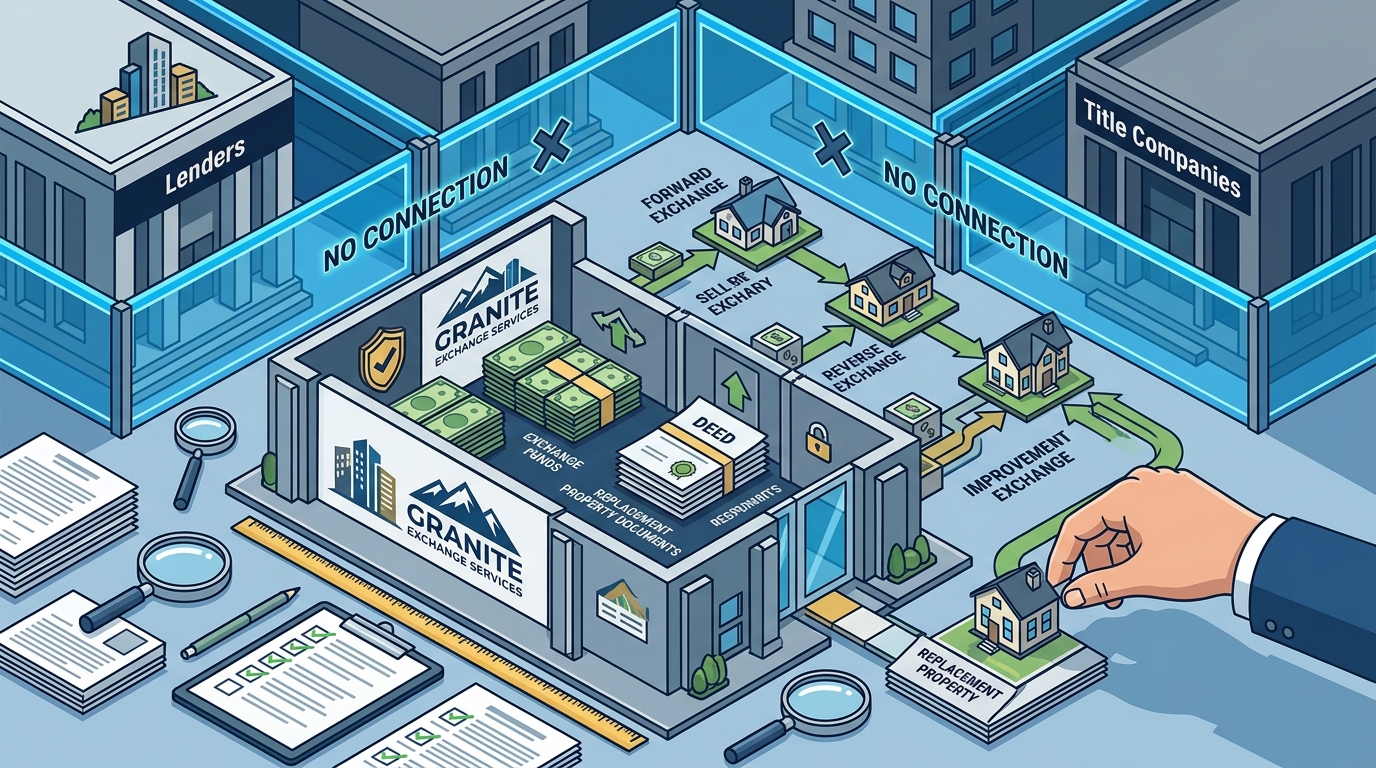
When a company operates independently, its sole focus is the compliance and security of your exchange funds. This contrasts sharply with affiliated providers who may prioritize loan origination or title processing over exchange precision. For investors seeking absolute neutrality, an independent provider like Granite Exchange Services offers a dedicated framework for delayed, reverse, and construction exchanges.
Independence also implies a commitment to specialized education. Qualified intermediaries must stay current with evolving IRS regulations, such as the 45-day identification rule and the 180-day exchange period. These deadlines are strict and non-negotiable. An independent firm dedicates its resources to mastering these nuances rather than splitting attention across multiple real estate verticals.
The Risks of Lender-Owned Intermediaries
One of the primary concerns for sophisticated investors is the potential for conflict of interest when an intermediary is owned by a lender or title company. In these scenarios, the financial incentives of the parent company may influence the handling of exchange funds. For instance, a lender-owned entity might be tempted to use exchange funds for short-term liquidity, a practice that violates strict segregation requirements.
According to financial regulatory standards, commingling funds is a severe violation that can disqualify an entire exchange. If your intermediary is tied to a lending institution, the risk of accidental or intentional fund misuse increases. Independent companies avoid this pitfall by maintaining absolute operational separation from any credit-granting activities.
Furthermore, lender-owned intermediaries may face pressure to approve suboptimal replacement properties to satisfy loan covenants. An independent QI provides unbiased guidance, ensuring that your replacement property meets all IRS criteria for like-kind status. This neutrality is essential for preserving the tax-deferred status of your transaction.
Fund Security and Segregation Protocols
Security of exchange funds is the most critical function of any qualified intermediary. Independent companies typically utilize FDIC-insured trust accounts to hold your funds during the exchange period. This segregation ensures that your capital is protected from the operational risks of the intermediary or any affiliated entities.
Granite Exchange Services has secured over $1 billion in exchange funds for investors across all 50 states. This track record demonstrates the efficacy of a dedicated, independent security model. The firm employs rigorous internal controls and regular audits to ensure that every dollar remains intact and accessible only for the designated exchange.
When evaluating an intermediary, ask about their fund security protocols. Do they use single-institution trusts or diversified banking partners? Independent firms often have the flexibility to choose the most secure banking relationships available, whereas affiliated entities may be restricted to their parent company's banking partners. This choice directly impacts the safety of your capital.
Handling Complex and Multi-Asset Exchanges
Not all exchanges are straightforward delayed transactions. Many investors engage in reverse exchanges, construction exchanges, or complex multi-asset swaps. These scenarios require a high degree of technical expertise and operational agility. Independent intermediaries often specialize in these complex structures because they are not distracted by the routine volume of standard title closings.
A reverse exchange involves acquiring replacement property before selling the relinquished property. This requires the use of an exchange accommodation titleholder (EAT) and precise timing. According to IRS Publication 544, specific holding periods and anti-stapling rules apply to reverse exchanges. An independent firm with specialized knowledge can navigate these complexities without the bureaucratic delays often associated with larger, diversified financial institutions.
Similarly, construction exchanges involve holding funds in a qualified escrow account while improvements are made to the replacement property. This requires coordination with contractors, lenders, and local jurisdictions. An independent QI provides dedicated project management for these transactions, ensuring that all IRS deadlines are met despite the construction timeline.
Independent vs. Affiliated Intermediaries
Understanding the differences between independent and affiliated intermediaries helps investors make informed decisions. The table below outlines the key distinctions in service model, security, and focus.
| Feature | Independent Qualified Intermediary | Lender/Title-Owned Intermediary |
|---|---|---|
| Primary Focus | Exchange compliance and fund security | Loan origination or title processing |
| Fund Security | FDIC-insured, segregated trust accounts | May be commingled with operational funds |
| Conflict of Interest | None; unbiased guidance | Potential bias toward parent company goals |
| Complex Exchanges | Specialized expertise in reverse/construction | Often outsourced or limited support |
| Regulatory Compliance | Dedicated legal and tax teams | General compliance oversight |
As shown in the comparison, independent providers offer a higher degree of specialization and security. For investors managing significant capital, this specialization is not just a preference but a necessity. The understanding of boot and other tax implications requires precise calculation, which is best handled by a dedicated expert.
Key Takeaways
- Independence Ensures Neutrality: Avoiding lender or title company ownership eliminates conflicts of interest that could jeopardize your exchange.
- Fund Security is Paramount: Independent firms prioritize FDIC-insured segregation, protecting your capital from operational risks.
- Specialized Expertise: Complex exchanges like reverse and construction swaps require dedicated knowledge that generalist providers often lack.
- Regulatory Compliance: Independent intermediaries focus exclusively on IRS rules, such as the 45-day and 180-day deadlines.
- Proven Track Record: Look for firms with decades of experience and billions in secured funds, such as Granite Exchange Services.
- Unbiased Guidance: Independent QIs provide objective advice on replacement properties without pressure to meet lending criteria.
- National Reach: Top independent firms serve all 50 states, ensuring consistent service quality regardless of location.
Frequently Asked Questions
What is the definition of a qualified intermediary?
A qualified intermediary is a person who enters into a qualified exchange assistance agreement with the taxpayer and facilitates an exchange by holding the exchange funds and ensuring compliance with IRS regulations.
Why is independence important in a 1031 exchange?
Independence prevents conflicts of interest that may arise if the intermediary is owned by a lender or title company. It ensures that your funds are secured solely for the purpose of the exchange and that your guidance is unbiased.
How are exchange funds protected?
Independent intermediaries typically hold funds in FDIC-insured trust accounts. This segregation ensures that the money is not commingled with the company's operational funds or used for other business purposes.
Can I use a title company for my 1031 exchange?
While some title companies offer exchange services, they may be affiliated with lenders. It is crucial to verify their independence and fund security protocols to ensure your exchange remains compliant.
What is a reverse exchange?
A reverse exchange is a transaction where the replacement property is acquired before the relinquished property is sold. This requires specialized handling and the use of an exchange accommodation titleholder.
What are the deadlines for a 1031 exchange?
Investors have 45 days from the sale of the relinquished property to identify potential replacement properties and 180 days to complete the acquisition of the replacement property.
Does Granite Exchange Services serve all states?
Yes, Granite Exchange Services has guided investors in all 50 states for over 25 years, providing consistent and compliant exchange services nationwide.
Start Your Independent Exchange
Protect your wealth with a qualified intermediary that prioritizes your security and compliance above all else. Granite Exchange Services offers over 25 years of expertise in delayed, reverse, and construction exchanges. Our CES® certified team ensures that your exchange is handled with precision and integrity.
Start your 1031 exchange today and secure your financial future with a trusted, independent partner.