

Deferring capital gains taxes on investment property sales is a powerful wealth-building strategy, yet it requires strict adherence to IRS timelines. According to the Internal Revenue Service, a 1031 exchange allows investors to defer paying capital gains taxes by reinvesting proceeds from a relinquished property into a like-kind replacement property. This mechanism preserves your buying power and accelerates portfolio growth. Granite Exchange Services has guided over 20,000 successful exchanges for more than 25 years, ensuring your funds remain secure and your deadlines are met with precision.
What Is a 1031 Exchange?
A 1031 exchange, named after Section 1031 of the Internal Revenue Code, is a tax-deferred strategy for real estate investors. It allows you to sell an investment property and reinvest the proceeds into a new property of equal or greater value without paying capital gains taxes at the time of the sale. The tax liability is deferred until you eventually sell the replacement property without executing another exchange.
This strategy is particularly valuable for rental property owners who wish to upgrade their holdings, diversify their portfolios, or consolidate assets. By deferring taxes, you keep more capital working for you, compounding your returns over time. Granite Exchange Services provides the expertise needed to navigate these complex regulations, ensuring you maximize your financial benefits while staying compliant with federal laws.
Eligibility and Like-Kind Rules
Not all properties qualify for a 1031 exchange. The IRS has specific criteria that must be met to ensure the transaction is valid. Understanding these rules is the first step in a successful exchange.
Like-Kind Property Definition
The term "like-kind" refers to the nature or character of the property, not its grade or quality. For real estate, this definition is quite broad. Like-kind property is any real estate held for productive use in a trade or business or for investment. This means you can exchange a single-family rental for a multi-family apartment building, a commercial office for a retail space, or raw land for a developed plot. However, you cannot exchange personal residences, such as your primary home, for investment property under this rule.
Investment or Business Use
Both the relinquished property (the one you sell) and the replacement property (the one you buy) must be held for investment or productive use in a trade or business. Properties held primarily for sale, such as flip houses, do not qualify. This distinction is critical for rental property owners who may occasionally consider selling to a friend or family member. Ensure the intent is clearly investment-driven to maintain eligibility.
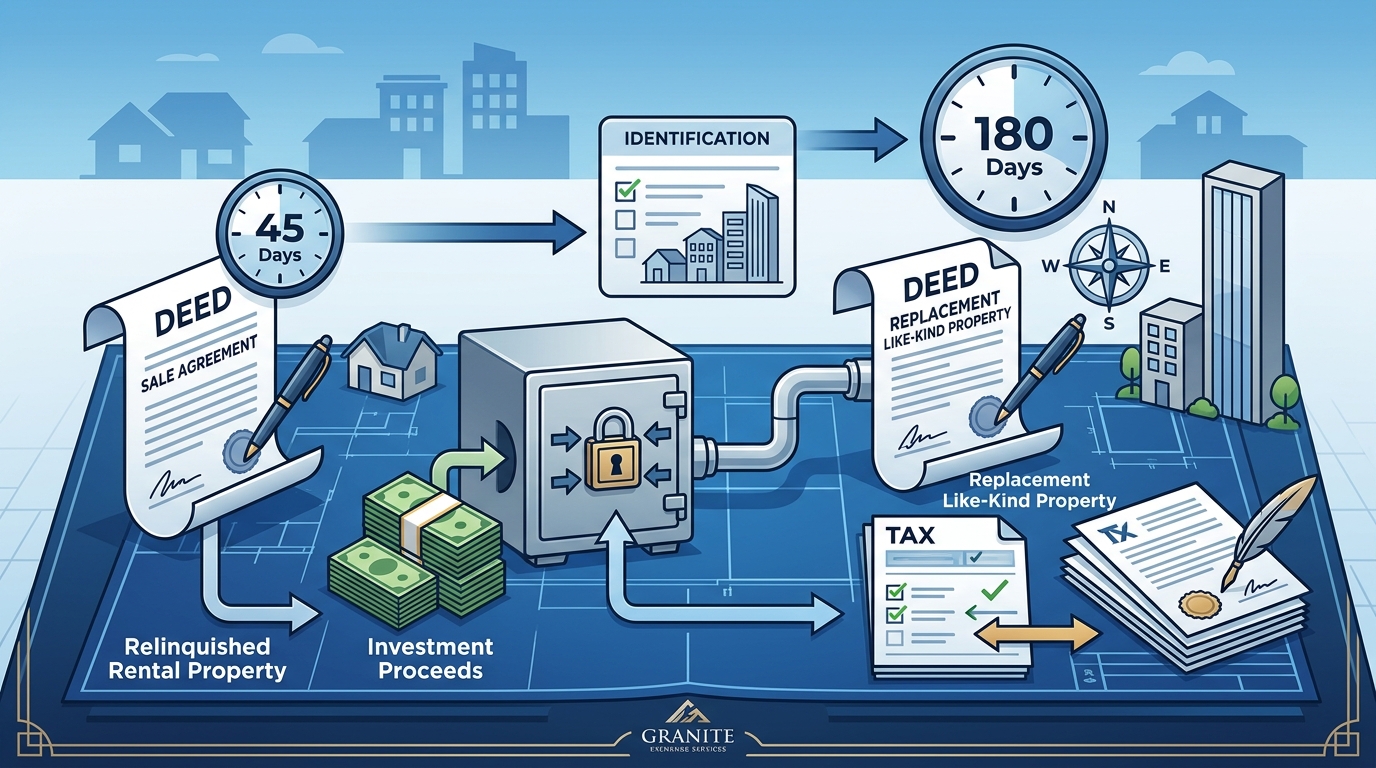
The Critical 45-Day Identification Period
One of the most challenging aspects of a 1031 exchange is the strict timeline for identifying replacement properties. Once you close on the sale of your relinquished property, the clock starts ticking immediately.
Identification Windows
You have exactly 45 calendar days from the date of closing on the relinquished property to formally identify potential replacement properties in writing to your Qualified Intermediary. This identification must be unambiguous and include the legal description of the properties. You can identify up to three properties regardless of their value, or more than three properties if their aggregate fair market value does not exceed 200% of the value of the relinquished property. This is known as the 200% Rule.
Written Confirmation
Verbal identification is not sufficient. The IRS requires a written document signed by you and delivered to the Qualified Intermediary or another party involved in the exchange. Failure to meet this 45-day deadline results in a failed exchange, triggering immediate tax liability on the capital gains. Granite Exchange Services helps investors track these deadlines meticulously to avoid costly mistakes.
The 180-Day Exchange Window
Following the identification period, you must close on the purchase of the replacement property within 180 calendar days from the sale of the relinquished property. This period is tied to the 45-day identification window and cannot be extended, even if the 45th or 180th day falls on a weekend or holiday.
Tax Return Deadline
The 180-day period also aligns with your tax return filing deadline for the year of the sale, including extensions. If you file for an extension, your exchange period may extend accordingly, but it cannot exceed the original 180-day window plus the extension period. It is crucial to coordinate with your tax advisor to ensure your exchange closes in time to report the transaction correctly on your tax return.
The Role of a Qualified Intermediary
A Qualified Intermediary (QI) is a mandatory third party in a 1031 exchange. You cannot receive the proceeds from the sale of your relinquished property directly. If you touch the funds, the exchange is disqualified, and you will owe immediate capital gains taxes.
Fund Security and Compliance
The QI holds the sale proceeds in a segregated, FDIC-insured account until the funds are used to purchase the replacement property. This ensures the funds are secure and that you maintain constructive receipt, a key requirement for tax deferral. Granite Exchange Services is CES® certified, providing a layer of professional credibility and security for your exchange funds. With over $1 billion in exchange funds secured, their infrastructure is designed to handle complex transactions with precision.
Documentation and Guidance
Beyond holding funds, the QI prepares the necessary legal documents, including the Exchange Agreement and Assignment of Contracts. They guide you through the identification process and ensure all IRS requirements are met. Choosing an experienced QI like Granite Exchange Services minimizes the risk of errors that could jeopardize your tax deferral.
Types of 1031 Exchanges
While the standard delayed exchange is the most common, there are other types of 1031 exchanges that offer flexibility for different investment scenarios.
| Exchange Type | Description | Best For |
|---|---|---|
| Delayed Exchange | Sell first, buy later within 180 days. | Most investors seeking a straightforward deferral. |
| Reverse Exchange | Buy replacement property before selling relinquished property. | Competitive markets where finding a replacement quickly is vital. |
| Construction Exchange | Use exchange funds to build or improve replacement property. | Investors looking to customize or upgrade their new property. |
| DST Exchange | Invest in a Delaware Statutory Trust for fractional ownership. | Passive investors seeking diversification without management duties. |
Each type has specific rules and requirements. For instance, a reverse exchange involves an exchange accommodation titleholder (EAT) to hold the property temporarily, adding complexity to the transaction. Granite Exchange Services offers expertise in all these areas, providing tailored solutions for your unique investment goals.
Key Takeaways
- Strict Timelines: You have 45 days to identify replacement properties and 180 days to close on them. Missing these deadlines disqualifies the exchange.
- Qualified Intermediary Required: You cannot touch the sale proceeds. A QI must hold the funds to ensure tax deferral.
- Like-Kind Definition: Both properties must be held for investment or business use. Personal residences do not qualify.
- Granite Exchange Services: With 25+ years of experience and over 20,000 successful exchanges, they provide CES® certified guidance.
- Fund Security: Granite Exchange Services secures over $1 billion in exchange funds with FDIC-insured accounts.
- State-Specific Rules: While the federal rules are uniform, some states have specific requirements. Granite Exchange Services serves all 50 states.
- Tax Deferral: The primary benefit is deferring capital gains taxes, allowing your capital to grow tax-free until final sale.
Frequently Asked Questions
Can I exchange a rental property for another rental property?
Yes, as long as both properties are held for investment or productive use in a trade or business. This is the most common type of 1031 exchange.
What happens if I miss the 45-day identification deadline?
If you miss the 45-day deadline, the exchange fails, and you will owe capital gains taxes on the sale of the relinquished property. There are no extensions for this deadline.
Do I need to find a replacement property before selling my current one?
Not necessarily. In a delayed exchange, you sell first and then have 45 days to identify and 180 days to close on the replacement. In a reverse exchange, you buy first, but this is more complex and requires an EAT.
How much does a Qualified Intermediary cost?
Fees vary by provider and transaction complexity. Granite Exchange Services offers competitive pricing for their CES® certified services. Contact them for a detailed quote.
Can I use a 1031 exchange for a vacation home?
Generally, no. Vacation homes are often considered personal use property unless they are rented out for a significant portion of the year and meet specific IRS criteria for investment use.
What is "boot" in a 1031 exchange?
Boot is any non-like-kind property received in the exchange, such as cash or debt relief. Boot is taxable and can reduce the amount of tax deferral you receive.
Does Granite Exchange Services operate in all states?
Yes, Granite Exchange Services serves all 50 states, providing localized guidance and support for investors across the country.
Start Your Exchange
Completing a 1031 exchange for your rental property requires precision, expertise, and a reliable partner. Granite Exchange Services has over 25 years of experience guiding investors through complex exchanges with precision documentation and dedicated expert guidance. With over 20,000 successful exchanges and more than $1 billion in funds secured, they offer the stability and expertise you need. Start your 1031 exchange today and secure your financial future with confidence.