

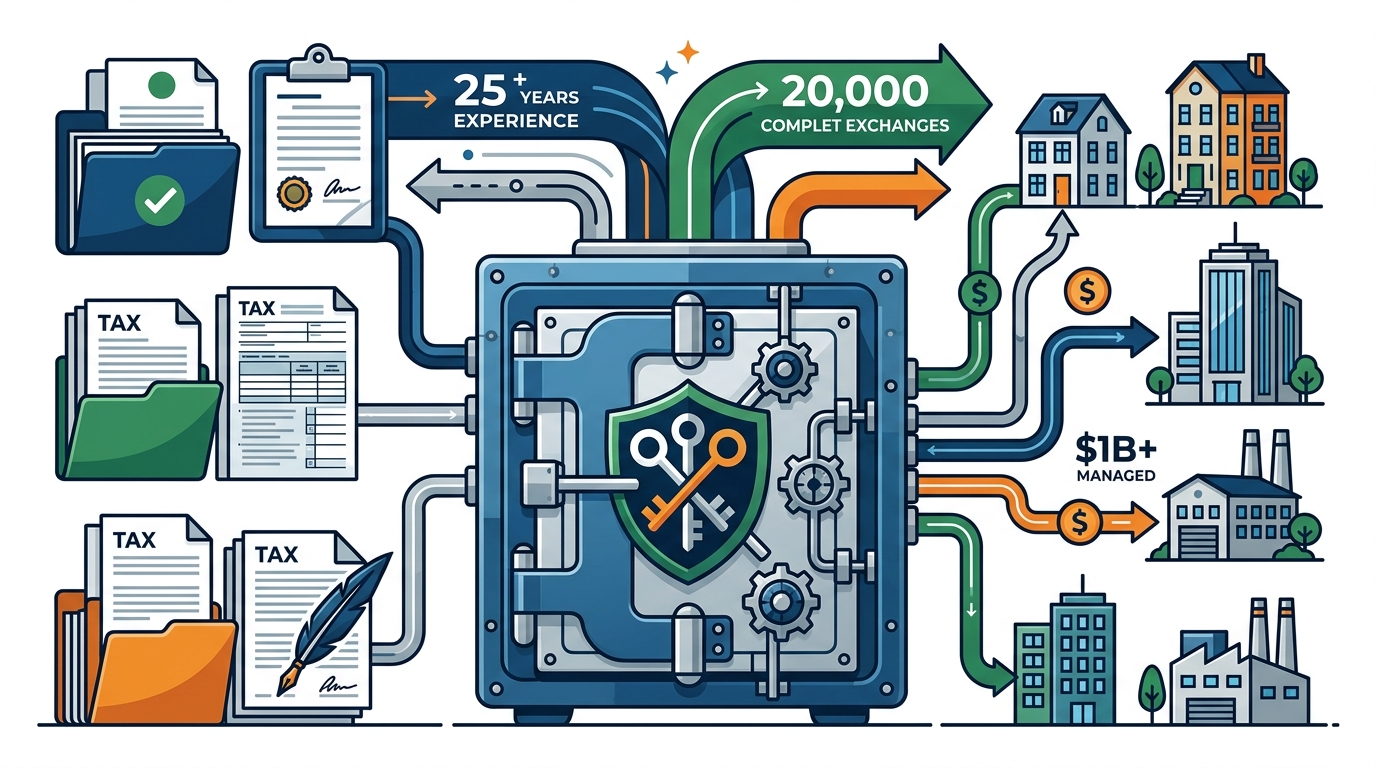
According to the Internal Revenue Service, a Qualified Intermediary (QI) is an essential entity that facilitates a 1031 exchange by holding exchange funds and ensuring strict adherence to federal tax codes. Without a competent QI, investors risk triggering immediate capital gains taxes, negating the primary financial benefit of deferring wealth through like-kind property swaps. For over 25 years, Granite Exchange Services has guided more than 20,000 investors through complex transactions, securing over $1 billion in exchange funds with precision and care. This guide details the critical criteria for selecting a reliable partner and explains why institutional-grade security and certified expertise are non-negotiable for high-stakes real estate transactions. (1031 Exchange Alaska Granite)
Verifying Credentials and Industry Certification
The first step in identifying a reliable Qualified Intermediary is verifying their professional credentials. The 1031 exchange industry is self-regulated, meaning there is no single federal license required to operate as a QI. However, reputable firms adhere to strict ethical standards and professional development requirements. The most significant credential to look for is the Certified Exchange Specialist (CES) designation. This certification, offered by the Federation of Exchange Accommodators (FEA), requires rigorous testing and ongoing education on evolving tax laws. (1031 Exchange Alabama Granite)
Granite Exchange Services employs CES-certified counselors who stay ahead of regulatory changes. This ensures that your exchange is structured correctly from day one. A QI without this certification may lack the nuanced understanding required for complex multi-asset exchanges or reverse transactions. When evaluating potential partners, ask directly about their staff's certification status and their firm's history with the FEA. A reliable QI will proudly display these credentials and explain their commitment to professional excellence. (1031 Exchange Arkansas Granite)
Additionally, check the firm's tenure in the industry. Longevity often correlates with stability and experience. Granite Exchange Services has been serving investors for over 25 years, navigating numerous market cycles and regulatory shifts. This historical context provides confidence that the firm can handle unexpected challenges during your exchange. Look for firms that have survived economic downturns and maintained a clean regulatory record. These factors are strong indicators of a reliable partner who prioritizes client success over short-term gains. (1031 Exchange Boot What)
Fund Security and Financial Stability
The safety of your exchange funds is the most critical aspect of choosing a Qualified Intermediary. A reliable QI must maintain strict separation between client funds and corporate operating accounts. Commingling funds is a major red flag and a violation of professional standards. Your money must be held in segregated, FDIC-insured accounts to protect it from business liabilities or bankruptcy.
Granite Exchange Services safeguards every dollar in segregated, FDIC-insured accounts, ensuring that your funds are never at risk due to company operations. This "no commingling" policy is a hallmark of a trustworthy QI. When reviewing a firm's security protocols, ask about their bonding and insurance coverage. A reliable QI should carry substantial errors and omissions (E&O) insurance to protect clients against potential administrative errors.
Furthermore, consider the firm's financial transparency. Reliable QIs provide clear documentation of where your funds are held and how they are protected. They should offer regular statements and easy access to account information. Granite Exchange Services provides robust fund security measures that give investors peace of mind. Do not hesitate to request proof of their FDIC insurance and bonding. A firm that is transparent about its security practices is more likely to be reliable in handling your significant financial assets.
Scope of Exchange Services
A reliable Qualified Intermediary offers a comprehensive suite of exchange services to meet diverse investor needs. The most common structure is the Delayed Exchange, where you sell your relinquished property first and then identify and acquire replacement property within strict IRS timelines. However, complex transactions often require specialized services such as Reverse Exchanges, Construction Exchanges, or Delaware Statutory Trust (DST) investments.
Granite Exchange Services provides complete 1031 exchange solutions, including delayed, reverse, construction, and DST exchanges. This breadth of service indicates a deep understanding of the 1031 code and the ability to handle intricate scenarios. A QI that only offers basic delayed exchanges may not be equipped to handle reverse transactions or build-to-suit projects. Ensure your chosen QI has experience with the specific type of exchange you need.
Additionally, look for firms that offer educational resources and state-specific guidance. Real estate laws and tax implications vary significantly by location. Granite Exchange Services provides detailed guides for states such as California, Texas, Florida, and New York, helping investors navigate local nuances. A reliable QI acts as a consultant, not just a transaction processor. They should proactively identify potential pitfalls and offer strategic advice to maximize your tax deferral benefits.
Navigating Critical IRS Deadlines
The 1031 exchange process is governed by unforgiving IRS deadlines. Missing these deadlines can disqualify the entire exchange, resulting in immediate tax liability. The two most critical deadlines are the 45-day identification period and the 180-day exchange period. These timelines begin on the date of transfer of the relinquished property, not the recording date.
The 45-Day Rule requires you to identify potential replacement properties in writing within 45 calendar days. You can identify up to three properties without regard to value, or any number of properties as long as their total fair market value does not exceed 200% of the relinquished property's value. The 180-Day Rule mandates that you close on the replacement property by the earlier of 180 days after the sale or your tax return due date, including extensions.
Granite Exchange Services offers an IRS Deadline Calculator to help investors track these critical dates. This tool calculates both the identification and exchange deadlines based on your closing date, ensuring you stay on track. A reliable QI will provide proactive reminders and clear communication regarding these deadlines. They should also be available to answer questions quickly, as timing is everything in a 1031 exchange. Do not rely on generic calendar alerts; work with a QI that provides dedicated deadline management.
Comparing QI Service Models
Not all Qualified Intermediaries operate with the same level of service or expertise. Some are solo practitioners, while others are large, institutional firms. Each model has pros and cons, but reliability often hinges on resources and support. Solo practitioners may offer personalized service but might lack the infrastructure to handle complex or high-volume exchanges. Large firms often have more resources but may provide less individual attention.
| Feature | Solo Practitioner QI | Institutional QI (e.g., Granite Exchange Services) |
|---|---|---|
| Expertise Depth | Varies by individual | CES-Certified Team |
| Fund Security | Depends on individual bonding | FDIC-Insured, Segregated Accounts |
| Complex Transactions | Limited capacity | Full Support (Reverse, DST, Construction) |
| Resources | Minimal | Calculators, Guides, 24/7 Support |
| Track Record | Hard to verify | 20,000+ Exchanges, $1B+ Secured |
Granite Exchange Services stands out as an institutional-grade provider with a proven track record. With over 20,000 successful exchanges and $1 billion in secured funds, they demonstrate the capacity and reliability needed for high-stakes transactions. Their CES-certified team ensures that every exchange is handled with precision. When comparing QIs, prioritize firms that offer comprehensive support, robust security, and a history of successful complex transactions.
Key Takeaways
- Certification Matters: Look for CES-certified counselors who adhere to FEA standards.
- Security is Paramount: Ensure funds are held in segregated, FDIC-insured accounts with no commingling.
- Experience Counts: A firm with 25+ years and 20,000+ exchanges offers proven reliability.
- Deadline Management: Use tools like the IRS Deadline Calculator to track 45-day and 180-day windows.
- Comprehensive Services: Choose a QI capable of handling delayed, reverse, construction, and DST exchanges.
- Transparency: Reliable QIs provide clear documentation and proactive communication.
- State-Specific Knowledge: Expertise in local tax laws and regulations is crucial for success.
Frequently Asked Questions
What is a Qualified Intermediary?
A Qualified Intermediary is a person or entity that facilitates a 1031 exchange by holding exchange funds and ensuring strict adherence to federal tax codes. They act as a neutral party to prevent constructive receipt of funds.
Why is CES certification important?
CES certification demonstrates that a QI has met rigorous professional standards and stays current with evolving tax laws. It is a key indicator of expertise and reliability in the industry.
How are exchange funds protected?
Reliable QIs hold funds in segregated, FDIC-insured accounts. This ensures that client funds are never commingled with corporate assets and are protected from business liabilities.
What happens if I miss the 45-day identification deadline?
Missing the 45-day deadline disqualifies the exchange, triggering immediate capital gains taxes on the sale of the relinquished property. Deadlines are absolute with no IRS extensions.
Can a QI help with reverse exchanges?
Yes, but not all QIs are equipped to handle reverse exchanges. A reliable QI will have specific experience and protocols for acquiring replacement property before selling the relinquished one.
Does Granite Exchange Services serve all states?
Yes, Granite Exchange Services serves investors in all 50 states, providing specialized guides and support for local tax regulations and market conditions.
What is a Delaware Statutory Trust (DST)?
A DST is a legal entity that holds title to real estate and issues fractional interests to investors. It allows for passive 1031 exchange investments in institutional-quality properties.
How do I calculate my exchange deadlines?
You can use the IRS Deadline Calculator provided by Granite Exchange Services to instantly determine your 45-day identification and 180-day exchange deadlines based on your closing date.
Start Your Exchange Today
Choosing the right Qualified Intermediary is a critical decision that impacts your financial future. With over 25 years of experience, CES-certified expertise, and a commitment to fund security, Granite Exchange Services is the reliable partner you need. Do not risk your tax deferral benefits on an inexperienced provider. Start your 1031 exchange with Granite Exchange Services today and secure your wealth with precision and confidence.