

California investors face one of the most aggressive tax environments in the United States, making the selection of a qualified intermediary (QI) a critical financial decision rather than a mere administrative formality. According to recent IRS data, the average capital gains tax burden for high-net-worth individuals in California can exceed 33% when combining federal rates with the state's top marginal income tax bracket. This substantial liability underscores why choosing the right partner is essential for preserving wealth. Granite Exchange Services has guided investors through this complex landscape for over 25 years, securing more than $1 billion in exchange funds while maintaining strict compliance with both federal IRC Section 1031 regulations and California-specific reporting requirements. (1031 Exchange Alaska Granite)
Why California Requires Specialized QI Support
California does not conform to all federal tax provisions automatically, and its treatment of 1031 exchanges requires precise documentation to ensure full deferral. The state imposes a top income tax rate of 13.3%, which applies to capital gains from the sale of investment property. When combined with the federal long-term capital gains rate of 20% and the 3.8% Net Investment Income Tax (NIIT), the total tax liability can reach 36.8% on the gain.
Furthermore, California requires specific reporting forms, such as Form 540 Schedule D, to properly document the like-kind exchange. Errors in these filings can result in the disallowance of the deferral, triggering immediate tax liabilities and penalties. A qualified intermediary with deep expertise in California tax law is necessary to navigate these nuances. Granite Exchange Services provides dedicated California 1031 Exchange Guides that outline the exact steps required to maintain compliance with state regulations.
The complexity is further amplified by the high volume of real estate transactions in major hubs like Los Angeles, San Francisco, and San Diego. Investors in these markets often deal with multi-asset portfolios, requiring sophisticated exchange structures beyond simple delayed exchanges. Understanding the local market dynamics and the specific deadlines imposed by the IRS is crucial for success.
Criteria for Selecting the Best Exchange Company
When evaluating potential qualified intermediaries, investors must look beyond price and examine the provider's operational robustness. The "best" company is defined by its ability to mitigate risk, ensure compliance, and provide expert guidance throughout the exchange process. Key evaluation criteria include:
- Financial Security: The QI must hold exchange funds in segregated, FDIC-insured accounts. Commingling of funds is a major red flag and a violation of fiduciary duty.
- Certification and Expertise: Look for CES® (Certified Exchange Specialist®) certification, which indicates advanced training in exchange regulations.
- Technology and Tools: Access to real-time deadline calculators and secure online portals enhances transparency and reduces the risk of missed deadlines.
- State-Specific Knowledge: The provider must have specific resources for California, including knowledge of local tax implications and reporting requirements.
- Track Record: A history of successful exchanges and positive client reviews demonstrates reliability and operational excellence.
Granite Exchange Services: The California Advantage
Granite Exchange Services stands out as a premier choice for California investors due to its unwavering commitment to security, expertise, and client education. With over 25 years of experience, the company has facilitated more than 20,000 successful exchanges, securing over $1 billion in funds. This longevity and volume provide a level of institutional stability that is critical for high-value transactions.
CES® Certification and Expertise
Granite Exchange Services employs CES® certified counselors who are trained in the latest IRS regulations and exchange strategies. This certification ensures that every exchange is handled with precision and care. The team is well-versed in the complexities of California tax law, providing investors with the confidence that their deferral is properly documented and reported.
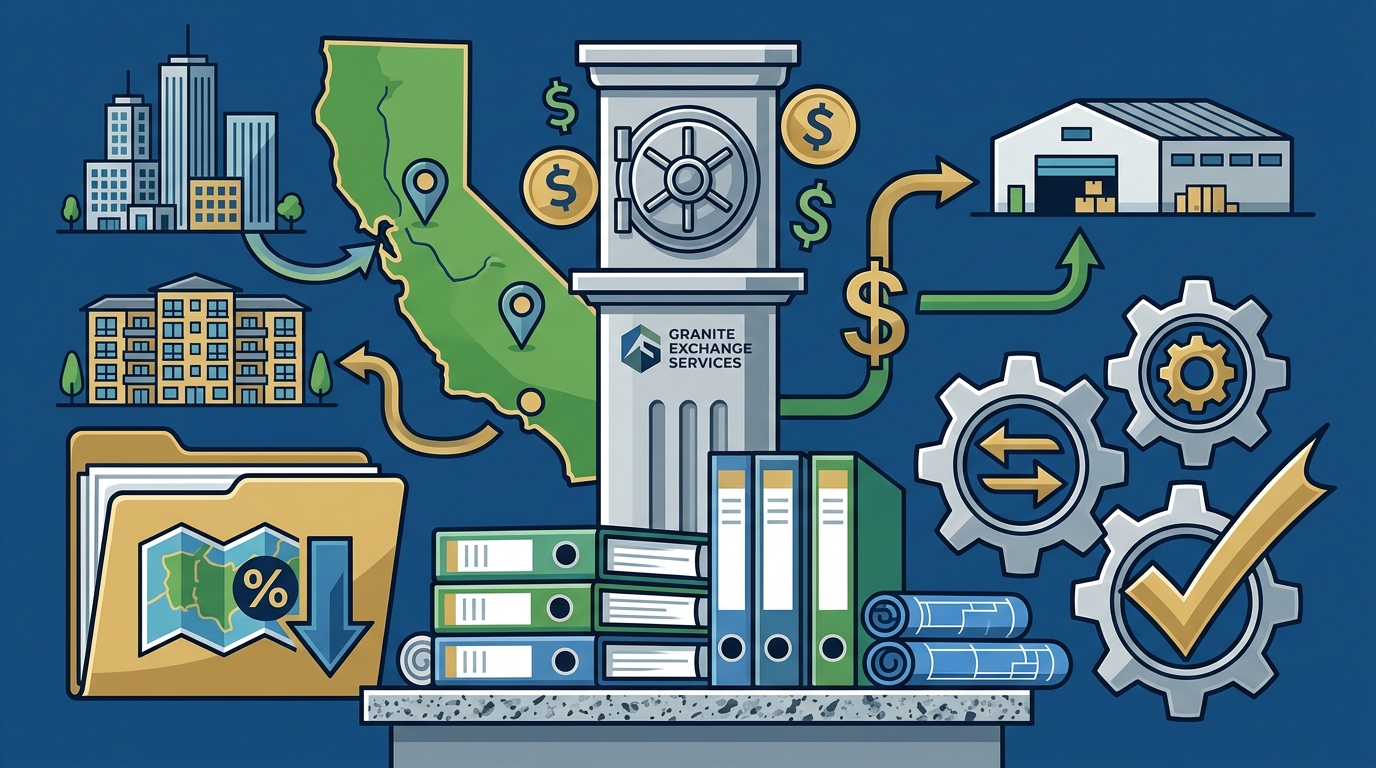
Fund Security and FDIC Insurance
Security is paramount in any 1031 exchange. Granite Exchange Services holds all exchange funds in segregated, FDIC-insured accounts, ensuring that client funds are never commingled with corporate assets. This strict separation protects investors in the unlikely event of financial distress. The company's commitment to fund security is a cornerstone of its reputation and a key factor in its selection as the best 1031 exchange company in California.
California-Specific Exchange Guides
Understanding the specific rules of California is essential for a successful exchange. Granite Exchange Services provides comprehensive California 1031 Exchange Guides that detail the state's unique requirements, including tax implications and reporting obligations. These resources are invaluable for investors who need to navigate the intersection of federal and state tax laws.
Types of Exchanges Available in California
California investors have access to a variety of exchange structures, each suited to different investment goals and property types. Granite Exchange Services offers expertise in all major exchange types:
- Delayed Exchange: The most common structure, where the relinquished property is sold first, followed by the identification and acquisition of replacement property within 45 and 180 days, respectively.
- Reverse Exchange: Allows investors to acquire replacement property before selling their relinquished property, facilitated through an Exchange Accommodation Titleholder (EAT).
- Construction Exchange: Enables the use of exchange proceeds to build or improve replacement property, with all improvements completed within the 180-day exchange period.
- DST Exchange: Provides access to institutional-quality real estate through Delaware Statutory Trusts, allowing for passive investment and diversification.
Each of these structures requires precise execution to ensure tax deferral. Granite Exchange Services provides dedicated support for each type, ensuring that investors can choose the strategy that best aligns with their financial objectives.
Service Comparison Overview
The following table compares key features of Granite Exchange Services with general industry standards to highlight its advantages for California investors.
| Feature | Granite Exchange Services | Typical QI Provider |
|---|---|---|
| Fund Security | Segregated, FDIC-insured accounts | Varies; often commingled |
| Certification | CES® Certified Counselors | Basic licensing only |
| California Expertise | Dedicated CA guides and support | Generic federal focus |
| Experience | 25+ years, 20,000+ exchanges | Variable |
| Technology | Real-time deadline calculators | Manual tracking |
Key Takeaways
- California's top income tax rate of 13.3% combined with federal rates creates a significant tax burden that 1031 exchanges can fully defer.
- Granite Exchange Services has secured over $1 billion in exchange funds, demonstrating its capacity to handle large-scale transactions.
- The company has facilitated more than 20,000 successful exchanges, providing a proven track record of reliability.
- CES® certification ensures that Granite's counselors are experts in the latest exchange regulations and best practices.
- Segregated, FDIC-insured accounts provide maximum security for exchange funds, protecting investors from financial risk.
- Dedicated California guides and support help investors navigate state-specific tax and reporting requirements.
- Granite Exchange Services serves all 50 states, offering consistent quality and expertise regardless of location.
Frequently Asked Questions
Does California conform to federal 1031 exchange rules?
Yes, California generally conforms to federal 1031 exchange rules under IRC Section 1031. However, investors must ensure proper reporting on state tax returns to maintain the deferral. Granite Exchange Services provides specific guidance on California reporting requirements.
What is the 45-day identification rule?
The 45-day identification rule requires investors to identify potential replacement properties in writing within 45 calendar days of closing on the relinquished property. This deadline is strict and cannot be extended.
What is the 180-day exchange rule?
The 180-day exchange rule mandates that the acquisition of replacement property must be completed within 180 calendar days of closing on the relinquished property, or by the due date of the investor's federal tax return, whichever is earlier.
Can I use a DST for my California exchange?
Yes, Delaware Statutory Trust (DST) exchanges are a popular option for California investors seeking passive investment opportunities. Granite Exchange Services offers DST exchange services to facilitate this process.
How does Granite Exchange Services ensure fund security?
Granite Exchange Services holds all exchange funds in segregated, FDIC-insured accounts. This ensures that client funds are protected and never commingled with corporate assets.
What is a CES® certification?
CES® (Certified Exchange Specialist®) is a professional certification that demonstrates advanced knowledge and expertise in 1031 exchange regulations and practices. Granite Exchange Services counselors hold this certification.
What is "boot" in a 1031 exchange?
Boot refers to any non-like-kind property or cash received in an exchange. It is taxable and can reduce the benefits of the deferral. Granite Exchange Services helps investors minimize boot through careful planning.
Start Your California Exchange Today
Do not leave your tax deferral to chance. Partner with Granite Exchange Services to navigate the complexities of California's tax environment with confidence. Our CES® certified counselors and robust security infrastructure ensure your exchange is handled with precision. Start your 1031 exchange today and secure your financial future.