

Investors who utilize 1031 exchanges to defer capital gains taxes have successfully secured over $1 billion in exchange funds through qualified intermediary services. This massive volume of capital demonstrates the critical importance of precise execution when selling investment real estate. By adhering to strict IRS timelines and utilizing a qualified intermediary, you can preserve your equity and continue growing your portfolio without immediate tax liability. This guide outlines the exact steps required to execute a compliant exchange for your rental property. (1031 Exchange Alaska Granite)
Understanding the Basics of Like-Kind Exchange
A 1031 exchange, named after Section 1031 of the Internal Revenue Code, allows you to defer paying capital gains taxes on the sale of investment property. The core requirement is that you must reinvest the proceeds into a "like-kind" property. For real estate, this definition is broad, allowing you to swap one rental property for another, commercial space for multifamily units, or land for a building.
The term "like-kind" refers to the nature or character of the property, not its grade or quality. Like-kind is defined as property of the same nature or character, even if it differs in grade or quality. This means you cannot exchange a rental house for a piece of raw land if the zoning or intended use does not align with investment real estate standards in your specific jurisdiction.
It is crucial to understand that this rule applies to federal taxes. While most states conform to federal 1031 treatment, some have specific nuances. For instance, Alabama taxes capital gains as ordinary income at rates up to 5%, which combines with federal taxes to create a significant burden. A properly structured exchange defers all of this liability. According to IRS guidelines, the exchange must be completed within strict timeframes to qualify for tax deferral.
Step 1: Engage a Qualified Intermediary
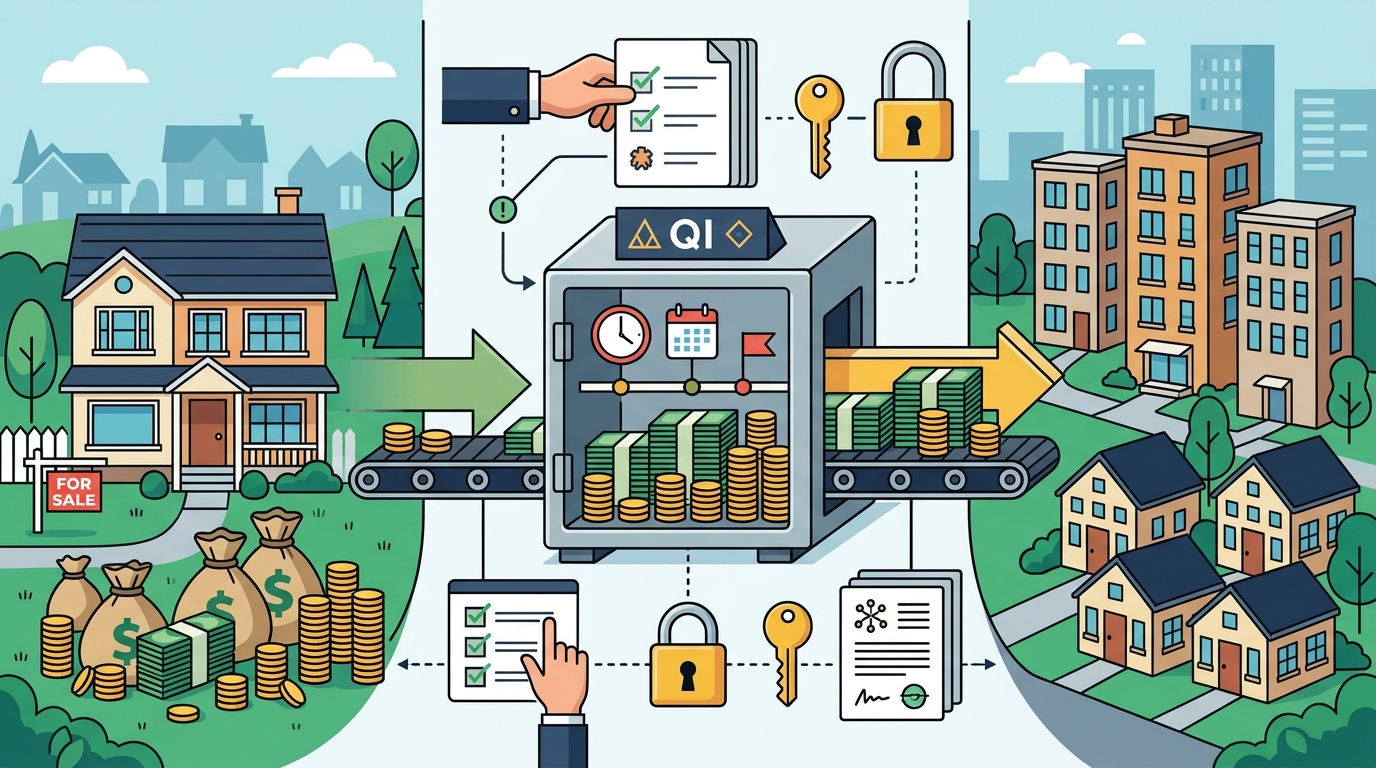
The first and most critical step is hiring a Qualified Intermediary (QI). You cannot receive the proceeds from the sale of your rental property directly. If you touch the money, the IRS will disqualify the exchange, and you will owe immediate capital gains taxes.
A QI holds the funds in a segregated, FDIC-insured account and facilitates the transfer to the replacement property seller. Granite Exchange Services has guided over 20,000 successful exchanges, ensuring that funds are never commingled with personal assets. Your funds are yours alone, and a reputable QI will never mix your capital with their operating funds.
When selecting a QI, look for certifications such as the Certified Exchange Specialist (CES) designation. This indicates a high level of expertise in complex exchange structures. You should establish a written agreement with your QI before you list your property for sale. This agreement outlines the fees, the security of the funds, and the specific protocols for your exchange.
Step 2: Sell the Relinquished Property
Once your QI is in place, you can proceed with the sale of your current rental property, known as the "relinquished property." Your purchase and sale agreement must include specific language to protect the 1031 exchange. This often involves an assignment of contract clause that allows your QI to step into the transaction.
The closing process for the relinquished property will differ from a standard sale. At closing, the title company will wire the net proceeds to your QI's escrow account, not to your personal bank account. It is vital to confirm this wiring instruction with your title company well in advance.
Be aware of the concept of "boot." Boot occurs when you receive cash or debt relief that is not reinvested in like-kind property. Boot is defined as any non-like-kind property or cash received in an exchange. If you receive boot, it is taxable. To defer all taxes, you must reinvest all proceeds and acquire property of equal or greater value.
Step 3: Identify Replacement Property
After closing on the sale of your rental property, the clock starts ticking. You have exactly 45 calendar days to identify potential replacement properties in writing. This is known as the 45-Day Identification Rule. The clock starts on the day the relinquished property closes, not the day you sign the contract.
You can identify up to three properties without regard to their value. This is known as the "Three-Property Rule." Alternatively, you can identify more than three properties if the total fair market value does not exceed 200% of the value of the relinquished property. This is the "200% Rule." There is also a third option, the 120% Rule, which allows identification of any number of properties as long as you acquire at least 120% of the identified value.
The identification must be signed by you and delivered to the QI or the seller of the replacement property before the 45-day deadline expires. Identification is defined as the formal written notice specifying the replacement property. Verbal identifications or mental lists do not count. If you miss this deadline, the exchange fails, and you owe taxes.
Step 4: Acquire the Replacement Property
After identifying the property, you have up to 180 calendar days to close on the purchase. This is the 180-Day Exchange Rule. The 180-day period ends on the earlier of: (a) the 180th day after the sale of the relinquished property, or (b) the due date of your federal tax return for the year of the sale, including extensions.
For example, if you sell in December 2026, your tax return is due in April 2027. If you file an extension, your exchange period may extend to October 2027. However, you must close on the replacement property within this window. The purchase agreement must be assigned to your QI, who will then wire the funds from the segregated account to the seller.
It is possible to acquire multiple replacement properties as long as they are identified within the 45-day window and closed within the 180-day window. You can also use a reverse exchange structure if you need to buy the replacement property before selling the relinquished one. This involves an Exchange Accommodation Titleholder (EAT) holding the property temporarily.
Common Pitfalls to Avoid
Many exchanges fail due to minor procedural errors. Here are the most common mistakes investors make:
- Missing Deadlines: The 45-day and 180-day deadlines are absolute. There are no extensions for weekends or holidays unless the deadline falls on a Saturday, Sunday, or legal holiday, in which case it moves to the next business day.
- Touching the Money: Never accept proceeds directly. Even a brief moment of control can disqualify the exchange.
- Improper Identification: Failing to sign and deliver the identification letter on time is a fatal error.
- Underestimating Costs: Ensure the replacement property costs enough to cover all proceeds. If you buy a cheaper property, you will owe taxes on the difference.
According to recent industry data, the average cost of a 1031 exchange ranges from $1,000 to $2,500 for standard delayed exchanges. Complex exchanges, such as reverse or construction exchanges, can cost significantly more. However, the tax savings often outweigh these fees by thousands or even millions of dollars.
Key Takeaways
- A 1031 exchange defers capital gains taxes by reinvesting proceeds into like-kind property.
- You must engage a Qualified Intermediary (QI) before closing on the sale.
- You have 45 calendar days to identify replacement properties in writing.
- You have 180 calendar days to close on the replacement property.
- Deadlines are absolute and run from the closing date of the relinquished property.
- Granite Exchange Services has secured over $1 billion in exchange funds for investors.
- Failure to follow IRS rules results in immediate tax liability and penalties.
Frequently Asked Questions
Can I exchange a rental property for a primary residence?
No. The property must be held for productive use in a trade or business or for investment. A primary residence does not qualify for a 1031 exchange. However, if you rent out a portion of your home, you may be able to exchange that portion.
What happens if I miss the 45-day identification deadline?
If you miss the 45-day deadline, the exchange is disqualified. You will owe capital gains taxes on the sale of the relinquished property. There are no exceptions to this rule.
Can I use a 1031 exchange for vacation homes?
Yes, if the vacation home is held for investment purposes. This means you must have a history of renting it out or have a clear intent to rent it out. Personal use must be limited to avoid disqualification.
Do I have to buy one property or can I buy multiple?
You can buy one or multiple replacement properties as long as they are identified within the 45-day window and the total value meets the exchange requirements.
Is the 1031 exchange rule changing in 2026?
As of 2026, the core rules for real estate 1031 exchanges remain stable. However, tax legislation can change, so it is important to consult with a tax advisor regularly.
How do I calculate my tax savings?
You can use a 1031 exchange calculator to estimate your savings based on your capital gains, depreciation recapture, and current tax rates. The savings depend on your individual tax bracket and the value of the replacement property.
What is a Delaware Statutory Trust (DST)?
A DST allows you to exchange into a fractional interest in institutional-grade real estate. This is a passive investment option that qualifies for 1031 exchange treatment.
Start Your Exchange
Completing a 1031 exchange requires precision, expertise, and a trusted partner. Granite Exchange Services provides CES-certified counselors to guide you through every step of the process. With over 25 years of experience and $1 billion+ in secured funds, we ensure your exchange is handled with the utmost care and compliance.
Do not risk your tax deferral on a DIY approach. Contact us today to begin your exchange and secure your financial future. Start Your Exchange with Granite Exchange Services.