

California investors face one of the most aggressive tax environments in the United States, making the Section 1031 exchange an essential tool for wealth preservation. According to recent financial data, the combined federal and state tax burden on capital gains can exceed 30% for high earners, creating an urgent need for deferral strategies. Granite Exchange Services has guided investors through these complex regulations for over 25 years, safeguarding more than $1 billion in client funds. This guide details how to navigate the unique requirements of California law while leveraging federal tax codes to defer your gains effectively. (1031 Exchange Qualified Intermediary)
What is a 1031 Exchange?
A 1031 exchange, also known as a like-kind exchange, allows real estate investors to defer paying capital gains taxes and depreciation recapture when they sell an investment property. The term "like-kind" refers to the nature of the asset rather than its grade or quality. In real estate, this means that any investment property held for productive use in a trade or business can be exchanged for another investment property of equal or greater value. (1031 Exchange Alaska Granite)
The primary benefit is the deferral of taxes. By reinvesting the proceeds from the sale into a new property, you do not trigger a taxable event. This allows your capital to continue working for you without being reduced by tax payments. For California investors, this deferral is particularly valuable given the state's high income tax rates. The discipline of a private bank and the attention of a boutique firm are required to manage these transactions correctly. Granite Exchange Services provides this precision for investors across all 50 states.
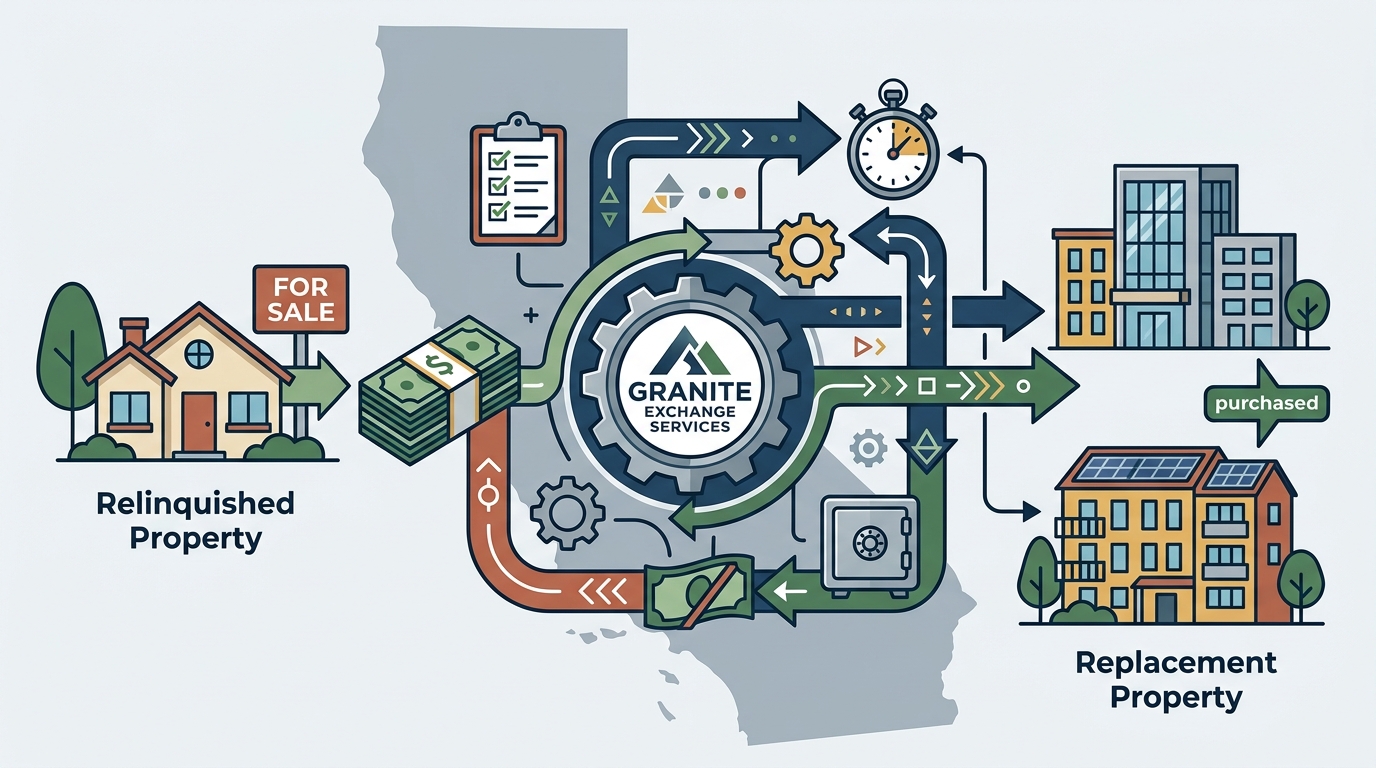
Understanding the mechanics is critical. You cannot receive the proceeds from the sale directly. Instead, a Qualified Intermediary (QI) holds the funds during the exchange period. This ensures that the transaction remains compliant with Internal Revenue Code Section 1031. Without a QI, the exchange would fail, and you would owe immediate taxes on the gain.
California-Specific Tax Rules
While Section 1031 is a federal tax provision, California handles the state portion of the tax differently than many other states. California does not conform to the federal deferral in the same way. Instead, the state tracks your deferred gain. This means that while you do not pay state tax at the time of the exchange, California keeps a record of the deferred amount.
When you eventually sell the replacement property and recognize the gain, California will tax the original deferred gain plus any new gain accrued on the replacement property. This is known as a "carryover basis." To manage this, California requires investors to file Form 3840 annually. This form reports the deferred gain to the Franchise Tax Board (FTB). Failure to file this form can result in penalties and interest.
Another critical aspect of California law is the treatment of "boot." Boot refers to any non-like-kind property received in the exchange, such as cash or relief from debt. California taxes boot immediately as ordinary income. Therefore, it is crucial to structure your exchange to minimize or eliminate boot. A CES®-certified specialist can help you navigate these nuances to ensure your exchange remains fully compliant.
California also has strict rules regarding the identification of replacement properties. The state follows the federal identification rules but adds its own layer of scrutiny during audits. Investors must ensure that their identification is in writing, signed by the taxpayer, and delivered to the QI or the seller of the replacement property within the 45-day window.
The 45 and 180-Day Rules
Timing is the most critical factor in a successful 1031 exchange. The IRS imposes two strict deadlines that cannot be extended, even if they fall on a weekend or federal holiday. These deadlines are absolute and non-negotiable.
The first deadline is the 45-day identification period. This period begins on the date you transfer the relinquished property and ends 45 days later. During this time, you must identify potential replacement properties in writing. You can identify up to three properties of any value. Alternatively, you can identify any number of properties as long as their total fair market value does not exceed 200% of the value of the relinquished property. This is known as the 200% rule.
The second deadline is the 180-day exchange period. This period ends on the earlier of 180 days after the sale of the relinquished property or the due date of your tax return for the year of the sale, including extensions. You must close on the replacement property by this date. If you miss this deadline, the exchange fails, and you owe all taxes on the gain.
Calculating these deadlines requires precision. Granite Exchange Services offers a calculator to help you determine your exact identification and closing dates. Enter your closing date, and the tool will compute the rest, adjusted for weekends and federal holidays. This tool is essential for planning your acquisition strategy and ensuring you do not miss a critical window.
Exchange Structures Available
Not all 1031 exchanges are created equal. Depending on your market conditions and investment goals, you may need a specific exchange structure. Granite Exchange Services specializes in several complex exchange types.
Delayed (Forward) Exchange
This is the most common structure. You sell your relinquished property first, then identify and acquire the replacement property. The standard forward exchange is the structure behind most of our twenty thousand engagements. It is ideal for investors who have already found a buyer for their current property and need time to find a replacement.
Reverse Exchange
In a reverse exchange, you acquire the replacement property before selling the relinquished property. This is useful in competitive markets where finding a replacement property is difficult. We form an Exchange Accommodation Titleholder (EAT) to hold the title of the replacement property. This structure is governed by Rev. Proc. 2000-37 and requires careful planning to ensure compliance.
Construction Exchange
A construction exchange, also known as a build-to-suit exchange, allows you to apply exchange funds to improvements on the replacement property. The title is parked until the improvements are completed. This structure is ideal for investors who want to customize their replacement property to meet specific investment criteria.
DST Exchange
A Delaware Statutory Trust (DST) exchange allows for passive investment in institutional real estate. This is a fractional ownership structure that qualifies for 1031 exchange treatment. It is ideal for investors who want to diversify their portfolio without the burden of property management.
Fund Security and Compliance
The security of your funds is the most important aspect of the exchange process. A qualified intermediary holds your proceeds during the exchange. That makes the custody arrangement, not the marketing, the real product. Our security architecture is built so you never have to take our word for it.
We use segregated accounts, with one account per exchange in your exchange's name. Funds are never commingled with other client funds or company operating accounts. This ensures that your money is protected and available when needed. Additionally, our accounts are FDIC-insured, providing an extra layer of security for your capital.
Compliance is also key to fund security. We adhere to strict internal controls and audit procedures to ensure that all transactions are handled correctly. Our specialists are CES®-certified, meaning they have undergone rigorous training and testing on 1031 exchange regulations. This certification ensures that you are working with experts who understand the nuances of the law.
For more details on our security measures, you can read the full security architecture on our website. Understanding how your funds are protected is essential for peace of mind during the exchange process.
Key Takeaways
- California tracks deferred gains and requires annual Form 3840 filings with the FTB.
- The 45-day identification period begins on the date of the relinquished property transfer.
- The 180-day exchange period ends on the earlier of 180 days or the tax return due date.
- Granite Exchange Services has completed over 20,000 exchanges since 2000.
- Funds are held in segregated, FDIC-insured accounts to prevent commingling.
- California taxes boot immediately as ordinary income, so minimizing boot is critical.
- Reverse and construction exchanges require specialized structures governed by Rev. Proc. 2000-37.
Frequently Asked Questions
Does California tax 1031 exchanges?
California does not tax the exchange itself, but it tracks the deferred gain. You must file Form 3840 annually to report the deferred amount. When you eventually sell the replacement property, California will tax the deferred gain plus any new gain.
What is the 45-day rule?
The 45-day rule requires you to identify potential replacement properties in writing within 45 days of selling your relinquished property. This deadline is strict and cannot be extended.
What is the 180-day rule?
The 180-day rule requires you to close on the replacement property within 180 days of selling the relinquished property. This period ends on the earlier of 180 days or your tax return due date.
Can I exchange a personal residence?
No. Section 1031 exchanges only apply to property held for productive use in a trade or business or for investment. Personal residences do not qualify.
What is boot?
Boot is any non-like-kind property received in the exchange, such as cash or debt relief. Boot is taxable immediately. Minimizing boot is essential for maximizing tax deferral.
How does Granite Exchange Services protect my funds?
We use segregated, FDIC-insured accounts for each exchange. Funds are never commingled with other client funds or company operating accounts. This ensures the security and availability of your capital.
What is a CES®-certified specialist?
A CES®-certified specialist has undergone rigorous training and testing on 1031 exchange regulations. This certification ensures that they have the expertise to handle complex exchanges correctly.
Start Your Exchange
Deferring your taxes through a 1031 exchange is a powerful strategy for preserving wealth. However, the complexity of California tax law and federal regulations requires expert guidance. Granite Exchange Services is ready to help you navigate this process with precision and care.
Speak with a specialist today to begin your exchange. Our team is available to answer your questions and guide you through every step of the process. Visit our Contact Us page to get started. You can also use our Exchange Savings Calculator to estimate your potential tax savings.
For more information on 1031 exchanges, visit our What is a 1031 Exchange? guide. You can also read our 45-Day Rule and 180-Day Rule pages for detailed deadlines. Explore our Delayed Exchange and Reverse Exchange services for more options.
Do not wait until the last minute. Contact us now to ensure a smooth and compliant exchange. Your financial future depends on it.