

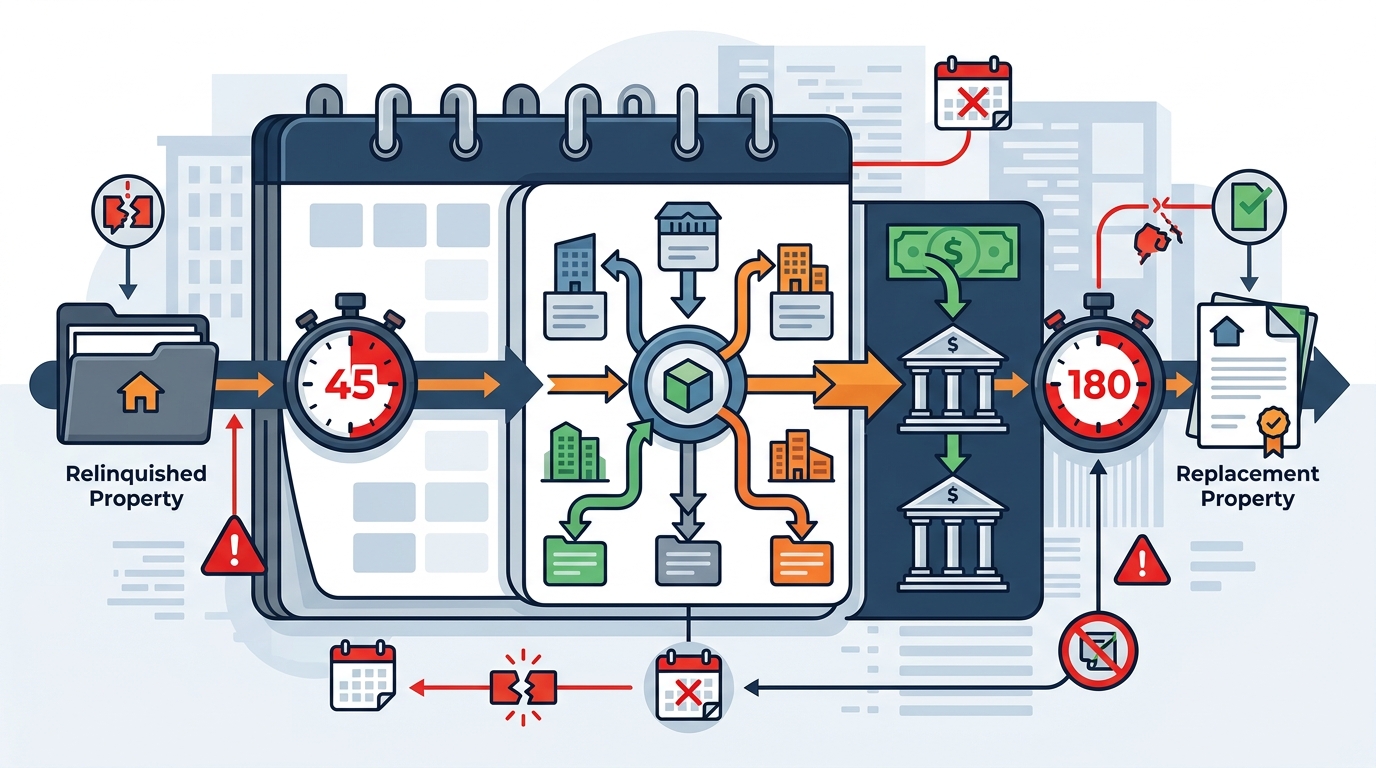
Investors who attempt to accelerate the timeline of a 1031 exchange often face severe tax consequences due to procedural missteps. According to IRS regulations, the strict 45-day identification period and 180-day completion window are absolute deadlines with no extensions granted for weekends or holidays. Missing these dates by even one day can trigger immediate capital gains liability, potentially exceeding 30% of the realized gain when combining federal rates, depreciation recapture, and state taxes. This guide details the critical errors investors make when trying to speed up the process and provides the precise operational steps to avoid them.
Understanding Fast-Track Exchange Structures
A "fast-track" 1031 exchange typically refers to strategies designed to minimize the time between the sale of a relinquished property and the acquisition of a replacement property. While the standard delayed exchange requires selling first, a reverse exchange allows investors to acquire the replacement property before selling the original asset. This structure is governed by Rev. Proc. 2000-37 and involves an Exchange Accommodation Titleholder (EAT) to hold title temporarily.
Many investors believe that accelerating the process reduces risk. In reality, fast-tracking introduces complex timing dependencies. The discipline of a private bank is required to manage these overlapping deadlines. Granite Exchange Services has guided investors through these complex structures for over 25 years, ensuring that the accelerated timeline does not compromise the tax-deferred status of the transaction.
For a detailed breakdown of how delayed exchanges work, explore our delayed exchange guide. For those considering acquiring before selling, review our reverse exchange framework.
Critical Identification Period Mistakes
The most common error in fast-track exchanges is the failure to properly identify replacement properties within the 45-day window. The clock starts ticking on the day the relinquished property closes. Investors often underestimate the time required to locate suitable properties, conduct due diligence, and prepare legal documentation.
Over-Identification and Ambiguity
Investors frequently list too many properties or use vague descriptions. The IRS requires specific, unambiguous descriptions. A common mistake is listing a property by its address without a legal description, which can lead to rejection if the address is incorrect or if the property is not clearly defined. Another error is failing to adhere to the 200% or 300% rules when identifying multiple properties.
Missed Deadlines Due to Poor Planning
Fast-tracking often involves simultaneous closings or tight overlaps. If the Qualified Intermediary (QI) is not engaged immediately, the 45-day clock may start before the QI has the relinquished property's proceeds in their segregated account. This can invalidate the exchange. Always ensure your QI is in place before the closing of the relinquished property.
For more on the critical deadlines, read our 45-Day Rule guide and our 180-Day Rule guide.
Fund Security and Commingling Risks
In a fast-track exchange, the movement of funds is rapid. A critical mistake is allowing funds to be commingled with personal or business accounts. The definition of a Qualified Intermediary is an entity that holds exchange funds in a segregated, FDIC-insured account. If funds are not held in such an account, the IRS may view the investor as having received constructive receipt of the funds, triggering immediate taxation.
Granite Exchange Services ensures that one account is created per exchange, in the exchange's name. This prevents commingling and ensures that your funds are yours alone. Understanding the importance of fund security is vital for any investor looking to defer taxes effectively. Learn more about our fund security architecture.
Documentation and Contractual Pitfalls
Fast-tracking requires precise contractual language. A common mistake is using standard purchase agreements that do not include exchange contingencies. If the contract does not explicitly state that the purchase is contingent on a successful 1031 exchange, the investor may lose the right to defer taxes if the exchange fails.
Missing Exchange Accommodation Agreements
In reverse exchanges, the Exchange Accommodation Agreement (EAA) must be executed before the title is transferred to the EAT. Failure to execute the EAA within five business days of the transfer can disqualify the entire exchange. This is a strict IRS requirement under Rev. Proc. 2000-37.
For details on the legal requirements, review Form 8824 reporting guidelines.
State-Specific Compliance Oversights
Investors often focus solely on federal taxes and neglect state-specific requirements. Some states, like California, track deferred gains and require annual filings (e.g., FTB Form 3840) even if the exchange is successful. Other states may have different withholding requirements for non-resident sellers.
For example, Alabama requires a 5% top income tax on capital gains, which is deferred through a 1031 exchange. Explore our Alabama 1031 Exchange services for state-specific details. Similarly, California investors must navigate unique tracking requirements.
Key Takeaways
- Deadlines are Absolute: The 45-day identification and 180-day completion periods are strict. No extensions are granted for holidays or weekends.
- Segregated Accounts are Mandatory: Funds must be held in segregated, FDIC-insured accounts to avoid constructive receipt.
- Documentation Must Be Precise: Use specific legal descriptions for identified properties and include exchange contingencies in all contracts.
- State Rules Vary: Check state-specific withholding and reporting requirements, such as California's FTB tracking or Alabama's 5% income tax.
- Engage a QI Early: Your Qualified Intermediary should be involved before the relinquished property closes to ensure proper setup.
- Reverse Exchanges Require EATs: An Exchange Accommodation Titleholder must be used for reverse exchanges, with the EAA executed within five business days.
- Professional Guidance is Critical: With over 20,000 exchanges completed, experienced specialists can prevent costly errors.
Frequently Asked Questions
What is a fast-track 1031 exchange?
A fast-track 1031 exchange is a strategy used to accelerate the timeline of a like-kind exchange, often involving reverse exchanges or simultaneous closings to minimize the time between selling and buying properties.
Can I miss the 45-day identification deadline if I have a good reason?
No. The IRS does not grant extensions for the 45-day identification period or the 180-day completion period. Missing these deadlines results in the disqualification of the exchange and immediate tax liability.
How does Granite Exchange Services protect my funds?
Granite Exchange Services holds funds in segregated, FDIC-insured accounts. Each exchange has its own account, ensuring that funds are never commingled with other clients' funds or company assets.
Do I need a Qualified Intermediary for a reverse exchange?
Yes. A reverse exchange requires an Exchange Accommodation Titleholder (EAT), which is typically a Qualified Intermediary, to hold title to the replacement property temporarily.
What happens if I receive "boot" in an exchange?
Boot refers to cash or non-like-kind property received in the exchange. It is taxable in the year of the exchange. To defer all taxes, the investor must reinvest all proceeds and acquire property of equal or greater value.
Are there state-specific taxes on 1031 exchanges?
Yes. While federal rules apply nationwide, states may have their own income tax implications. For example, California tracks deferred gains, while states like Alaska have no state income tax.
How long has Granite Exchange Services been in business?
Granite Exchange Services has been serving investors since 2000, completing over 20,000 exchanges and safeguarding more than $1 billion in client funds.
Begin Your Secure Exchange
Do not let procedural errors jeopardize your tax deferral. Granite Exchange Services provides the expertise and security needed to navigate fast-track exchanges successfully. Our CES®-certified specialists are ready to assist you with every step of the process.
Start your 1031 exchange today and ensure your investment strategy remains intact. Contact us at 800-899-6959 to speak with a specialist.