

For rental property investors, the qualified intermediary (QI) is the single most critical third party in a 1031 exchange. The QI holds your sale proceeds, coordinates the purchase of replacement property, and ensures the transaction complies with IRS rules. Choosing the wrong provider can jeopardize your tax deferral. This guide explains the legal requirements for QIs, the step-by-step exchange process, and how to evaluate major providers like Granite Exchange Services to protect your investment.
Qualified Intermediary Requirements
A Qualified Intermediary is a third-party entity that facilitates a like-kind exchange by holding the proceeds from the sale of the relinquished property and using those funds to acquire the replacement property. This separation is mandatory under the Internal Revenue Code. If the investor takes constructive receipt of the funds, the exchange fails, and capital gains taxes become immediately due. according to Qualified intermediary FTB For additional details, review the Customer Experience.
Legal and Regulatory Standards
The IRS requires that the QI be independent of the investor, the seller, and the buyer. The QI cannot be the investor’s attorney, accountant, or broker. Furthermore, the QI must hold the funds in a segregated, non-commingled account. This ensures that your money is safe and distinct from the QI’s operating capital. Most reputable QIs are licensed and bonded, providing an additional layer of financial protection for the investor.
Independence and Neutrality
True independence is a key differentiator. Some large exchange companies are owned by title, escrow, or lender corporations. While these entities may be compliant, their primary business interest often lies in closing the real estate transaction, not necessarily in the tax strategy of the exchange. An independent QI, such as Granite Exchange Services, operates as a neutral third party. This structure ensures that the QI’s sole focus is on the success of the tax deferral, providing unbiased guidance without conflicts of interest from affiliated financial institutions.
The 1031 Exchange Process Steps
Understanding the workflow helps investors anticipate their role and the QI’s responsibilities. The process is strictly time-bound, with specific deadlines that must be met to maintain tax deferral.
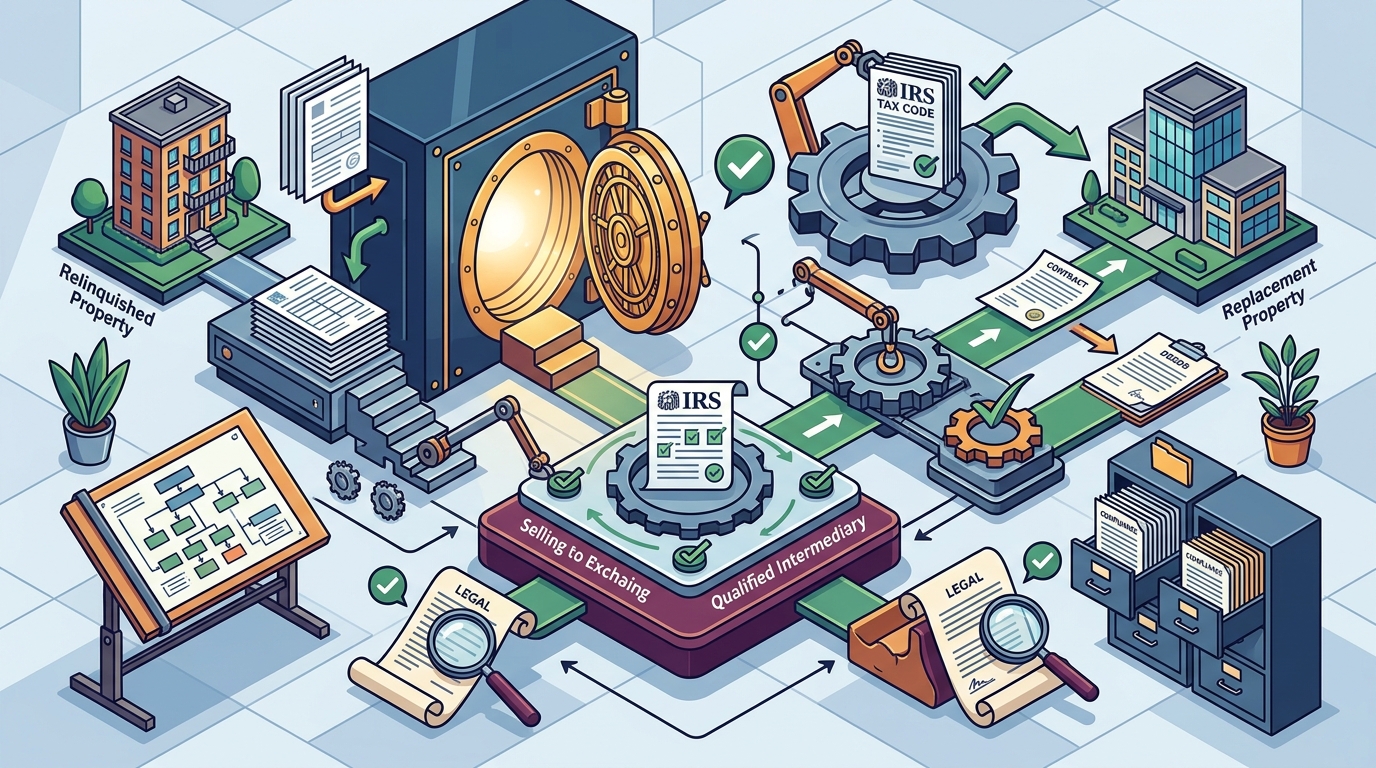
Step 1: Engagement and Documentation
The process begins when the investor signs a Qualified Intermediary Agreement (QIA) before closing the sale of the relinquished property. This document outlines the terms of the exchange, including how funds will be held and the rules for acquiring the replacement property. The QI then issues a closing instruction to the title company or escrow agent, directing that the sale proceeds be wired directly to the QI’s segregated account.
Step 2: The 45-Day Identification Period
Within 45 days of the closing of the relinquished property, the investor must identify potential replacement properties. The IRS allows for up to three properties of any value, or an unlimited number of properties as long as their total value does not exceed 200% of the value of the relinquished property. The QI typically assists in tracking these deadlines and ensuring the identification is delivered correctly to the appropriate parties.
Step 3: The 180-Day Closing Period
The investor has 180 days from the date of the relinquished property closing to close on the replacement property. The QI coordinates the purchase, ensuring that the funds from the segregated account are released to the title company for the new property. If the investor is using a reverse exchange, the QI may take title to the replacement property before the relinquished property is sold, a complex structure that requires careful management.
Step 4: Final Reporting
After the exchange is complete, the QI provides a final exchange report. This document is essential for the investor’s tax return, as it proves that the exchange was conducted in accordance with IRS regulations. The investor’s CPA will use this report to file Form 8824 and report the deferred gain.
Major QI Providers and How to Choose
The market for 1031 exchange services is dominated by a few large national players, but the quality of service varies significantly. When choosing a provider, investors should look beyond marketing claims and evaluate the operational structure, fee transparency, and level of personal attention.
Comparison of Service Models
The following table compares the typical characteristics of large corporate QIs versus independent, relationship-driven firms.
| Ownership Structure | Often owned by title, escrow, or lender companies | Independent, not owned by financial institutions |
| Client Interaction | Call centers, automated systems, handoffs | Direct access to knowledgeable team members |
| Focus | Volume and transaction closing | Customer service and tax compliance |
| Experience | Varies by branch or region | Deep expertise in specific markets (e.g., California) |
Evaluating Provider Expertise
Experience matters, particularly in complex markets. Granite Exchange Services has been facilitating exchanges since 2000, with a strong focus on California’s complex real estate landscape. Their team handles every exchange structure, including forward, reverse, and improvement exchanges. For investors in California or those dealing with multi-property portfolios, this specialized knowledge can be a significant advantage over a generic national provider.
Service Level and Accessibility
Key Takeaways
- A Qualified Intermediary is a mandatory third party that holds exchange funds to prevent constructive receipt by the investor.
- The QI must be independent of the investor, seller, and buyer to comply with IRS regulations.
- The exchange process has strict deadlines: 45 days to identify replacement properties and 180 days to close.
- Large corporate QIs may have conflicts of interest if owned by title or escrow companies.
- Independent QIs often provide more personalized service and direct access to knowledgeable staff.
- Experience in specific real estate markets, such as California, can be a critical factor for complex deals.
- Always verify that the QI is licensed, bonded, and holds funds in a segregated account.
- The final exchange report from the QI is essential for your tax return and CPA.
Frequently Asked Questions
What is a Qualified Intermediary?
A Qualified Intermediary is a third-party entity that facilitates a 1031 exchange by holding the proceeds from the sale of the relinquished property and using those funds to acquire the replacement property. This role is required by the IRS to ensure the investor does not take constructive receipt of the funds.
Can I use my own attorney as a Qualified Intermediary?
No. The IRS prohibits the investor’s attorney, accountant, or broker from acting as the Qualified Intermediary. The QI must be an independent third party to maintain the integrity of the exchange.
How long does a 1031 exchange take?
The entire process must be completed within 180 days of the closing of the relinquished property. The first 45 days are reserved for identifying replacement properties, and the remaining time is used to close on the new property.
What is the difference between a forward and a reverse exchange?
In a forward exchange, the investor sells the relinquished property first and then buys the replacement property. In a reverse exchange, the investor buys the replacement property first, with the QI taking title, and then sells the relinquished property. Reverse exchanges are more complex and require careful coordination.
Why is independence important for a QI?
Independence ensures that the QI has no conflict of interest. If a QI is owned by a title or escrow company, their primary goal may be to close the real estate transaction rather than to ensure the tax exchange is compliant. An independent QI focuses solely on the success of the tax deferral.
How much does a Qualified Intermediary cost?
Fees vary by provider and the complexity of the exchange. Some QIs charge a flat fee, while others may have additional costs for complex structures like reverse exchanges. It is important to get a clear fee schedule in writing before signing the QIA.
Can I do a 1031 exchange on a rental property?
Yes. Rental properties are the most common type of property used in 1031 exchanges. The property must be held for investment or productive use in a trade or business, not for personal use.
What happens if I miss the 45-day identification deadline?
If you miss the 45-day deadline to identify replacement properties, the exchange fails. You will owe capital gains taxes on the sale of the relinquished property. It is critical to track these deadlines carefully.