

Investors looking to defer capital gains taxes often seek the most efficient path to preserve their wealth. According to the Internal Revenue Code, Section 1031 allows for the deferral of these taxes if specific like-kind exchange rules are followed. However, the standard timeline can be restrictive for many market participants. Granite Exchange Services has guided over 20,000 investors through these complex transactions since 2000, ensuring that every exchange is handled with precision. This guide compares the primary exchange structures to help you determine which fast-track or standard option aligns with your investment goals.
Delayed (Forward) Exchange
The delayed exchange is the most common structure for 1031 exchanges. It is often referred to as a standard forward exchange because the timeline follows a strict sequence. You sell your relinquished property first, then identify a replacement property, and finally close on that replacement.
This structure is governed by two critical deadlines. The first is the 45-day identification period. You must identify potential replacement properties in writing within 45 days of closing on your sold property. The second is the 180-day completion period. You must close on the replacement property within 180 days of the sale of the relinquished property. These deadlines are absolute and do not include weekends or federal holidays.
For investors who have already found their next property or are comfortable with the standard timeline, the delayed exchange offers a straightforward path to tax deferral. Granite Exchange Services handles the documentation and fund custody to ensure compliance with IRS regulations. Learn more about how delayed exchanges work to understand the mechanics in detail.
Reverse Exchange
A reverse exchange allows you to acquire the replacement property before selling your relinquished property. This structure is often necessary when investors find a desirable replacement property but have not yet sold their current asset. It is particularly useful in competitive markets where timing is critical.
In a reverse exchange, Granite Exchange Services forms an Exchange Accommodation Titleholder (EAT) to hold the title of the replacement property. This entity parks the title under the safe harbor provisions of Rev. Proc. 2000-37. This ensures that the transaction is treated as a valid 1031 exchange rather than a taxable sale followed by a purchase.
The reverse exchange is more complex than a delayed exchange due to the additional legal and financial structures required. However, it provides the flexibility to secure a high-value replacement property without the risk of missing out. Explore the reverse exchange structure to see how it can benefit your specific situation.
Construction Exchange
A construction exchange, also known as a build-to-suit exchange, allows you to use exchange funds to make improvements on the replacement property. This is ideal for investors who want to customize their new property or undertake substantial renovations.
In this structure, the replacement property must be identified within the 45-day period. The improvements must be completed within the 180-day completion period. Title is parked until the construction is finished, ensuring that the property meets the like-kind requirements.
This option is particularly valuable for multifamily investors or commercial property owners looking to increase the value of their holdings through strategic improvements. Granite Exchange Services coordinates with your contractors and title companies to ensure the timeline is met. Discover how to plan an improvement exchange effectively.
Delaware Statutory Trust (DST)
A Delaware Statutory Trust (DST) exchange allows investors to acquire a fractional interest in institutional-grade real estate. This is a passive investment option that eliminates the responsibilities of property management.
DSTs are ideal for investors who want to diversify their portfolio without the burden of active management. The exchange process is streamlined because the DST sponsor handles the acquisition and management of the property. This structure is particularly popular among high-net-worth individuals seeking tax deferral with minimal effort.
Granite Exchange Services provides guidance on DST opportunities, ensuring that the investment meets the strict IRS requirements for 1031 exchanges. Learn more about the DST exchange options available to you.
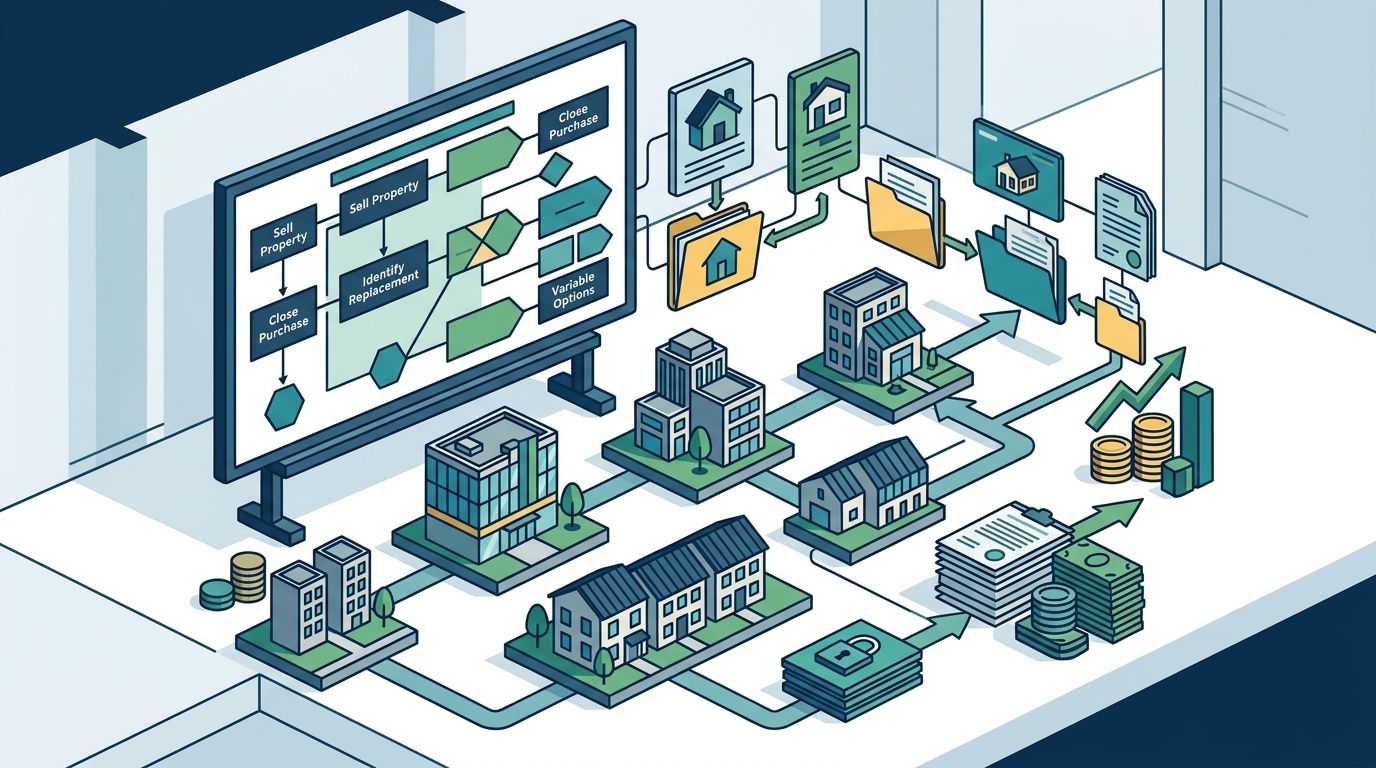
Structural Comparison
The following table compares the key features of each exchange structure to help you make an informed decision.
| Exchange Type | Timeline | Best For | Complexity |
|---|---|---|---|
| Delayed Exchange | 45-day ID, 180-day Close | Standard sales with clear replacement targets | Low |
| Reverse Exchange | Acquire first, sell later | Competitive markets or unique replacement properties | High |
| Construction Exchange | 45-day ID, 180-day Close + Construction | Investors seeking value-add improvements | High |
| DST Exchange | Varies by Trust Offering | Passive investors seeking institutional assets | Medium |
Key Takeaways
- Granite Exchange Services has completed over 20,000 exchanges since 2000, providing a track record of reliability.
- All exchange funds are held in segregated, FDIC-insured accounts to ensure maximum security.
- The 45-day identification and 180-day completion deadlines are strict and non-negotiable for delayed exchanges.
- Reverse exchanges require an Exchange Accommodation Titleholder (EAT) to hold title to the replacement property.
- DST exchanges offer a passive investment option for investors seeking institutional-grade real estate.
- Construction exchanges allow for improvements on the replacement property within the 180-day window.
- Granite Exchange Services is CES® Certified, ensuring that your exchange is handled by a specialist.
Frequently Asked Questions
What is the difference between a delayed and reverse exchange?
A delayed exchange requires you to sell the relinquished property first, while a reverse exchange allows you to acquire the replacement property first. The reverse exchange is more complex and requires an Exchange Accommodation Titleholder.
Can I use a 1031 exchange for a vacation home?
Generally, no. The property must be held for investment or for productive use in a trade or business. Personal-use vacation homes do not qualify unless they are rented out and meet specific IRS criteria.
How does Granite Exchange Services protect my funds?
Granite Exchange Services holds your funds in segregated, FDIC-insured accounts. Each exchange has its own account, ensuring that your funds are never commingled with other clients' funds.
What is a Delaware Statutory Trust (DST)?
A DST is a legal entity that holds title to real estate. Investors can buy fractional interests in the DST, allowing them to participate in institutional-grade real estate investments passively.
Are there state-specific rules for 1031 exchanges?
While the federal rules under IRC Section 1031 apply nationwide, some states have specific reporting requirements or tax implications. Granite Exchange Services provides guidance on state-specific rules for all 50 states.
What happens if I miss the 45-day identification deadline?
If you miss the 45-day identification deadline, the exchange fails, and the capital gains tax becomes due. It is critical to work with a qualified intermediary to ensure all deadlines are met.
Can I exchange property in one state for property in another?
Yes, you can exchange property in one state for property in another state. The like-kind requirement applies to the nature of the property, not its location.
Begin Your Exchange
Choosing the right exchange structure is critical to maximizing your tax deferral. Granite Exchange Services offers expert guidance on delayed, reverse, construction, and DST exchanges. With over 25 years of experience and $1 billion+ in client funds safeguarded, we provide the security and expertise you need. Start your exchange today and secure your financial future.