

Comparing 1031 Exchange Types: Delayed, Reverse, and Build-to-Suit Structures
Investors looking to defer capital gains taxes must understand that not all 1031 exchanges are created equal. The Internal Revenue Code Section 1031 provides a powerful mechanism for deferring taxes, but the structure you choose dictates your risk, timeline, and flexibility. According to industry data, over 20,000 exchanges are completed annually by qualified intermediaries, with the vast majority utilizing delayed structures. However, as real estate markets shift, more investors are turning to reverse and construction exchanges to secure high-value replacement properties before selling their relinquished assets. This guide compares the three primary exchange types to help you navigate the complexities of like-kind exchanges with precision.
The Standard Delayed Exchange
The delayed exchange, often referred to as a forward exchange, is the most common and straightforward structure for deferring capital gains taxes. In this scenario, you sell your relinquished property first, then identify and acquire a replacement property within strict IRS deadlines. This structure is governed by IRC Section 1031 and requires the use of a Qualified Intermediary (QI) to hold the proceeds during the exchange period.
How It Works
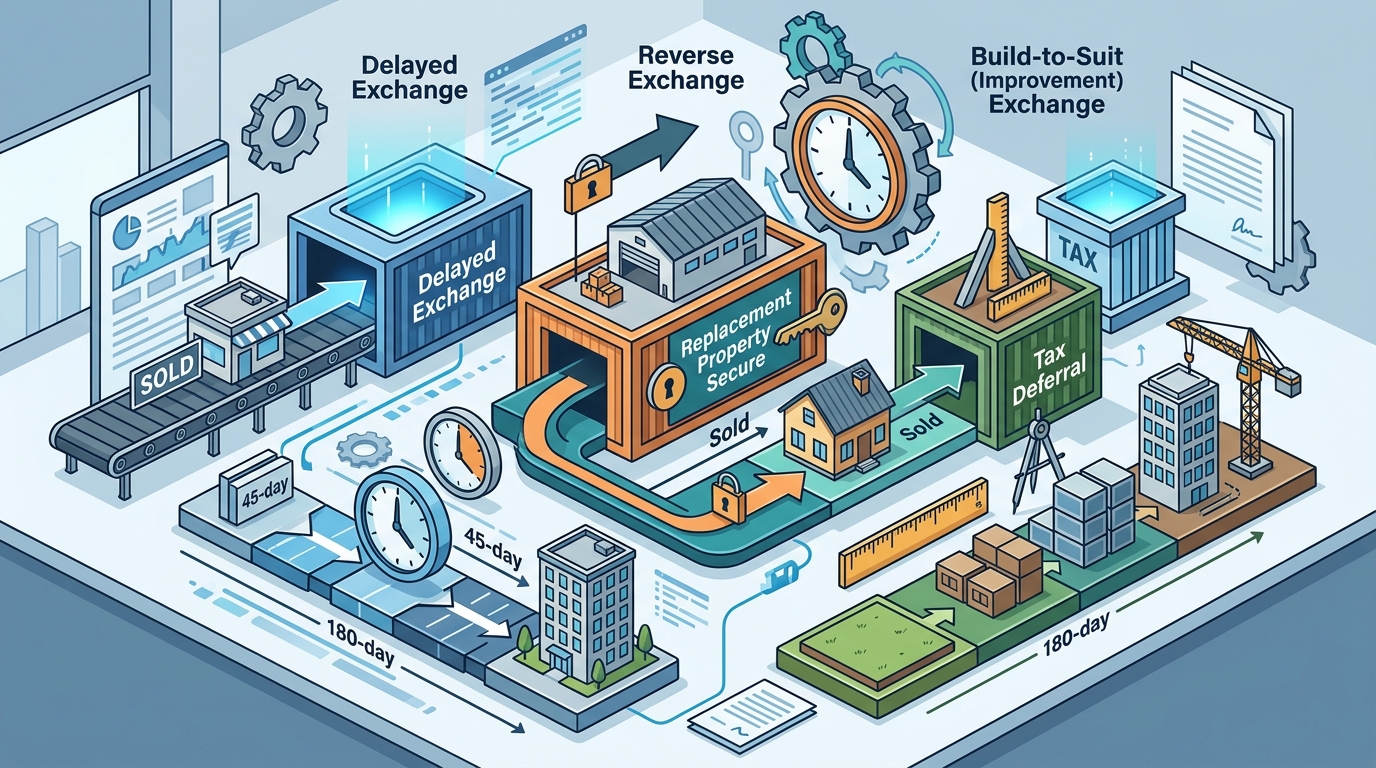
The process begins with the sale of your original investment property. The proceeds are transferred to your Qualified Intermediary, who holds the funds in a segregated, FDIC-insured account. You then have 45 days from the date of sale to identify potential replacement properties. This is known as the 45-day identification period. Following identification, you have 180 days from the sale date to close on the replacement property. This is the 180-day completion period.
Advantages and Limitations
The primary advantage of a delayed exchange is its simplicity and lower cost compared to other structures. Since you sell first, you know exactly how much cash is available for the replacement property. However, the limitation is clear: you must sell your current property before you can buy the new one. In competitive markets, this can be a disadvantage if you cannot find a buyer quickly or if you need to secure a replacement property before selling.
For more details on the mechanics of delayed exchanges, visit our Delayed Exchange page. You can also use our Exchange Savings Calculator to estimate your tax deferral benefits.
The Reverse Exchange (Improvement Period)
A reverse exchange allows you to acquire a replacement property before selling your relinquished property. This structure is particularly useful in hot markets where finding a suitable replacement property is difficult, or when you want to secure a high-value asset before your current property sells. The reverse exchange is governed by Rev. Proc. 2000-37, which provides a safe harbor for these transactions.
How It Works
In a reverse exchange, an Exchange Accommodation Titleholder (EAT) is formed to hold the title to the replacement property. The EAT purchases the property and holds it until you sell your relinquished property. Once the relinquished property is sold, the EAT transfers the title to you. The entire process must be completed within 180 days from the date the EAT acquires the replacement property.
Advantages and Limitations
The main advantage of a reverse exchange is the ability to secure a replacement property without the pressure of a pending sale. This can be crucial in competitive markets where properties sell quickly. However, reverse exchanges are more complex and expensive due to the need for an EAT and additional legal and title work. Financing can also be challenging, as traditional lenders may be hesitant to lend on a property held by an EAT.
Learn more about structuring a reverse exchange on our Reverse Exchange page. For guidance on specific state requirements, check our California Guide or Texas Guide.
The Construction or Build-to-Suit Exchange
A construction exchange, also known as a build-to-suit exchange, allows you to use exchange funds to make improvements on a replacement property. This structure is ideal for investors who want to customize their replacement property or undertake substantial renovations. The improvements must be made within the 180-day exchange period.
How It Works
In a construction exchange, the Qualified Intermediary holds the proceeds and transfers them to the EAT, which then purchases the replacement property. The EAT contracts with a builder to make the necessary improvements. Once the improvements are completed, the title is transferred to you. The entire process, including construction, must be completed within the 180-day deadline.
Advantages and Limitations
The primary advantage of a construction exchange is the ability to customize the replacement property to your specific needs. This can increase the property's value and rental income potential. However, construction exchanges are complex and require careful planning. Delays in construction can jeopardize the entire exchange, so it is crucial to work with experienced professionals.
Explore the details of construction exchanges on our Construction Exchange page. For a deeper understanding of the rules, review our What is a 1031 Exchange? guide.
Comparison of Exchange Structures
Understanding the differences between delayed, reverse, and construction exchanges is critical for making an informed decision. The table below summarizes the key features of each structure.
| Feature | Delayed Exchange | Reverse Exchange | Construction Exchange |
|---|---|---|---|
| Order of Transactions | Sell first, buy later | Buy first, sell later | Buy and improve, then sell |
| Identification Period | 45 days | N/A (property already acquired) | 45 days (if part of delayed) |
| Completion Period | 180 days | 180 days from acquisition | 180 days from acquisition |
| Complexity | Low | High | High |
| Cost | Standard QI fees | Higher (EAT fees, legal) | Higher (EAT fees, construction) |
| Best For | Standard deferrals | Competitive markets | Customization needs |
Fund Security and Qualified Intermediary Role
The role of the Qualified Intermediary (QI) is paramount in any 1031 exchange. The QI holds the proceeds from the sale of the relinquished property in a segregated, FDIC-insured account. This ensures that the funds are never commingled with the QI's own assets. According to industry standards, a reputable QI should have a robust security architecture, including segregated accounts and strict compliance protocols.
Granite Exchange Services has safeguarded over $1 billion in client funds since 2000. Our CES®-certified specialists ensure that every exchange is handled with precision and care. We provide airtight documentation and personalized support to help you navigate the complexities of the exchange process. For more information on our fund security measures, visit our Fund Security page.
Key Takeaways
- Delayed Exchanges are the most common and straightforward structure, suitable for most investors.
- Reverse Exchanges allow you to buy before you sell, ideal for competitive markets.
- Construction Exchanges enable customization of replacement properties within the 180-day window.
- 45-Day Rule is absolute; you must identify replacement properties within 45 days of sale.
- 180-Day Rule is absolute; you must close on the replacement property within 180 days of sale.
- Qualified Intermediaries must hold funds in segregated, FDIC-insured accounts to ensure security.
- Granite Exchange Services has completed over 20,000 exchanges with a 5.0-star Google rating.
Frequently Asked Questions
What is the difference between a delayed and reverse exchange?
A delayed exchange requires you to sell your relinquished property first, then identify and acquire a replacement property within 45 and 180 days, respectively. A reverse exchange allows you to acquire the replacement property first, then sell the relinquished property within 180 days. The reverse exchange is more complex and typically used in competitive markets.
Can I make improvements to the replacement property during a 1031 exchange?
Yes, through a construction or build-to-suit exchange. You can use exchange funds to make improvements on the replacement property, provided the improvements are completed within the 180-day exchange period. This structure requires an Exchange Accommodation Titleholder (EAT) to hold the title during construction.
What happens if I miss the 45-day identification deadline?
If you miss the 45-day identification deadline, the exchange fails, and you will be liable for capital gains taxes on the sale of the relinquished property. The IRS does not grant extensions for this deadline, so it is crucial to identify replacement properties promptly.
How does a Qualified Intermediary protect my funds?
A Qualified Intermediary holds your proceeds in a segregated, FDIC-insured account. This ensures that the funds are never commingled with the QI's own assets. Reputable QIs, like Granite Exchange Services, have robust security architectures and strict compliance protocols to safeguard your funds.
Are there state-specific rules for 1031 exchanges?
While IRC Section 1031 is federal, some states have specific rules or requirements for 1031 exchanges. For example, California tracks deferred gains with an annual FTB filing. It is important to consult with a tax advisor familiar with your state's regulations. Visit our California Guide or Texas Guide for more information.
What is "boot" in a 1031 exchange?
Boot refers to any non-like-kind property received in the exchange, such as cash or personal property. Receiving boot can trigger taxable gains. To fully defer taxes, you must reinvest all proceeds and acquire property of equal or greater value. Learn more about Understanding Boot.
Can I exchange property in one state for property in another?
Yes, IRC Section 1031 permits exchanges of real property anywhere in the United States. You can exchange property in one state for property in another, provided both properties are held for investment or business use. This flexibility allows investors to diversify their portfolios across different markets.
Start Your Exchange
Ready to defer your taxes through a 1031 exchange? Granite Exchange Services is here to help. With 25+ years of experience, CES® certification, and a proven track record of safeguarding over $1 billion in client funds, we provide the expertise and security you need. Contact us today to speak with a specialist and begin your exchange journey.
Contact Us | Our Services | About GES