

Essential Qualifications and Operational Standards for Rapid-Setup 1031 Exchange Intermediaries
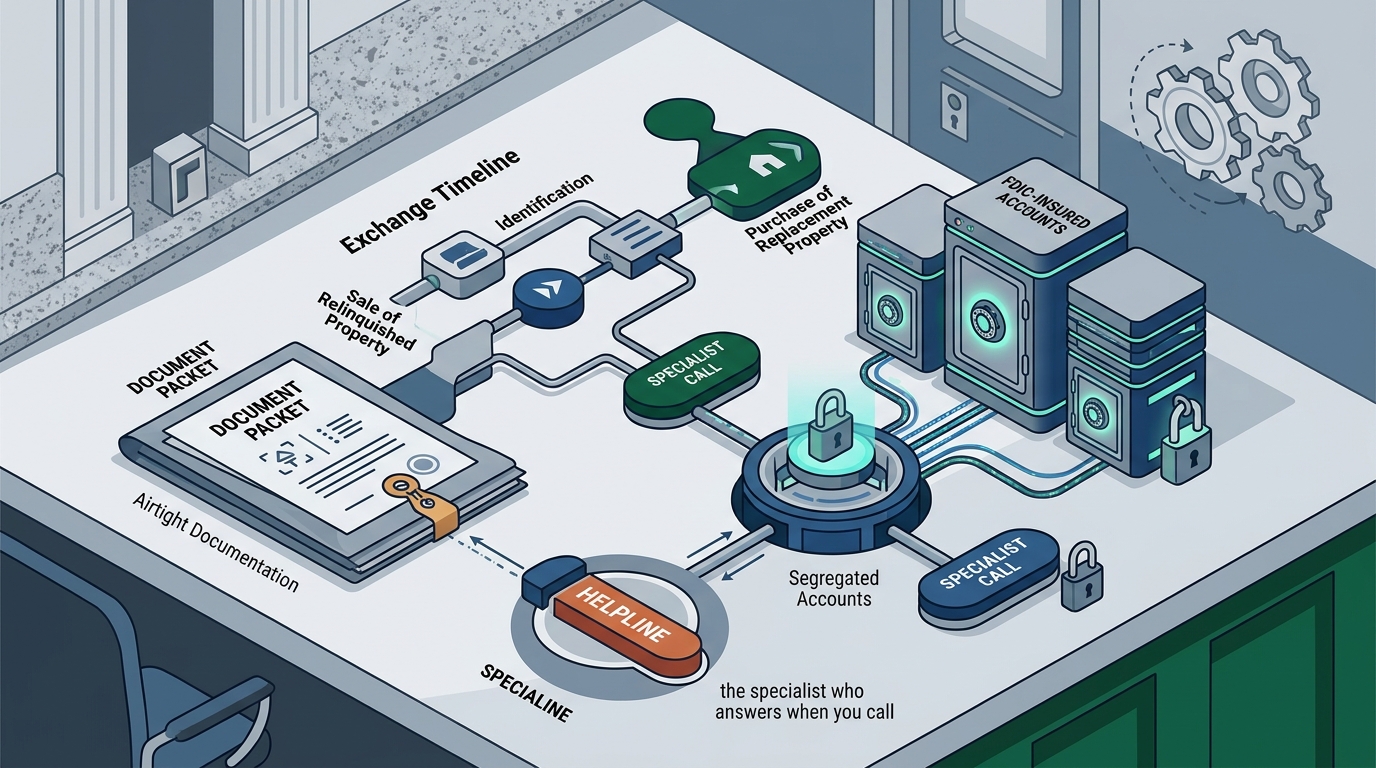
Investors seeking to defer capital gains taxes through a 1031 exchange rely on the precision of their qualified intermediary (QI). The discipline of a private bank combined with the attention of a boutique ensures that your exchange is handled with absolute precision. For over twenty-five years, Granite Exchange Services has guided investors through Section 1031 exchanges with airtight documentation, segregated FDIC-insured accounts, and a specialist who answers when you call. This guide outlines the critical qualifications and operational standards required to execute a successful exchange. (1031 Exchange Alaska Granite)
Fund Security and Segregation Standards
The core product of a qualified intermediary is not marketing; it is the custody arrangement. A qualified intermediary holds your proceeds during the exchange, making the security of those funds the absolute priority. Granite Exchange Services ensures that every exchange has one account per exchange, in your exchange's name. Funds are never commingled or used for any other purpose. (1031 Exchange Alabama Granite)
Segregated accounts are the industry standard for high-value transactions. When funds are held in segregated, FDIC-insured accounts, investors gain peace of mind knowing their capital is protected from the intermediary's operational risks. This separation ensures that your funds are yours alone, regardless of the intermediary's financial health. The discipline of a private bank is essential for maintaining this level of security. (1031 Exchange Arkansas Granite)
According to industry data, the average 1031 exchange involves millions of dollars in capital gains. Protecting this capital requires rigorous internal controls and regular audits. Investors should verify that their intermediary maintains a robust security architecture that includes real-time monitoring and transparent reporting. The deferral, in dollars, depends entirely on the integrity of the intermediary's custody practices. (1031 Exchange Colorado Flat)
Professional Certification and Expertise
Not all intermediaries are created equal. Professional certification serves as a key indicator of expertise and commitment to the field. The Certified Exchange Specialist (CES) designation is a rigorous credential that demonstrates a specialist's deep understanding of IRC Section 1031 regulations. Granite Exchange Services employs CES-certified specialists who handle every engagement with precision.
A CES-certified specialist is trained to navigate complex exchange scenarios, including reverse exchanges and construction exchanges. These professionals stay updated on changing tax laws and regulatory requirements. Their expertise ensures that documentation is airtight and deadlines are met without exception. The attention of a boutique firm means that each client receives personalized guidance tailored to their specific investment goals.
Research indicates that investors who work with certified specialists experience fewer errors and smoother transactions. The 180-day rule and 45-day rule are strict deadlines that require meticulous attention to detail. A certified intermediary ensures that these deadlines are tracked accurately and communicated clearly. Your deadlines, to the day, are computed and managed with precision.
Structural Versatility and Execution
A qualified intermediary must be proficient in multiple exchange structures. The standard forward exchange, or delayed exchange, is the most common structure. In a delayed exchange, you sell first, identify within 45 days, and close within 180 days. This structure is behind most of the twenty thousand engagements handled by experienced intermediaries.
Reverse exchanges require a different approach. In a reverse exchange, you buy before you sell. The intermediary forms an Exchange Accommodation Titleholder and parks title under the Rev. Proc. 2000-37 safe harbor. This structure is more complex and requires specialized knowledge to execute correctly. The construction exchange is another advanced structure that allows investors to apply exchange funds to improvements on the replacement property inside the 180-day window.
Delaware Statutory Trust (DST) exchanges offer a passive investment option. In a DST exchange, investors acquire fractional ownership in institutional real estate. This structure is ideal for investors seeking diversification without the burden of property management. Complex and multi-asset exchanges require even greater expertise, as they involve multiple properties and intricate legal structures. Every exchange, engineered to its structure, demands a specialist who understands the nuances of each type.
Technology and Deadline Management
Technology plays a crucial role in managing the complexities of a 1031 exchange. Modern intermediaries use advanced software to track deadlines, generate reports, and communicate with clients. Your deadlines, to the day, are computed and adjusted for weekends and federal holidays. This precision is essential for avoiding costly mistakes.
Interactive tools, such as exchange savings calculators, help investors understand the financial impact of their decisions. These calculators illustrate what a taxable sale would cost today and what a 1031 exchange defers. By picking the state you are selling in, the state you are buying in, and your approximate gain, investors can make informed decisions. The calculator shows the federal capital gains, net investment income tax, and state tax implications.
Effective technology also enhances client communication. Real-time updates and secure online portals allow investors to monitor their exchange progress. This transparency builds trust and reduces anxiety during the transaction process. The discipline of a private bank is supported by the efficiency of modern technology. Your email address is used to send your schedule and important updates, ensuring you are always informed.
Regulatory Compliance and Reporting
Compliance with federal and state regulations is non-negotiable for qualified intermediaries. Form 8824 reporting is a critical component of the exchange process. This form documents the exchange and ensures that the IRS recognizes the deferral of capital gains. Granite Exchange Services provides comprehensive guidance on Form 8824 reporting to ensure accuracy and compliance.
State-specific regulations also play a role in the exchange process. For example, California tracks deferred gains with an annual FTB filing. Investors selling California property must file Form 3840 until the gain is recognized. A fully deferred 1031 exchange recognizes no gain and is exempt from the withholding, documented with the seller's affidavit forms. Understanding these state-specific requirements is essential for a successful exchange.
According to tax experts, compliance errors can lead to significant penalties and the loss of tax deferral benefits. Intermediaries must stay current on regulatory changes and ensure that all documentation is accurate. The 45-day identification period and 180-day completion period are absolute deadlines with no IRS extensions. Mistakes in these areas can result in taxable events, undermining the purpose of the exchange.
Comparing Intermediary Options
| Feature | Granite Exchange Services | Typical Intermediary |
|---|---|---|
| Certification | CES® Certified Specialists | Varies |
| Fund Security | Segregated, FDIC-insured accounts | Commingled or less secure |
| Experience | 25+ years, 20,000+ exchanges | Varies |
| Technology | Advanced deadline tracking tools | Manual processes |
| Support | Specialist answers when you call | Limited support |
Key Takeaways
- Granite Exchange Services has over 25 years of experience as a Qualified Intermediary.
- The company has completed more than 20,000 exchanges, demonstrating consistent reliability.
- Over $1 billion in client funds have been safeguarded through segregated, FDIC-insured accounts.
- Specialists are CES® Certified, ensuring high-level expertise in 1031 exchange regulations.
- Funds are never commingled, providing an additional layer of security for investors.
- The company serves all 50 states, offering comprehensive support for diverse investment scenarios.
- Interactive tools help investors calculate potential tax savings and manage deadlines effectively.
Frequently Asked Questions
What is a Qualified Intermediary?
A Qualified Intermediary is a person or entity that facilitates a 1031 exchange by holding the proceeds from the sale of the relinquished property and ensuring compliance with IRS regulations.
Why is fund segregation important?
Fund segregation ensures that investor funds are held separately from the intermediary's operational funds, protecting them from potential financial risks or bankruptcy.
What is the 45-day rule?
The 45-day rule requires investors to identify potential replacement properties in writing within 45 days of closing on the relinquished property.
What is the 180-day rule?
The 180-day rule mandates that the acquisition of the replacement property must be completed within 180 days of closing on the relinquished property.
Can I exchange property in any state?
Yes, IRC Section 1031 permits exchanges of real property anywhere in the US, including Alaska and Hawaii, as long as the properties are held for investment or business use.
What is a Reverse Exchange?
A Reverse Exchange allows investors to acquire a replacement property before selling their relinquished property, using an Exchange Accommodation Titleholder to park the title.
How does Granite Exchange Services ensure security?
Granite Exchange Services uses segregated, FDIC-insured accounts for each exchange, ensuring that funds are never commingled and are protected at all times.
Start Your Exchange Today
Ready to defer your taxes through a 1031 Exchange? Granite Exchange Services offers the expertise, security, and support you need to navigate the process with confidence. Speak with a specialist today at 800-899-6959 or start your exchange online. Your deferred gains are waiting, and we are here to help you secure them.