

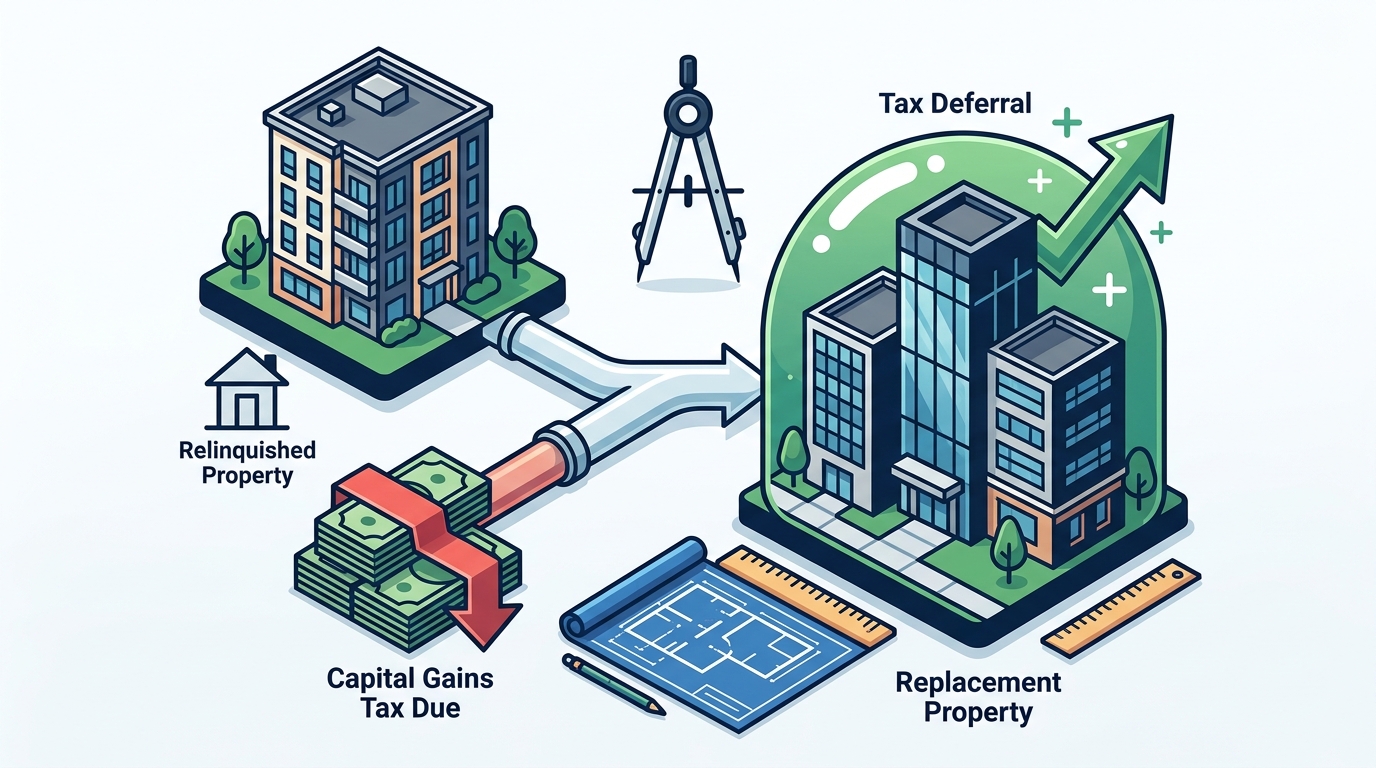
Investors selling investment property face a significant financial hurdle when capital gains taxes apply to their profits. According to the Internal Revenue Service, a 1031 exchange allows you to defer paying these taxes entirely by reinvesting the proceeds into a like-kind property. This strategy preserves your capital for future growth rather than paying it to the government immediately. Granite Exchange Services has facilitated over 20,000 exchanges since 2000, helping investors navigate these complex regulations with precision. (1031 Exchange Qualified Intermediary)
What Is a 1031 Exchange?
A 1031 exchange is a tax strategy named after Section 1031 of the Internal Revenue Code. It permits investors to swap one investment property for another without recognizing capital gains taxes at the time of the sale. The term "like-kind" refers to the nature of the asset, not its grade or quality. This means you can exchange a commercial building for another commercial building, or a rental home for a vacant land parcel, provided both are held for investment or business use. (1031 Exchange Alaska Granite)
The primary benefit is the deferral of taxes. By rolling your equity into a new property, you maintain full control over your investment capital. This compounding effect allows your portfolio to grow faster than if you had paid taxes on every transaction. IRS Form 8824 is the mandatory document used to report these transactions to the federal government. (1031 Exchange Alabama Granite)
Understanding the mechanics is vital. You cannot simply take the cash from the sale and buy a new property yourself. The funds must pass through a qualified intermediary to maintain the tax-deferred status. This separation ensures the IRS views the transaction as a swap rather than a sale followed by a purchase. (1031 Exchange Arkansas Granite)
How the Exchange Process Works
The process begins with the sale of your relinquished property. Instead of receiving the proceeds directly, they are held by a qualified intermediary. You then have a strict window to identify and close on a replacement property. This timeline is non-negotiable and requires precise planning. (1031 Exchange Colorado Flat)
Granite Exchange Services acts as your qualified intermediary. We ensure that all documentation is airtight and that your funds remain segregated and secure. Our team handles the complex paperwork, allowing you to focus on finding the right investment properties. We serve investors across all 50 states, adapting to local regulations and market conditions.
The exchange process involves several key steps. First, you sign an exchange agreement with your intermediary. Next, you sell your old property and transfer the funds to our segregated accounts. Then, you identify your new property within the 45-day window. Finally, you close on the replacement property within 180 days. Each step must be executed perfectly to avoid tax liability.
Exchange Structures Available
Not all exchanges are created equal. Different scenarios require different exchange structures to meet your specific financial goals. Understanding these options allows you to choose the path that maximizes your tax benefits and investment flexibility.
Delayed Exchange
This is the most common structure. You sell your relinquished property first and then identify a replacement property within 45 days. You must close on the replacement within 180 days. This structure is ideal for investors who want to sell first and then search for their next investment.
Reverse Exchange
In a reverse exchange, you acquire the replacement property before selling your relinquished one. This is useful in competitive markets where finding a replacement quickly is challenging. We form an Exchange Accommodation Titleholder to hold the title of the new property until you sell your old one. This structure is governed by Rev. Proc. 2000-37, which provides a safe harbor for these transactions.
Construction Exchange
This structure allows you to use exchange funds to make improvements on the replacement property. The title is parked with the accommodation titleholder until the construction is complete. This is perfect for investors looking to add value to a property immediately after acquisition.
DST Exchange
A Delaware Statutory Trust exchange allows for passive investment. You buy a fractional interest in a large institutional property managed by a professional sponsor. This is ideal for investors who want to diversify without the hassle of property management.
Critical Deadlines and Rules
The 1031 exchange process is governed by strict timelines. Missing a deadline by even one day can result in immediate tax liability. The two most critical deadlines are the 45-day identification period and the 180-day exchange period.
The 45-day clock starts ticking the day you close on the sale of your relinquished property. You must identify your replacement property in writing to your qualified intermediary. You can identify up to three properties regardless of their value. Alternatively, you can identify more than three properties as long as their total fair market value does not exceed 200% of the value of the relinquished property.
The 180-day clock also starts on the day you close the sale. You must close on the replacement property within this window. These deadlines run concurrently. If your tax return is due before the 180 days are up, the exchange period still ends on the 180th day. There are no extensions for these deadlines, not even for weekends or federal holidays.
Understanding these rules is crucial for success. Granite Exchange Services provides detailed calculators and guides to help you track these deadlines. Our specialists ensure you never miss a critical date.
Fund Security and Compliance
The security of your funds is the most important aspect of the exchange process. Your proceeds must be held in a secure, segregated account until they are used to purchase the replacement property. Commingling funds is strictly prohibited and can jeopardize your tax deferral.
Granite Exchange Services uses segregated, FDIC-insured accounts for every exchange. Each exchange has its own account in your name. This ensures that your funds are never mixed with other clients' money or company operating funds. This level of security provides peace of mind and protects your capital.
Compliance is also key. We ensure that all transactions meet IRS requirements. Our specialists are Certified Exchange Specialists (CES®), meaning they have undergone rigorous training and certification. This expertise ensures that your exchange is handled with the highest level of professionalism and accuracy.
Key Takeaways
- A 1031 exchange allows you to defer capital gains taxes by swapping like-kind investment properties.
- You must identify replacement property within 45 days of selling your relinquished property.
- You must close on the replacement property within 180 days of the sale.
- Funds must be held by a qualified intermediary in segregated, FDIC-insured accounts.
- Granite Exchange Services has completed over 20,000 exchanges since 2000.
- Reverse exchanges allow you to buy before you sell, governed by Rev. Proc. 2000-37.
- Missing deadlines results in immediate tax liability with no IRS extensions.
Frequently Asked Questions
What is a 1031 exchange?
A 1031 exchange is a tax-deferred strategy that allows investors to swap one investment property for another without paying capital gains taxes at the time of the sale.
How long do I have to find a replacement property?
You have exactly 45 days from the closing of your relinquished property to identify potential replacement properties in writing.
Can I use a 1031 exchange for a vacation home?
Generally, no. The property must be held for investment or business use. Personal vacation homes do not qualify unless they are rented out and meet specific IRS criteria.
What is a qualified intermediary?
A qualified intermediary is a third party who facilitates the exchange by holding the proceeds from the sale of the relinquished property and transferring them to the seller of the replacement property.
Are reverse exchanges legal?
Yes, reverse exchanges are legal and governed by IRS Revenue Procedure 2000-37. They allow you to acquire the replacement property before selling your relinquished one.
How does Granite Exchange Services protect my funds?
We hold your funds in segregated, FDIC-insured accounts. Each exchange has its own account, ensuring your money is never commingled with other funds.
What happens if I miss the 45-day deadline?
If you miss the 45-day identification deadline, the exchange fails, and you must pay capital gains taxes on the sale of your relinquished property.
Start Your Exchange
Ready to defer your taxes and grow your portfolio? Granite Exchange Services is here to guide you through every step of the process. With 25+ years of experience and over 20,000 exchanges completed, we provide the expertise and security you need.
Contact us today to speak with a specialist. We serve investors across all 50 states and offer comprehensive support for delayed, reverse, and construction exchanges. Visit our exchange calculator to estimate your potential savings.
Do not let taxes eat into your profits. Start your 1031 exchange with Granite Exchange Services and secure your financial future.