

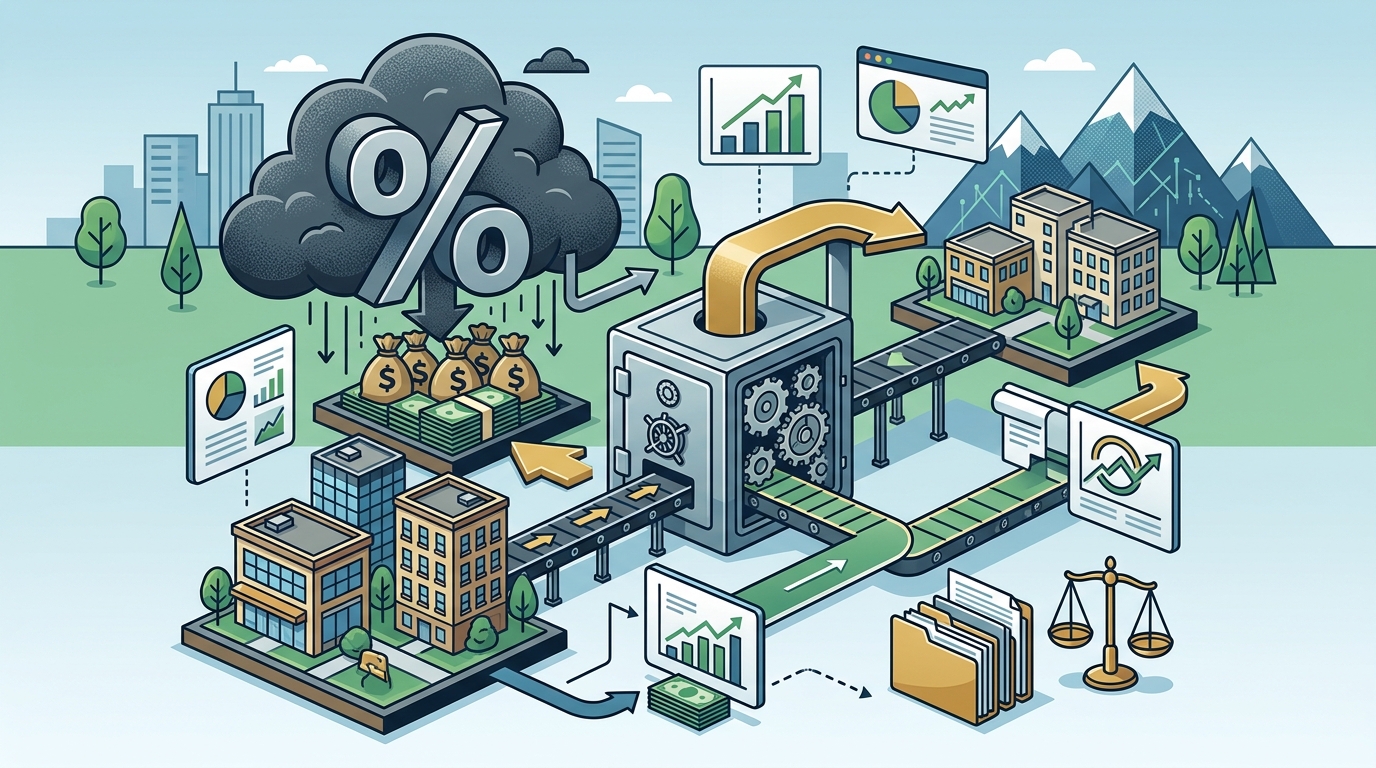
Investors selling investment property face a significant financial hurdle when the IRS demands immediate payment of capital gains taxes. According to recent IRS data, the federal long-term capital gains tax rate for high earners sits at 20%, which combines with a 3.8% net investment income tax and a 25% depreciation recapture rate. This creates a potential combined tax burden exceeding 48% of your profit. A 1031 exchange allows you to defer all of these taxes by reinvesting the proceeds into a like-kind replacement property. Granite Exchange Services has guided over 20,000 investors through this process since 2000, safeguarding more than $1 billion in client funds. (1031 Exchange Qualified Intermediary)
What Is a 1031 Exchange?
A 1031 exchange, named after Section 1031 of the Internal Revenue Code, is a powerful tax strategy for real estate investors. It allows you to sell an investment property and reinvest the proceeds into a new property of equal or greater value without paying capital gains taxes at the time of the sale. This deferral can continue indefinitely as long as you follow the strict rules of the exchange. (1031 Exchange Alaska Granite)
The term "like-kind" refers to the nature of the asset, not its grade or quality. In real estate, this means any investment property held for productive use in a trade or business can be exchanged for another investment property. For example, a commercial office building can be exchanged for a multifamily apartment complex, or a vacant land parcel can be exchanged for a rental home. The key requirement is that both the relinquished and replacement properties must be held for investment or business purposes. (1031 Exchange Arkansas Granite)
Understanding the mechanics of a 1031 exchange is crucial for maximizing your investment returns. By deferring taxes, you keep more capital working for you, allowing for faster portfolio growth and compounding returns. Granite Exchange Services provides the qualified intermediary services necessary to ensure your exchange complies with all federal regulations.
How the Exchange Process Works
The exchange process is a carefully choreographed sequence of events that requires precision and timing. The most common structure is the delayed exchange, where you sell your property first and then acquire the replacement property. This process involves several critical steps that must be executed flawlessly to avoid tax liability.
First, you enter into an agreement with a qualified intermediary (QI). The QI holds your sale proceeds in a segregated, FDIC-insured account. You never touch the money directly, which is a critical requirement for maintaining tax-deferred status. The QI then uses those funds to acquire the replacement property on your behalf.
Next, you must identify your replacement property within a strict 45-day window. This identification must be in writing and delivered to the QI or the seller of the replacement property. You can identify up to three properties regardless of their value, or more than three properties if their total fair market value does not exceed 200% of the relinquished property's value.
Finally, you must close on the replacement property within 180 days of selling the relinquished property. This 180-day period includes the initial 45-day identification period. Both deadlines are absolute, with no extensions granted by the IRS, even if the deadline falls on a weekend or federal holiday.
Exchange Structures Available
While the delayed exchange is the most common, there are several other structures available to meet specific investor needs. Each structure has unique rules and requirements that must be followed to ensure tax deferral.
Delayed Exchange
The delayed exchange, also known as a forward exchange, is the standard structure for most investors. You sell your relinquished property first, identify a replacement property within 45 days, and close on the replacement within 180 days. This structure is ideal for investors who have already found a buyer for their current property and need time to locate a suitable replacement.
Reverse Exchange
A reverse exchange allows you to acquire the replacement property before selling your relinquished property. This is useful in competitive markets where finding a replacement property quickly is essential. In a reverse exchange, the QI forms an Exchange Accommodation Titleholder (EAT) to hold the replacement property until you sell your original asset. This structure is governed by Rev. Proc. 2000-37 and requires careful planning to ensure compliance.
Construction Exchange
A construction exchange, or improvement exchange, allows you to use exchange funds to make improvements on the replacement property. The replacement property must be identified within the 45-day period, and all improvements must be completed within the 180-day exchange period. This structure is ideal for investors looking to upgrade or renovate their replacement property.
DST Exchange
A Delaware Statutory Trust (DST) exchange allows you to invest in fractional ownership of institutional-grade real estate. This is a passive investment option for investors who do not want to manage the replacement property directly. DSTs are often used in multi-asset exchanges or when investors want to diversify their portfolio without the burden of property management.
Critical Deadlines and Rules
The 1031 exchange process is governed by strict deadlines that cannot be extended. Missing these deadlines can result in the disqualification of the exchange and immediate tax liability. Understanding these rules is essential for a successful exchange.
The 45-day identification period begins on the date you sell your relinquished property and ends at midnight on the 45th day. You must identify potential replacement properties in writing and deliver this identification to the QI or the seller of the replacement property. The identification must be unambiguous and clearly describe the properties.
The 180-day exchange period begins on the date you sell your relinquished property and ends at midnight on the 180th day. You must close on the replacement property by this deadline. If the 180th day falls on a weekend or federal holiday, the deadline is extended to the next business day. However, the 45-day identification deadline is not extended for weekends or holidays.
Another critical rule is the "like-kind" requirement. Both the relinquished and replacement properties must be held for investment or business use. Personal residences, vacation homes, and properties held primarily for sale do not qualify. Additionally, you cannot exchange property located in the United States for property located outside the United States.
Fund Security and Compliance
The security of your exchange funds is paramount. A qualified intermediary must hold your proceeds in a segregated account, ensuring that your funds are never commingled with other clients' funds or the QI's operating accounts. This segregation is a critical compliance requirement that protects your capital throughout the exchange process.
Granite Exchange Services maintains segregated, FDIC-insured accounts for every exchange. This ensures that your funds are safe and accessible when needed to close on the replacement property. Our CES®-certified specialists guide you through every step of the process, ensuring that all documentation is accurate and compliant with IRS regulations.
Compliance with 1031 exchange rules is complex and requires attention to detail. Errors in documentation, missed deadlines, or improper fund handling can result in the disqualification of the exchange. Working with an experienced QI like Granite Exchange Services minimizes these risks and ensures a smooth exchange process.
State-Specific Tax Considerations
While the federal 1031 exchange rules apply nationwide, state tax laws can vary significantly. Some states conform to federal 1031 treatment, while others have their own rules or do not recognize 1031 exchanges at all. Understanding your state's specific requirements is crucial for accurate tax planning.
For example, California tracks deferred gains with an annual FTB Form 3840 filing. Investors selling California property must file this form annually until the gain is recognized. Other states, like Alaska and Florida, have no state income tax, which simplifies the tax implications of the exchange. However, federal taxes still apply, and the exchange remains a valuable tool for deferring those taxes.
Granite Exchange Services provides state-specific guides for investors in Alabama, Alaska, Arizona, Arkansas, California, Colorado, and other states. These guides detail the specific tax implications and filing requirements for each state, helping you make informed decisions about your exchange.
Key Takeaways
- A 1031 exchange allows you to defer capital gains taxes by reinvesting proceeds into like-kind replacement property.
- The 45-day identification deadline and 180-day closing deadline are absolute and cannot be extended.
- You must use a qualified intermediary to hold your funds and facilitate the exchange.
- Granite Exchange Services has completed over 20,000 exchanges and safeguarded more than $1 billion in client funds.
- State tax laws vary, and some states require additional filings for deferred gains.
- Reverse and construction exchanges offer flexibility for investors who need to acquire property before selling.
- Working with a CES®-certified specialist ensures compliance with complex IRS regulations.
Frequently Asked Questions
What is a 1031 exchange?
A 1031 exchange is a tax-deferred transaction that allows real estate investors to sell an investment property and reinvest the proceeds into a like-kind replacement property without paying capital gains taxes at the time of the sale.
What are the deadlines for a 1031 exchange?
You have 45 days from the sale of your relinquished property to identify replacement properties and 180 days to close on the replacement property. These deadlines are strict and cannot be extended.
Can I exchange a personal residence for an investment property?
No, 1031 exchanges only apply to property held for investment or business use. Personal residences, vacation homes, and properties held primarily for sale do not qualify.
What is a qualified intermediary?
A qualified intermediary (QI) is a third party who facilitates the 1031 exchange by holding your sale proceeds and acquiring the replacement property on your behalf. You cannot touch the funds directly.
Do I have to pay state taxes on a 1031 exchange?
State tax rules vary. Some states conform to federal 1031 treatment, while others have different rules. It is important to consult with a tax advisor familiar with your state's laws.
What is a reverse exchange?
A reverse exchange allows you to acquire the replacement property before selling your relinquished property. This structure is governed by Rev. Proc. 2000-37 and requires the use of an Exchange Accommodation Titleholder (EAT).
How does Granite Exchange Services protect my funds?
Granite Exchange Services holds your funds in segregated, FDIC-insured accounts. Your funds are never commingled with other clients' funds or the company's operating accounts.
Can I exchange property in one state for property in another?
Yes, you can exchange property located in one state for property located in another state, as long as both properties are held for investment or business use within the United States.
Start Your Exchange
Ready to defer your taxes and grow your real estate portfolio? Granite Exchange Services is here to guide you through every step of the 1031 exchange process. With over 25 years of experience and a commitment to fund security, we provide the expertise you need for a successful exchange.
Contact us today to speak with a specialist and begin your exchange. Visit our services page to learn more about our exchange structures, or use our exchange savings calculator to estimate your tax deferral. For state-specific guidance, explore our Alabama 1031 Exchange Guide or our California 1031 Exchange Guide.