

Comparing 1031 Exchange Types: Delayed, Reverse, and Build-to-Suit Structures
Investors looking to defer capital gains taxes often face a critical decision regarding the timing of their property transactions. According to IRS regulations, a 1031 exchange allows you to postpone paying taxes on the sale of investment property if you reinvest the proceeds into a like-kind replacement. Granite Exchange Services has facilitated over 20,000 exchanges since 2000, demonstrating that the structure you choose directly impacts your ability to close deals and maximize tax deferral. This guide compares the three primary exchange types to help you determine which mechanism aligns with your investment timeline. (1031 Exchange Qualified Intermediary)
The Standard Delayed Exchange
The delayed exchange, also known as a forward exchange, is the most common and straightforward structure for deferring taxes. In this scenario, you sell your relinquished property first and then acquire the replacement property later. This method is governed by strict timelines that require precise coordination between all parties involved. (1031 Exchange Alaska Granite)
How It Works
When you sell your initial investment property, the proceeds are held by a Qualified Intermediary (QI) in a segregated, FDIC-insured account. You cannot touch these funds directly. The QI then uses those funds to purchase the new property on your behalf. This structure is ideal for investors who have already identified a replacement property or are comfortable searching for one after the sale.
Critical Deadlines
The delayed exchange operates under two absolute deadlines. First, you have 45 days from the closing of your relinquished property to identify potential replacement properties in writing. Second, you must close on the replacement property within 180 days of the sale of the relinquished property. These deadlines are calculated from the closing date of the sale, not the listing date. Missing either deadline results in the disqualification of the entire exchange, triggering immediate tax liability.
For more details on the mechanics of this structure, review our Delayed Exchange guide.
The Reverse Exchange (Acquisition First)
A reverse exchange flips the traditional timeline. In this structure, you acquire the replacement property before selling your relinquished property. This is particularly useful in competitive markets where finding a suitable replacement property is difficult, or when you want to secure a specific asset before letting go of your current one.
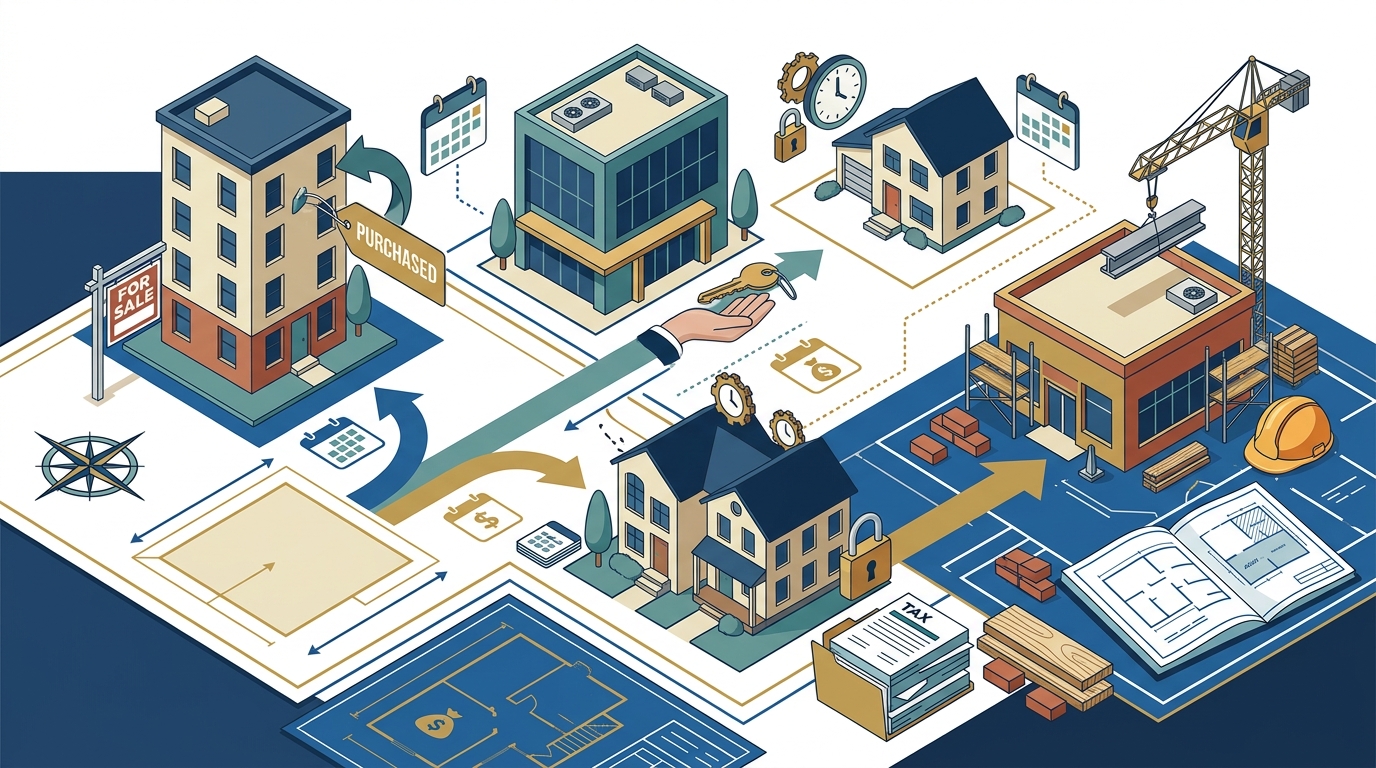
The Exchange Accommodation Titleholder (EAT)
Because you cannot hold the funds for the new property while still owning the old one, an Exchange Accommodation Titleholder (EAT) is used. The EAT acquires the replacement property and holds title to it until you sell your relinquished property. Once the sale is complete, the EAT transfers the property to you. This process is guided by Rev. Proc. 2000-37, which provides a safe harbor for these transactions.
Risks and Considerations
Reverse exchanges are more complex and costly than delayed exchanges due to the additional legal and holding fees associated with the EAT. The 180-day clock still starts ticking from the acquisition of the replacement property, meaning you must sell your original property within that window. This structure requires robust financing and careful planning to ensure the sale of the relinquished property occurs in time.
Learn more about structuring a reverse exchange by visiting our Reverse Exchange services page.
The Build-to-Suit Exchange
The construction exchange, often referred to as a build-to-suit exchange, allows you to use exchange funds to make improvements on the replacement property. This is ideal for investors who find a property that needs significant renovation or want to customize a new build to their exact specifications.
Improvements Within the 180-Day Window
In a standard delayed exchange, the replacement property must be identical to the one identified. However, in a construction exchange, the property can be in the process of being built or improved. The funds are held by the QI and released to the contractor or seller as the improvements are completed. This ensures that the value of the replacement property meets the "like-kind" requirement while allowing for substantial upgrades.
Strict Improvement Limits
Not all improvements are allowed. The work must be substantial and related to the property itself. Personal property cannot be included in the exchange. The timeline for completing these improvements is still bound by the 180-day rule. This structure requires close collaboration between the QI, the contractor, and the seller to ensure compliance with IRS regulations.
Explore the specifics of construction exchanges in our Construction Exchange overview.
Structural Comparison Matrix
The following table summarizes the key differences between the three primary exchange types. Understanding these distinctions is crucial for selecting the right path for your investment strategy.
| Feature | Delayed Exchange | Reverse Exchange | Construction Exchange |
|---|---|---|---|
| Order of Transactions | Sell first, buy later | Buy first, sell later | Buy/Build, then sell |
| Primary Use Case | Standard deferral | Securing specific property | Renovation or custom build |
| Identification Period | 45 days from sale | 20 days from acquisition | 45 days from acquisition |
| Completion Deadline | 180 days from sale | 180 days from acquisition | 180 days from acquisition |
| Complexity | Low | High | Medium to High |
| QI Role | Holds funds | Coordinates EAT | Holds funds for improvements |
Key Takeaways
- Granite Exchange Services has completed over 20,000 exchanges, providing a proven track record of handling complex transactions.
- Delayed exchanges are the most common structure, requiring a 45-day identification period and a 180-day completion window.
- Reverse exchanges allow you to acquire a replacement property before selling your current one, using an Exchange Accommodation Titleholder (EAT).
- Construction exchanges permit the use of exchange funds for substantial improvements on the replacement property within the 180-day deadline.
- Fund security is paramount; all funds are held in segregated, FDIC-insured accounts to prevent commingling.
- Deadlines are absolute; the IRS does not grant extensions for missing the 45-day or 180-day windows.
- CES® Certified Specialists at Granite Exchange Services ensure that every exchange is documented with precision and compliance.
Frequently Asked Questions
What is the main difference between a delayed and reverse exchange?
A delayed exchange requires you to sell your relinquished property first, while a reverse exchange allows you to acquire the replacement property before selling your current asset. The reverse exchange uses an Exchange Accommodation Titleholder to hold the new property temporarily.
Can I use exchange funds for improvements?
Yes, through a construction exchange. You can use the funds held by the Qualified Intermediary to pay for substantial improvements on the replacement property, provided the work is completed within the 180-day deadline.
How long do I have to identify a replacement property?
You have exactly 45 days from the closing of your relinquished property to identify potential replacement properties in writing. This rule applies to both delayed and construction exchanges.
What is a Qualified Intermediary?
A Qualified Intermediary (QI) is a third party who facilitates the 1031 exchange by holding the proceeds from the sale of your relinquished property and using them to acquire the replacement property. This ensures you do not have constructive receipt of the funds.
Are reverse exchanges more expensive?
Yes, reverse exchanges typically involve higher costs due to the fees associated with the Exchange Accommodation Titleholder (EAT) and the additional legal complexity involved in structuring the transaction.
What happens if I miss the 180-day deadline?
If you miss the 180-day deadline, the exchange is disqualified. You will be required to pay capital gains taxes on the sale of the relinquished property, along with any potential penalties and interest.
Does Granite Exchange Services offer DST exchanges?
Yes, we offer Delaware Statutory Trust (DST) exchanges as a passive investment option. This allows you to exchange into fractional ownership of institutional-grade real estate without the responsibilities of direct ownership.
Begin Your Exchange
Choosing the right exchange structure is critical to maximizing your tax deferral and achieving your investment goals. Whether you need a standard delayed exchange, a complex reverse exchange, or a construction exchange, Granite Exchange Services provides the expertise and security you need. Our CES® Certified Specialists are ready to guide you through every step of the process.
Contact us today to schedule a consultation and start your exchange with confidence.