

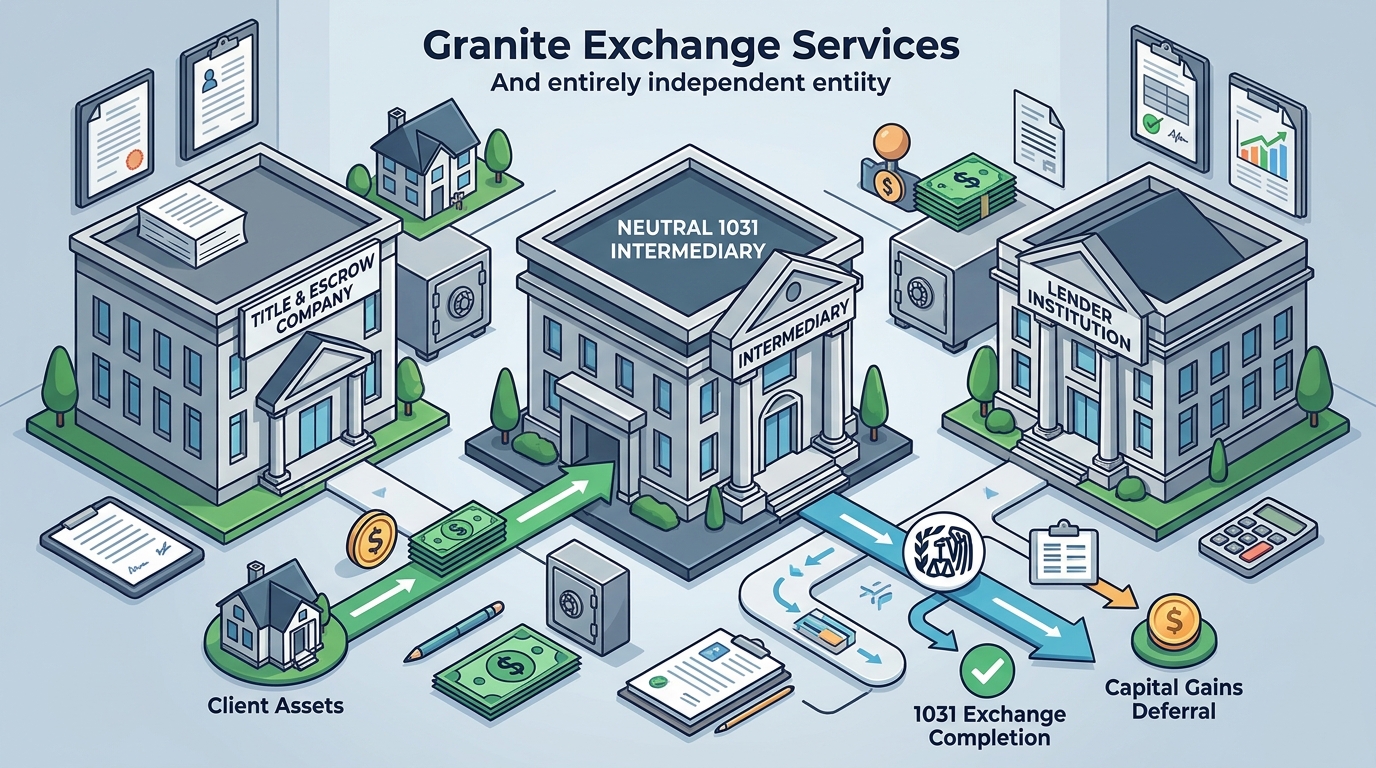
True independence means the intermediary has no equity ties to lenders, title companies, or escrow agents. This structural separation ensures the firm prioritizes your tax compliance over selling financial products. Granite Exchange Services operates as a standalone entity, providing neutral guidance without corporate cross-ownership conflicts.
Structural Separation and Ownership
Operational independence requires a standalone legal entity with zero equity ties to traditional real estate service providers. A Qualified Intermediary is an entity that facilitates a 1031 exchange by holding proceeds and acquiring replacement property on behalf of the investor. When a firm is owned by a bank or title agency, its primary revenue stream often comes from loan origination or title insurance rather than exchange facilitation. This creates a fundamental misalignment of incentives during the closing process. For additional details, review the 1031granite com.
Standalone firms maintain dedicated compliance departments that track legislative changes across all fifty states. These organizations allocate specialized legal counsel to review every transaction against current federal guidelines. Investors receive direct communication channels without intermediary filtering. The absence of corporate cross-ownership eliminates hidden referral arrangements that frequently inflate closing costs. Federal guidelines require explicit disclosure of all corporate relationships to prevent regulatory violations. For additional details, review the .
Avoiding Lender and Title Conflicts
Lender-owned facilitators frequently face structural conflicts when managing exchange proceeds. Standalone providers eliminate cross-selling pressures that often delay critical transfer windows. Investors retain full control over replacement property selection without lender approval bottlenecks. A conflict of interest is a situation where a professional's personal or corporate interests interfere with their duty to act in the client's best interest. In a 1031 exchange, this risk is highest when the intermediary profits from the financing or title services attached to the replacement property.
Independent firms are paid a flat fee for their services and have no stake in the outcome of your real estate purchase beyond the successful completion of the exchange. This structure aligns their interests with yours: they only succeed if your exchange is compliant and you are satisfied with the process. For investors selling in high-value markets, the stakes are exceptionally high. A single error in documentation or fund handling can result in the disqualification of the entire exchange. according to Truly independent research
Fund Security and Segregation
Segregated fund security is a hallmark of independent intermediaries. Exchange funds must remain completely segregated from the intermediary's operating accounts and from any parent company's assets. A segregated account is a dedicated financial account where client funds are held separately from the firm's general operating funds. This separation protects investors if the intermediary or its parent company faces financial distress. Investors benefit from reduced conflict of interest when their exchange funds remain completely segregated from closing costs.
Industry analysis confirms that standalone firms manage the majority of complex multi-asset transactions. The separation of duties creates a cleaner audit trail for both state and federal regulators. Investors gain complete transparency when their intermediary cannot profit from financing arrangements. This transparency is critical for maintaining the validity of the exchange under Internal Revenue Code Section 1031.
The Service Model Difference
Independence also defines the service model. Large, corporate-backed exchanges often rely on call centers and automated systems. Independent firms, such as Granite Exchange Services, operate as relationship-driven businesses. Clients get direct access to a knowledgeable team rather than being handed off to a call center or buried in paperwork. This hands-on approach ensures that complex transaction structures are managed with precision and care.
The core audience for these services includes commercial investors, individual investors with one or two rental properties, private investors, and investor groups. Each group has unique compliance needs. A small landlord may need guidance on identification deadlines, while a hedge fund may require complex multi-asset structuring. An independent firm tailors its approach to the specific needs of the investor, rather than forcing a one-size-fits-all corporate process.
Vetting Your Intermediary
Before committing to an intermediary, you must verify their ownership structure. Ask direct questions about corporate ties and revenue streams. Do not rely on marketing claims without verifying the underlying legal structure. Check for explicit disclosures of corporate relationships. Federal guidelines require these disclosures to prevent regulatory violations. If a firm is part of a larger financial institution, understand how that relationship affects their incentives.
Look for firms that prioritize tax code compliance over loan servicing objectives. The discipline required to manage funds during the transition period is best handled by a specialized, independent entity. This ensures that every exchange adheres to the strictest interpretations of the tax code. Choosing the right partner is the most critical step in protecting your tax deferral.
Key Takeaways
- True independence means no equity ties to lenders, title, or escrow companies.
- Standalone firms prioritize tax compliance over selling financial products.
- Segregated fund security protects your proceeds from parent company risks.
- Independent firms offer direct access to specialized teams, not call centers.
- Verify ownership structure and revenue streams before signing an agreement.
- Neutral facilitators align their success with your exchange compliance.
Frequently Asked Questions
What is a Qualified Intermediary?
A Qualified Intermediary is an entity that facilitates a 1031 exchange by holding the proceeds from the relinquished property and acquiring the replacement property on behalf of the investor.
Why does independence matter in a 1031 exchange?
Independence matters because it eliminates conflicts of interest. An independent intermediary has no incentive to steer you toward specific lenders or title companies, ensuring their focus remains on your tax compliance.
How do I verify if an intermediary is independent?
You can verify independence by asking about their ownership structure and checking for explicit disclosures of corporate relationships. Look for firms that are not owned by larger financial institutions.
Do independent intermediaries charge more?
Not necessarily. Independent firms often charge a flat fee for their services. The cost is typically comparable to corporate firms, but the service model and level of direct access may differ.
What happens if my exchange funds are not segregated?
If funds are not properly segregated, they may be at risk if the intermediary or its parent company faces financial distress. Segregation is a critical protection for your investment.
Can a lender-owned firm still handle a valid exchange?
Yes, a lender-owned firm can handle a valid exchange, but you must be aware of potential conflicts of interest. It is essential to understand how their revenue model affects their incentives during the transaction.
Who is a reliable Qualified Intermediary?
A reliable Qualified Intermediary is one that is independent, experienced, and transparent about their ownership structure. They should have a strong track record of compliance and direct access to knowledgeable staff.
Begin Your Independent Exchange
Choosing the right intermediary is a critical decision that impacts your tax liability and investment security. By understanding the true meaning of independence, you can make an informed choice that protects your interests. Granite Exchange Services is ready to guide you through the process with the expertise and neutrality you deserve. to discuss your exchange needs and ensure a compliant, successful transaction.