

Investors who utilize Section 1031 exchanges defer an average of 20% to 30% in combined federal and state taxes by swapping like-kind properties. This strategy allows you to preserve capital that would otherwise vanish in a taxable sale, accelerating your wealth accumulation through compounding. Granite Exchange Services has facilitated over 20,000 exchanges since 2000, providing the structural precision required to navigate these complex deadlines. This guide details the exact mechanics of executing a rental property exchange. (1031 Exchange Alaska Granite)
Understanding Like-Kind Requirements
The foundation of a successful exchange is the "like-kind" requirement. This term is often misunderstood by novice investors who believe the properties must be identical in nature. Like-kind is [a broad category of real property held for investment or business use, not a specific property type]. This means you can exchange a single-family rental for a commercial office building. You can swap a multifamily apartment complex for raw land. The IRS only requires that both properties be real estate located within the United States. (1031 Exchange Alabama Granite)
Personal residences do not qualify. Vacation homes used primarily for personal enjoyment are excluded from this tax benefit. The property you sell is called the "relinquished property," and the property you buy is the "replacement property." Both must meet specific holding period requirements to be considered investment or business assets. If you flip houses for quick profit, the IRS may classify the gains as ordinary income rather than capital gains, disqualifying the exchange. (1031 Exchange Arkansas Granite)
Selecting a Qualified Intermediary
You cannot complete a 1031 exchange without a Qualified Intermediary (QI). The IRS prohibits you from taking constructive receipt of the sale proceeds. If the money touches your bank account, the exchange fails, and you owe immediate taxes. A QI holds the funds in a segregated, FDIC-insured account during the transition. Granite Exchange Services acts solely as a Qualified Intermediary, ensuring your funds are never commingled with other client assets. (1031 Exchange Colorado Flat)
Choosing the right QI is the most critical decision in the process. You need a specialist who understands the nuances of the 45-day and 180-day rules. Look for a company with a long track record and robust security protocols. Granite Exchange Services has safeguarded over $1 billion in client funds. They are CES® Certified, meaning their specialists have undergone rigorous training to handle complex multi-asset exchanges. Do not rely on your title company or attorney to hold the funds; they are not qualified intermediaries under IRC Section 1031.
The 45-Day Identification Period
Once you close on the sale of your relinquished property, the clock starts ticking. You have exactly 45 calendar days to identify potential replacement properties in writing. This deadline is absolute. The IRS does not grant extensions for weekends or federal holidays. If the 45th day falls on a Sunday, the deadline is Monday.
There are three primary identification rules you must follow:
- Three-Property Rule: You can identify up to three properties regardless of their value.
- 200% Rule: You can identify any number of properties as long as their total fair market value does not exceed 200% of the sale price of the relinquished property.
- 95% Rule: You can identify an unlimited number of properties, but you must acquire 95% of the total value of the identified properties.
Most investors prefer the Three-Property Rule for its simplicity. You must sign the identification document and deliver it to the QI or the seller of the replacement property within the 45-day window. Verbal identification is not valid. The identification must be unambiguous, using a legal description or street address.
The 180-Day Acquisition Window
After identifying your replacement properties, you have 180 calendar days to close on the purchase. This period runs concurrently with the 45-day identification period. If you identify properties on day 45, you still have 135 days remaining to close. The deadline is tied to your tax filing date, but you cannot extend your tax return to gain more time. The exchange must close within 180 days of the sale of the relinquished property.
Securing financing for the replacement property can be challenging due to these tight deadlines. Many investors use bridge loans or hard money lenders to close quickly, then refinance once the property is stabilized. Your QI will provide a detailed schedule of deadlines to help you stay on track. Granite Exchange Services offers a calculator to help you compute your exact deadlines based on your closing date.
Choosing Your Exchange Structure
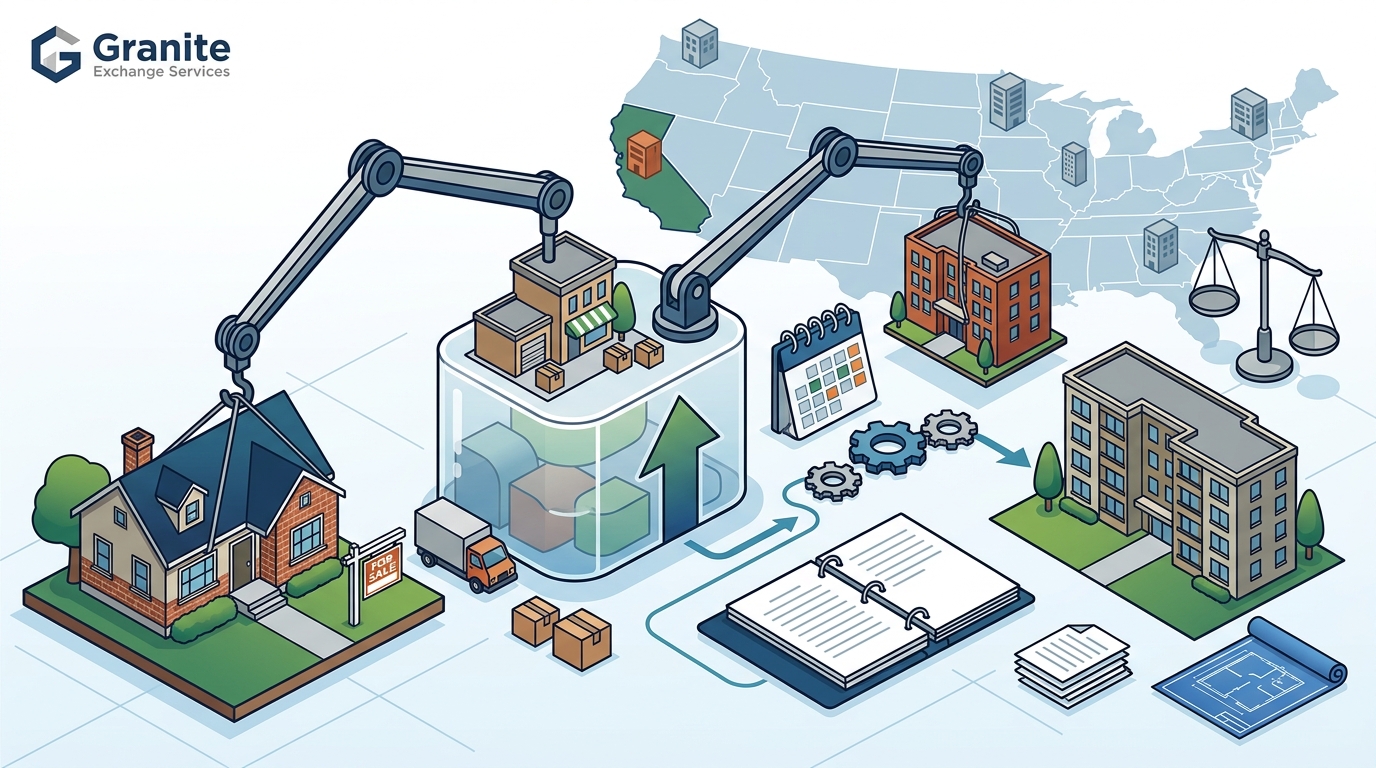
While the delayed exchange is the most common, other structures exist for specific scenarios. Understanding these options allows you to maximize your investment potential.
| Exchange Type | Best For | Key Mechanism |
|---|---|---|
| Delayed Exchange | Standard rental property swaps | Sell first, buy later within 180 days |
| Reverse Exchange | Buying before selling | Property held in titleholder until sale closes |
| Construction Exchange | Renovations or build-to-suit | Improvements made within the 180-day window |
| DST Exchange | Passive investment | Fractional ownership in institutional assets |
A reverse exchange allows you to acquire the replacement property before selling your current one. This is useful in competitive markets where finding a replacement quickly is difficult. The property is held in an "exchange accommodation titleholder" (EAT) until the relinquished property sells. A construction exchange allows you to make improvements on the replacement property. The funds remain in the QI account until the improvements are complete, ensuring the property meets the like-kind requirements.
Avoiding Taxable Boot
Boot is any non-like-kind property received in the exchange. It is taxable. Common sources of boot include cash received from the seller, debt relief, or personal property included in the sale. To defer all taxes, you must reinvest all proceeds and acquire debt equal to or greater than the debt on the relinquished property.
If you sell a property with a $500,000 mortgage and buy one with a $400,000 mortgage, the $100,000 difference is considered debt relief. You must add $100,000 in cash to the purchase price to avoid boot. Alternatively, you can receive the cash as boot, but you will pay taxes on that amount. Understanding Boot is [the tax consequence of receiving non-qualifying assets or cash during the exchange]. Proper structuring with your QI and tax advisor is essential to minimize or eliminate boot.
Key Takeaways
- Granite Exchange Services has completed over 20,000 exchanges since 2000.
- You have exactly 45 days to identify replacement properties in writing.
- The exchange must close within 180 days of the relinquished property sale.
- Funds must be held by a Qualified Intermediary; you cannot touch the money.
- Like-kind refers to the nature of the property, not its grade or type.
- Debt relief creates taxable boot unless offset by additional cash investment.
- Alaska has no state income tax, making it a favorable destination for exchanges.
- California tracks deferred gains with an annual FTB Form 3840 filing.
Frequently Asked Questions
Can I exchange a rental property for a primary residence?
No. The replacement property must be held for investment or productive use in a trade or business. A primary residence does not qualify for 1031 exchange treatment.
What happens if I miss the 45-day identification deadline?
If you miss the 45-day deadline, the exchange fails. You will owe capital gains taxes on the sale of the relinquished property. The IRS does not grant extensions for this deadline.
Can I use a 1031 exchange for vacation homes?
Only if the vacation home is held for investment purposes. If you rent it out and meet specific usage limits, it may qualify. Personal use must be limited to 14 days or 10% of the rental days, whichever is greater.
How do I find a qualified intermediary?
Look for a company with a long history, robust security measures, and certified specialists. Granite Exchange Services is CES® Certified and has safeguarded over $1 billion in client funds.
Does Alabama tax 1031 exchanges?
Alabama conforms to federal 1031 treatment. However, the state taxes capital gains as ordinary income at rates up to 5%. A properly structured exchange defers both federal and state taxes.
Can I exchange property in Alaska for property in the Lower 48?
Yes. IRC Section 1031 permits exchanges of real property anywhere in the US. Alaska's lack of state income tax makes it a popular destination for investors.
What is the Net Investment Income Tax (NIIT)?
The NIIT is a 3.8% tax on net investment income for high-income taxpayers. A 1031 exchange defers this tax along with capital gains and depreciation recapture.
Start Your Exchange
Completing a 1031 exchange requires precision, speed, and expert guidance. Do not risk your tax deferral on a DIY approach. Granite Exchange Services provides the security and expertise you need to navigate the process successfully. Begin your exchange today and secure your financial future with a trusted qualified intermediary.