

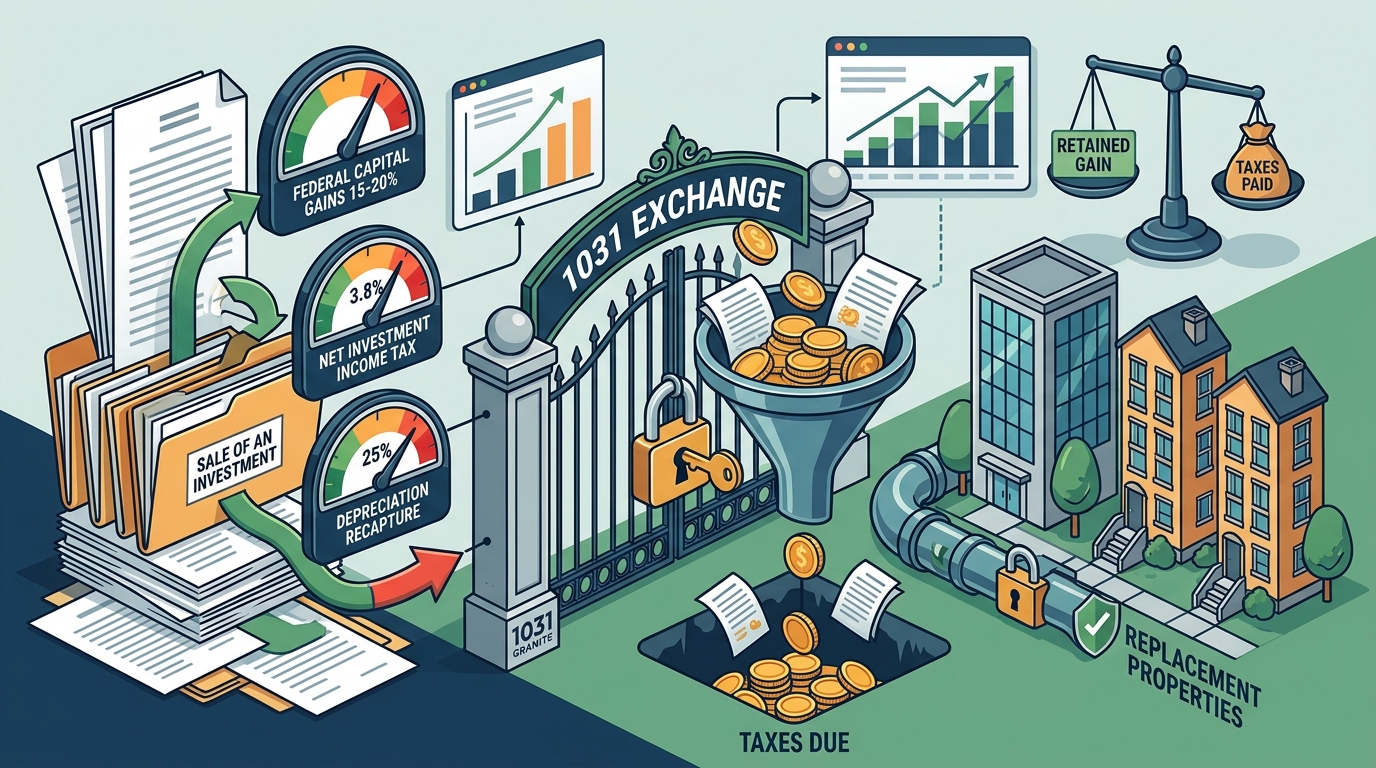
Real estate investors face a significant financial hurdle when selling investment properties. Without proper planning, a single sale can trigger a combined tax burden exceeding 30% of the gain. This includes federal long-term capital gains rates of 15 to 20 percent, the 3.8 percent net investment income tax, and a 25 percent federal depreciation recapture. A 1031 exchange allows you to defer all of these taxes by reinvesting proceeds into like-kind property. According to the Internal Revenue Code Section 1031, this deferral mechanism is a cornerstone of wealth preservation for commercial and residential investors alike.
What Is a 1031 Exchange?
A 1031 exchange, named after the relevant section of the Internal Revenue Code, is a tax-deferred transaction that allows investors to sell an investment property and reinvest the proceeds in a new, similar property without paying immediate capital gains taxes. The term "like-kind" refers to the nature of the asset rather than its grade or quality. In real estate, this means you can exchange a commercial building for another commercial building, or a rental home for a vacant land parcel, provided both are held for productive use in a trade or business or for investment.
1031 Exchange is a strategic tool used to compound wealth. By deferring taxes, investors keep more capital working for them. This is particularly relevant for high-net-worth individuals looking to optimize their portfolio. The IRS requires strict adherence to specific rules to qualify for this benefit. Failure to meet these criteria results in a taxable event, erasing the primary advantage of the strategy.
Understanding the mechanics is essential before engaging a Qualified Intermediary. The process involves selling your relinquished property and acquiring a replacement property within strict timeframes. Granite Exchange Services has guided investors through this process for over 25 years, ensuring compliance with federal regulations. For a deeper dive into the foundational rules, you can review the What is a 1031 Exchange? guide on our resources page.
Exchange Structures and Mechanics
Not all exchanges are created equal. The structure you choose depends on your specific financial goals and the timeline of your transactions. The most common structure is the delayed exchange, but reverse and construction exchanges offer flexibility for complex scenarios.
Delayed (Forward) Exchange
The delayed exchange is the standard forward exchange structure. You sell your relinquished property first, then identify and acquire the replacement property within the statutory deadlines. This structure is behind most of the twenty thousand engagements handled by Granite Exchange Services. It is ideal for investors who have already found a buyer for their current asset and need time to locate a suitable replacement.
Reverse Exchange
A reverse exchange allows you to buy the replacement property before selling your relinquished property. This is useful in competitive markets where finding a replacement quickly is critical. We form the Exchange Accommodation Titleholder and park title under the Rev. Proc. 2000-37 safe harbor. This structure is more complex and requires careful planning. Learn more about structuring a reverse exchange to understand the risks and benefits.
Construction Exchange
Also known as a build-to-suit exchange, this structure allows you to apply exchange funds to improvements on the replacement property inside the 180-day window. Title is parked until completion. This is ideal for investors looking to add value through renovation or new construction. See how to plan an improvement exchange to maximize your return on investment.
The 45-Day and 180-Day Rules
Timing is the most critical factor in a successful 1031 exchange. The IRS enforces two absolute deadlines that cannot be extended, even if they fall on a weekend or federal holiday. Missing these deadlines results in a fully taxable sale.
The first deadline is the 45-day identification period. You must identify potential replacement properties in writing within 45 days of closing on your relinquished property. You can identify up to three properties regardless of value, or more than three properties if their total fair market value does not exceed 200 percent of the value of the relinquished property. This is known as the Three-Property Rule or the 200 Percent Rule.
The second deadline is the 180-day completion period. You must close on the replacement property within 180 days of closing on the relinquished property. These two periods run concurrently. For example, if you sell on January 1st, your 45-day identification window closes on February 15th, and your 180-day closing window ends on July 1st. Use our Exchange Savings Calculator to visualize these deadlines and estimate your tax savings.
Deadlines are absolute. No IRS extensions are granted for holidays or weekends. If the 45th day falls on a Sunday, the identification must be received by the close of business on that Sunday. Precision is non-negotiable in 1031 exchanges. Granite Exchange Services provides detailed deadline tracking to ensure you never miss a critical date.
Fund Security and Qualified Intermediaries
A qualified intermediary (QI) is a necessary party in a 1031 exchange. The QI holds your proceeds during the exchange period. This custody arrangement is the real product, not the marketing. Your funds must never be commingled with the QI's operating accounts.
Granite Exchange Services uses segregated, FDIC-insured accounts for every exchange. One account is created per exchange, in your exchange's name. This ensures that your funds are yours alone. The discipline of a private bank and the attention of a boutique define our approach to fund security. We are CES® Certified, meaning our specialists are trained in the latest exchange regulations.
Read the full security architecture to understand how we protect your capital. The integrity of the exchange depends on the QI's ability to maintain strict separation of funds. Any breach of this protocol can disqualify the entire transaction. Our 25+ years of experience and $1 billion+ in safeguarded client funds demonstrate our commitment to security.
State-Specific Tax Implications
While Section 1031 is a federal provision, state tax laws vary significantly. Some states conform to federal rules, while others have their own requirements or do not recognize 1031 exchanges at all. Understanding your state's specific rules is crucial for accurate tax planning.
| State | Income Tax Status | 1031 Conformity | Key Considerations |
|---|---|---|---|
| Alabama | Up to 5% | Yes | Withholds 3% for non-residents; tracks deferred gains. |
| Alaska | None | Yes | No state income tax; federal rules apply only. |
| California | Up to 13.3% | Yes | Tracks deferred gains with annual FTB filing. |
| Texas | None | Yes | No state income tax; favorable for exchanges. |
For investors in Alabama, the state taxes capital gains as ordinary income at rates up to 5 percent. Combined with federal taxes, the burden can be substantial. Granite Exchange Services has guided Yellowhammer State investors for 25+ years. View our 1031 Exchange Alabama guide for specific local insights.
Alaska investors benefit from no state income tax. However, federal taxes still apply. A 1031 exchange defers the federal burden. See our 1031 Exchange Alaska page for details on remote property exchanges.
California tracks deferred gains with an annual FTB Form 3840 filing. This requirement continues until the gain is recognized. Our specialists handle the mechanics of this filing. Read the California Guide to understand the long-term implications.
Key Takeaways
- A 1031 exchange defers federal capital gains, NIIT, and depreciation recapture taxes.
- The 45-day identification rule is absolute and starts from the relinquished property closing date.
- The 180-day completion rule is absolute and runs concurrently with the identification period.
- Granite Exchange Services has completed over 20,000 exchanges since 2000.
- Funds are held in segregated, FDIC-insured accounts to prevent commingling.
- State tax laws vary; Alabama taxes gains up to 5 percent, while Alaska has no state income tax.
- California requires annual FTB filings for deferred gains until recognition.
Frequently Asked Questions
Does a 1031 exchange eliminate taxes forever?
No, it defers them. Taxes are paid when you sell the replacement property without doing another exchange. However, if held until death, the basis is stepped up, potentially eliminating the tax liability for heirs.
Can I exchange a personal residence?
Generally, no. The property must be held for investment or productive use in a trade or business. A primary residence does not qualify unless it was previously used as a rental.
What is "boot" in a 1031 exchange?
Boot is cash or non-like-kind property received in the exchange. It is taxable. To defer all taxes, you must reinvest all proceeds and acquire property of equal or greater value.
How much does a Qualified Intermediary cost?
Fees vary by complexity. Granite Exchange Services offers competitive pricing for delayed, reverse, and construction exchanges. Contact us for a detailed quote.
Can I exchange property in one state for property in another?
Yes. IRC Section 1031 permits exchanges of real property anywhere in the US. State tax implications will differ based on the locations involved.
What happens if I miss the 45-day deadline?
The exchange fails. The sale becomes fully taxable, and you must pay capital gains taxes on the relinquished property. Deadlines are strict with no extensions.
Is my money safe with the Qualified Intermediary?
Yes. We use segregated, FDIC-insured accounts. Your funds are never commingled with our operating accounts. See our Fund Security page for details.
Start Your Exchange
Do not let taxes erode your investment returns. Granite Exchange Services provides the expertise and security you need to execute a flawless 1031 exchange. With 25+ years of experience and CES® certification, we are your trusted partner in wealth preservation.
Speak with a specialist today at 800-899-6959 or contact us online to begin your exchange. Visit our home page to explore our full range of services.