

Investors who attempt to acquire replacement property before selling their relinquished asset face a significantly higher risk profile than those using standard delayed exchanges. According to IRS regulations, the reverse exchange structure is governed by Rev. Proc. 2000-37, which provides a safe harbor for these complex transactions. Failure to adhere strictly to these guidelines can result in the disqualification of the entire exchange, triggering immediate capital gains taxes, depreciation recapture, and net investment income tax liabilities. This guide details the most frequent errors made by investors and qualified intermediaries, providing actionable strategies to protect your tax deferral status.
Understanding the Reverse Exchange Structure
A reverse 1031 exchange occurs when an investor purchases a replacement property before selling their current relinquished property. This structure is often necessary in competitive real estate markets where sellers require immediate possession or where the investor wants to secure a property before listing their own asset. The core mechanism involves parking the title of the replacement property in an Exchange Accommodation Titleholder (EAT) until the relinquished property is sold.
The discipline of a private bank is required to manage the funds and title during this period. Granite Exchange Services has guided investors through these complex transactions for over 25 years, ensuring that every step complies with federal tax codes. The primary goal is to maintain the continuity of the exchange so that the IRS views the transaction as a single, unified like-kind exchange rather than two separate sales and purchases.
The 45-Day Identification Pitfall
One of the most critical deadlines in any 1031 exchange is the 45-day identification period. This clock starts ticking on the day the relinquished property is transferred to the buyer. In a reverse exchange, this creates a unique timing challenge because the replacement property is already in the process of being acquired.
Mistake: Investors often assume that because they have already purchased the replacement property, they do not need to formally identify it within the 45-day window. This is incorrect. The IRS requires that the replacement property be identified in writing within 45 days of the transfer of the relinquished property, even if the EAT already holds title.
Solution: Ensure your Qualified Intermediary (QI) and EAT coordinate the identification process immediately. The identification must be signed, dated, and delivered to the party involved in the exchange (usually the EAT or the seller of the relinquished property) within the strict 45-day limit. Missing this deadline by even one day can disqualify the entire exchange.
Choosing the Right Exchange Accommodation Titleholder (EAT)
The EAT is the entity that holds title to the replacement property during the exchange period. Selecting an inexperienced or financially unstable EAT is a common and costly error. The EAT must be a disqualified person, meaning they cannot be related to the investor or have a pre-existing business relationship that could be construed as a partnership.
Mistake: Using a family member or a close business associate as the EAT. This violates the disqualified person rules under IRC Section 1031(f), which can lead to the immediate recognition of gain.
Solution: Engage a professional EAT service provided by a reputable Qualified Intermediary. Granite Exchange Services utilizes a robust EAT framework to ensure that the title holding entity is independent and compliant. Our CES®-certified specialists verify that the EAT structure meets all IRS requirements, providing a layer of security that protects your tax deferral.
Safe Harbor Compliance and Financing Risks
Rev. Proc. 2000-37 provides a safe harbor for reverse exchanges. If you follow the safe harbor rules, the IRS will automatically treat the transaction as a valid exchange. However, deviating from these rules does not automatically disqualify the exchange, but it shifts the burden of proof to the taxpayer.
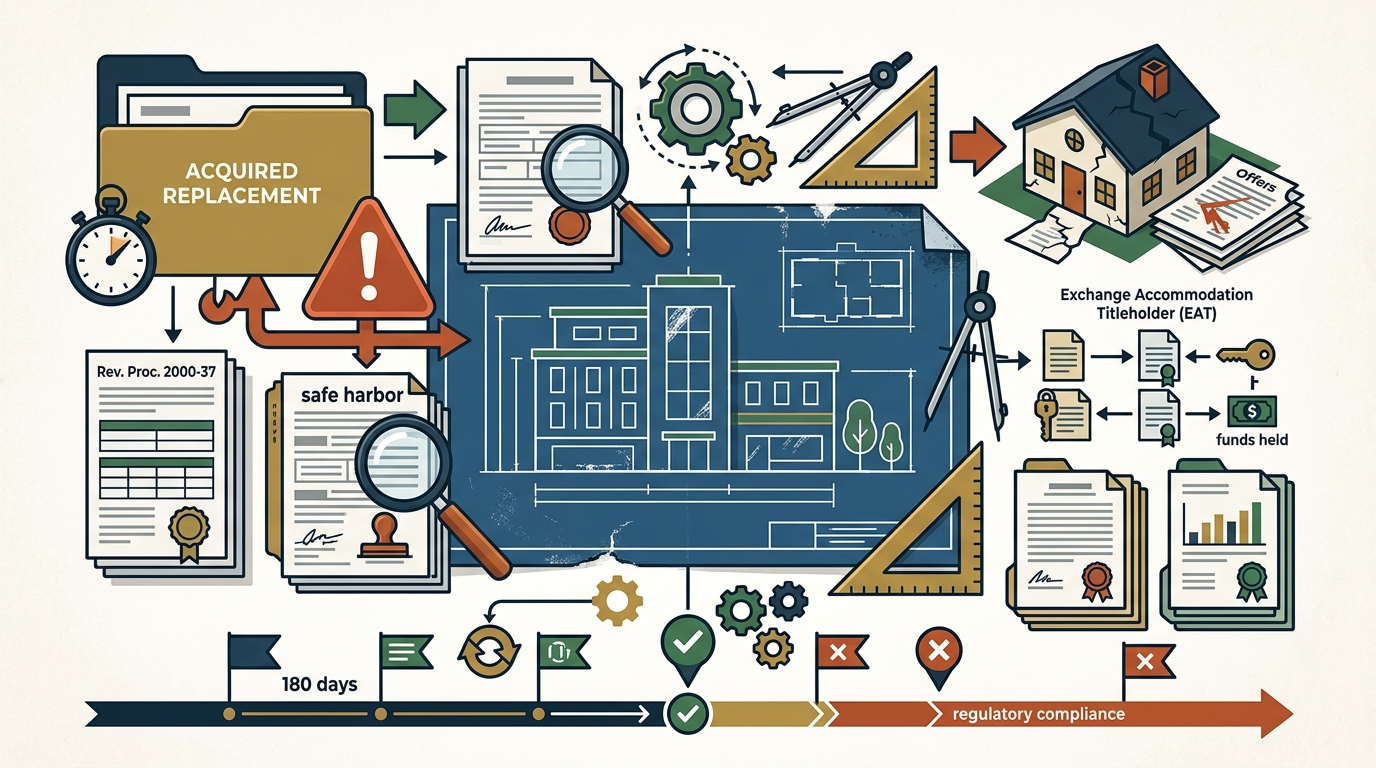
Mistake: Failing to adhere to the safe harbor requirements, particularly regarding the holding period and the number of properties that can be treated as the replacement property. The safe harbor requires that the replacement property be held for at least 180 days and that no more than three properties be identified.
Solution: Strictly follow the safe harbor guidelines. Ensure that the EAT holds the replacement property for the required duration and that the financing arrangements do not create a debt that is effectively secured by the relinquished property. Our specialists at Granite Exchange Services monitor these deadlines and compliance metrics daily to prevent any structural failures.
Like-Kind Property Requirements and Misclassification
The concept of like-kind property is often misunderstood. In real estate, like-kind refers to the nature or character of the property, not its grade or quality. However, there are strict boundaries regarding what qualifies.
Mistake: Attempting to exchange investment real estate for personal use property, such as a vacation home that is not rented out. Under current tax laws, personal residences do not qualify for 1031 exchange treatment unless they have been used for business or investment purposes for a significant period.
Solution: Verify that both the relinquished and replacement properties are held for productive use in a trade or business or for investment. Granite Exchange Services provides detailed guides on state-specific regulations and property types to help investors make informed decisions. For example, our California 1031 Exchange Guide outlines specific nuances for high-value markets.
Financing and Leverage Mistakes
Financing a reverse exchange is more complex than a standard exchange because the EAT must secure the purchase of the replacement property. Investors often underestimate the cost and complexity of this financing.
Mistake: Using personal funds to pay for the replacement property and expecting reimbursement later. This can break the chain of title and disqualify the exchange. Additionally, taking on excessive debt in the replacement property can result in "boot," which is taxable cash or property received in the exchange.
Solution: Work with your QI to structure the financing properly. The EAT should use exchange funds or third-party financing to acquire the replacement property. Ensure that the debt on the replacement property is equal to or greater than the debt on the relinquished property to avoid boot. Our Delayed Exchange and Reverse Exchange services include comprehensive financial structuring support.
Key Takeaways
- Strict Deadlines: The 45-day identification and 180-day completion deadlines are absolute. No extensions are granted by the IRS.
- EAT Independence: The Exchange Accommodation Titleholder must be an independent entity to avoid disqualified person rules.
- Safe Harbor: Adhering to Rev. Proc. 2000-37 safe harbor rules simplifies compliance and reduces audit risk.
- Like-Kind Definition: Both properties must be held for investment or business use. Personal residences generally do not qualify.
- Financing Structure: Proper financing of the replacement property by the EAT is critical to maintaining the exchange chain.
- Professional Guidance: Granite Exchange Services has completed over 20,000 exchanges, providing a track record of expertise in complex transactions.
- Fund Security: Funds are held in segregated, FDIC-insured accounts, ensuring that your capital is protected throughout the process.
Frequently Asked Questions
What is a reverse 1031 exchange?
A reverse 1031 exchange is a transaction where an investor acquires a replacement property before selling their relinquished property. The title of the replacement property is held by an Exchange Accommodation Titleholder (EAT) until the sale is complete.
Can I use a family member as the EAT?
No. The IRS prohibits using a "disqualified person" as the EAT. This includes family members, employees, and business associates. Using a related party can disqualify the entire exchange.
What happens if I miss the 45-day identification deadline?
If you miss the 45-day deadline, the exchange is disqualified. You will be liable for all capital gains taxes, depreciation recapture, and any applicable state taxes on the sale of the relinquished property.
How does Rev. Proc. 2000-37 help?
Rev. Proc. 2000-37 provides a safe harbor for reverse exchanges. If you follow its rules, the IRS will automatically treat the transaction as a valid exchange, reducing the risk of audit and disqualification.
Do I need to pay taxes on the gain if I do a reverse exchange?
No. If structured correctly, a reverse 1031 exchange allows you to defer all capital gains taxes, depreciation recapture, and net investment income tax until you eventually sell the replacement property.
Can I exchange property in one state for property in another?
Yes. IRC Section 1031 permits the exchange of real property located in any U.S. state for real property in another U.S. state. However, state-specific tax laws may apply. For example, our Alabama 1031 Exchange guide details local requirements.
What is the role of the Qualified Intermediary?
The QI facilitates the exchange by holding the funds, preparing the necessary documentation, and ensuring compliance with IRS rules. They also coordinate with the EAT to manage the title of the replacement property.
Are there any state-specific rules for reverse exchanges?
While the federal rules are uniform, some states have specific reporting requirements or tax implications. Granite Exchange Services provides state-specific guides, including our Texas Guide and Florida Guide, to help investors navigate these nuances.
Start Your Exchange
Reverse 1031 exchanges offer a powerful tool for real estate investors to defer taxes and grow their portfolios. However, the complexity of the process requires expert guidance. Granite Exchange Services has been a trusted Qualified Intermediary for over 25 years, serving investors across all 50 states. Our CES®-certified specialists are ready to help you navigate the intricacies of a reverse exchange.
Do not risk your tax deferral on a do-it-yourself approach. Contact us today to begin your exchange with confidence. Visit our Contact Us page to speak with a specialist or use our Exchange Savings Calculator to estimate your potential tax savings.